Industry Solutions
How to Increase Biofilter Capacity in an Existing RAS Without Expanding Tank Volume
When an existing RAS reaches its biological treatment limit, this article explains how biofilter capacity can be improved through media selection, oxygen transfer and solids control.
In many recirculating aquaculture systems, the first limitation does not appear in the fish tanks themselves. It appears in the biological treatment stage.
As production increases, feed loading rises and the biofilter must remove more ammonia within the same available footprint. At that point, operators often face a practical question: how can biological treatment capacity be increased without building a much larger biofilter tank?
The answer is rarely simply to add more media. Biofilter performance depends on available biofilm area, oxygen transfer, hydraulic conditions, solids control and the actual biological loading placed on the system. A successful retrofit therefore starts with understanding where the existing process is becoming limiting.
1. Start With the Real Biofilter Bottleneck
Before replacing media or increasing the filling ratio, the first step is to identify what is actually limiting nitrification.
A system may show rising ammonia because the available biofilm area is no longer sufficient for the current feed load. But similar symptoms can also appear when dissolved oxygen is low, suspended solids are coating the carrier surface, circulation is uneven, alkalinity is inadequate or water temperature has changed.
For this reason, a retrofit should normally begin with operating data rather than with a media volume calculation.
Important operating information includes system water volume, daily feed rate, ammonia and nitrite levels, water temperature, dissolved oxygen, pH, alkalinity, existing biofilter volume, media type and filling ratio.
These values help determine whether the main problem is insufficient biological surface area or whether another process condition is preventing the existing biofilter from performing properly.
2. Why Media Surface Area Matters in Space-Limited RAS
When additional tank volume is difficult or expensive to add, the amount of effective biofilm surface available inside the existing reactor becomes much more important.
Traditional moving-bed carriers are widely used in RAS because they are robust, relatively simple to operate and suitable for continuous biological treatment. However, different carrier structures provide very different amounts of protected and usable surface area per cubic meter of reactor volume.
For retrofit projects, higher-surface-area media can therefore be considered when the objective is to increase biological capacity within a limited footprint.
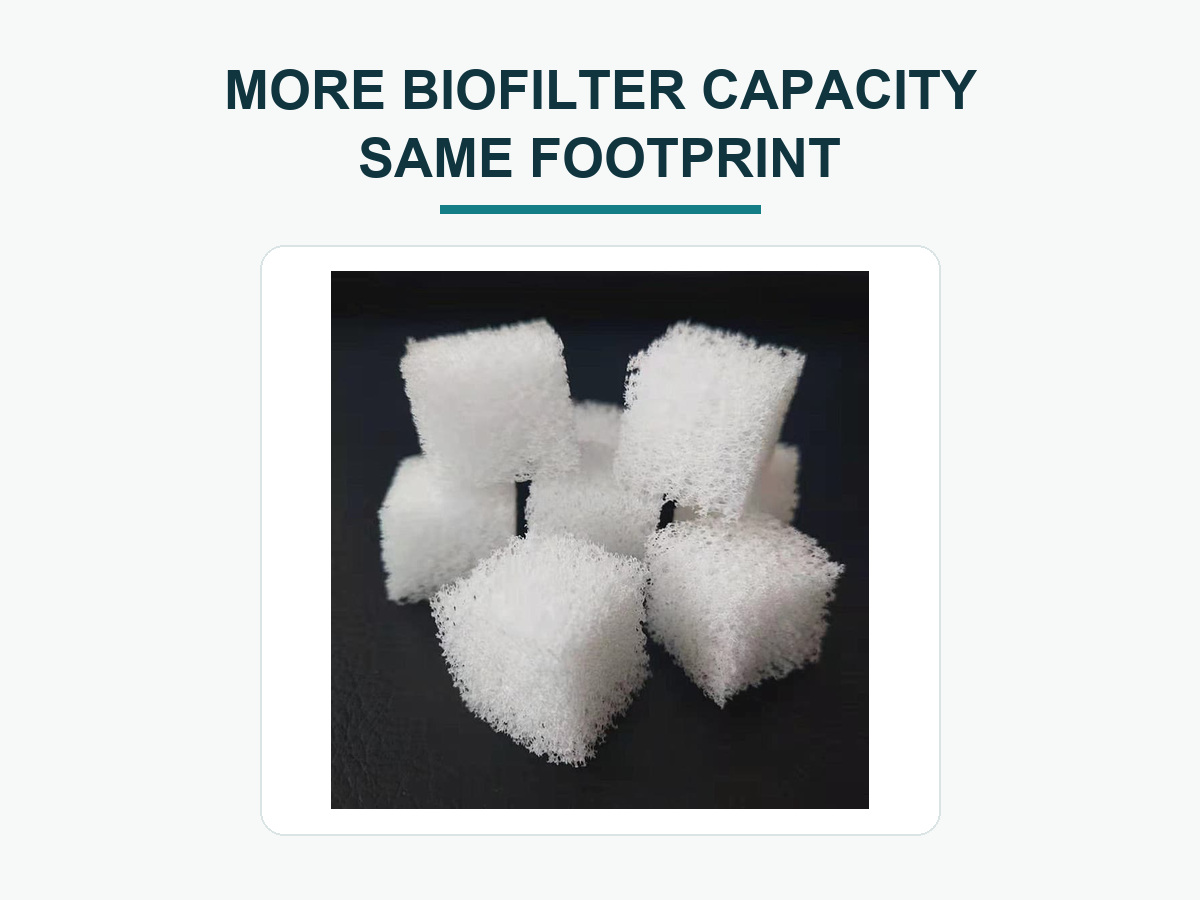
HydroNovus NovusPore™ HPU is a porous polyurethane biofilm carrier developed for high-density biological growth. Its open porous structure provides a large internal area for attached biomass while allowing water to move through the media.
This makes HPU particularly relevant when reactor space is limited and the project needs more biological surface area without simply increasing tank dimensions.
3. Higher Surface Area Alone Is Not Enough
A common mistake in biofilter upgrades is to focus only on the published surface-area number.
High surface area only becomes useful when the biofilm receives enough oxygen, substrate and water movement.
A carrier may provide a large theoretical surface area, but microorganisms still require sufficient oxygen transfer, substrate transport and hydraulic contact to use that area effectively.
In a high-load RAS, several factors therefore need to be considered together:
- media-water contact
- dissolved oxygen
- reactor circulation
- suspended solids loading
- hydraulic dead zones
- biofilm thickness and activity
This is why changing media without reviewing aeration, circulation and solids separation can produce disappointing results.
The better approach is to treat the biofilter as one part of the complete RAS treatment train rather than as an isolated tank.
4. HPU Media as a Retrofit Option
NovusPore™ HPU uses an open-cell polyurethane structure with high porosity and a large internal biofilm area.
Typical HydroNovus specifications include:
- Specific surface area: approximately 3,500–5,000 m²/m³
- Pore structure: approximately 20–25 PPI
- Porosity: above 95%
- Standard dimensions: approximately 30 × 30 × 30 mm
- Typical filling ratio for evaluation: around 25–30%
The porous structure provides protected internal space for microbial attachment while maintaining water contact through the carrier.
For an existing RAS, this gives system designers another option when the available biofilter tank is fixed but additional biological capacity is required.
The final media quantity should still be based on actual feed loading, ammonia production, water conditions and target treatment performance.
5. Do Not Ignore Solids and Oxygen
Biological filtration works best when upstream mechanical treatment is doing its job.
If excessive suspended solids enter the biofilter, they can occupy reactor volume, increase oxygen demand and interfere with biofilm activity. In aquaculture systems, rotary drum filtration or other fine-solids separation is therefore closely connected with biological treatment performance.
Oxygen is equally important.
As feed loading increases, both the fish and the biological treatment process require more oxygen. A retrofit that increases biological capacity may therefore also increase oxygen demand inside the biofilter.
For this reason, aeration, oxygen transfer and circulation should always be reviewed when biological capacity is upgraded.
In many retrofit projects, the best result comes from improving several parts of the system together:
- better solids removal
- higher effective biofilm area
- improved oxygen transfer
- better reactor circulation
6. What Data Should Be Checked Before a Retrofit?
Before recommending a specific media volume or reactor modification, enough operating information should be available to understand the current load.
Basic System Data
- Total system water volume
- Biofilter tank volume
- Existing media type and quantity
- Available space for modification
Biological Loading Data
- Daily feed rate
- Fish species
- Fish biomass
- Target production capacity
Water Quality Data
- Water temperature
- TAN or ammonia concentration
- Nitrite concentration
- Dissolved oxygen
- pH
- Alkalinity
With this information, it becomes much easier to determine whether the project needs more carrier surface, a different media configuration, additional oxygen transfer, improved solids management or a combination of these measures.
7. Retrofit the Process, Not Just the Media
For an existing RAS, the most useful question is not simply which biofilter media has the highest surface area.
The more important question is what is preventing the current system from supporting the required production load.
In some systems, increasing effective biofilm area may provide the additional capacity needed. In others, oxygen transfer, solids accumulation or hydraulic conditions may be the real constraint.
A practical retrofit therefore starts with process data, identifies the limiting stage and then selects the most suitable combination of biological media and supporting equipment.
If you are evaluating an RAS biofilter upgrade, HydroNovus can review the existing system conditions and discuss suitable options for biological filtration, solids removal, aeration and oxygen supply.