Jul 12, 2026Global Projects & Cases
The Evolution of Screw Press Dewatering: From Mechanical Equipment to Intelligent Sludge Management
Discover how screw press dewatering has evolved from mechanical equipment to intelligent sludge management, driven by automation, smart monitoring, and AI for modern wastewater treatment.
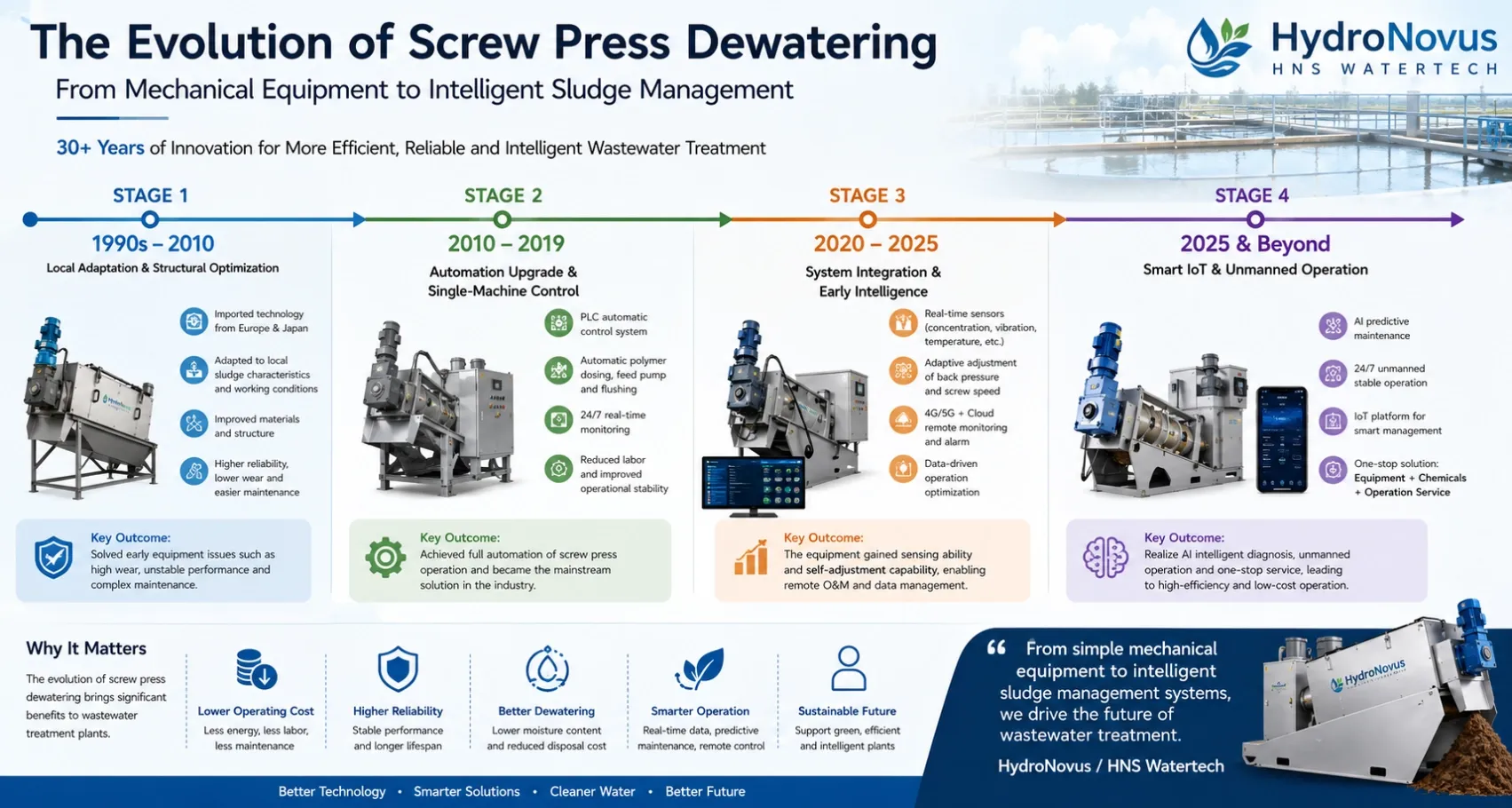
The Evolution of Screw Press Dewatering: From Mechanical Equipment to Intelligent Sludge Management
How automation, smart monitoring, and AI are reshaping sludge dewatering in modern wastewater treatment plants
Introduction
Sludge dewatering has never been the most glamorous part of wastewater treatment—but it is certainly one of the most important.
Whether you're operating a municipal wastewater plant, a food processing facility, a paper mill, or an industrial treatment system, the way sludge is handled has a direct impact on operating costs, transportation, energy consumption, and environmental compliance.
Among today's dewatering technologies, the screw press has earned a strong reputation for its compact design, low energy consumption, and continuous operation. Yet the machines we see today are very different from those first introduced decades ago.
Over the past thirty years, screw press technology has steadily evolved—from simple mechanical equipment into intelligent systems capable of automation, remote monitoring, and increasingly, data-driven operation.
Understanding this journey isn't just about looking back. It also offers valuable insight into where sludge management is heading and what buyers should expect from modern equipment.
Why Has Screw Press Technology Changed?
Wastewater treatment plants today are expected to do more with fewer resources.
Operators are under constant pressure to reduce operating costs, improve process stability, minimize labor requirements, and comply with increasingly stringent environmental regulations.
As these expectations continue to grow, equipment manufacturers have had to rethink how screw press systems are designed and operated.
Today's customers are no longer looking for a machine that simply removes water from sludge. They're looking for equipment that operates reliably, requires less maintenance, integrates with plant automation systems, and delivers long-term value throughout its service life.
Stage One (1990s–2010)
Building a More Reliable Machine
Early screw press technology was introduced from Europe and Japan. While the equipment performed well, many early systems were designed for operating conditions that differed from those found in other markets.
Manufacturers gradually improved the design by selecting more corrosion-resistant materials, strengthening key components, and simplifying routine maintenance.
Typical improvements included:
- Stainless steel construction for improved corrosion resistance
- More durable screw shafts and rings
- Better wear resistance
- Simplified maintenance procedures
- Lower operating costs over time
The focus during this period was straightforward: build equipment that operators could rely on every day.
Stage Two (2010–2019)
Automation Became the Standard
As wastewater treatment plants expanded and labor costs increased, automation quickly moved from being a premium feature to an industry expectation.
PLC-based control systems changed the way screw presses were operated.
Instead of relying on constant manual adjustment, equipment could automatically coordinate sludge feeding, polymer dosing, washing cycles, and safety protection.
For plant operators, this meant:
- More stable sludge cake quality
- Reduced manual intervention
- Improved process consistency
- Lower labor requirements
Automation didn't replace operators—it allowed them to spend less time adjusting equipment and more time optimizing the treatment process.
Stage Three (2020–2025)
Equipment Began to Monitor Itself
The next step wasn't simply more automation—it was greater awareness.
Modern screw press systems started incorporating sensors capable of continuously monitoring operating conditions.
Depending on the application, these systems may monitor:
- Sludge concentration
- Motor load
- Bearing temperature
- Vibration
- Torque
- Equipment status
Combined with cloud connectivity and remote diagnostics, operators gained far better visibility into machine performance.
Instead of discovering problems after a shutdown, many issues could now be identified much earlier, reducing unexpected downtime and improving maintenance planning.
Stage Four (2025 and Beyond)
Smarter Operation Through AI and IoT
The latest evolution is less about hardware and more about intelligence.
Artificial intelligence and Industrial IoT technologies are beginning to transform how screw press systems are managed.
Rather than simply following preset operating parameters, future systems are expected to analyze historical operating data and recommend adjustments automatically.
Potential developments include:
- Predictive maintenance based on equipment condition
- Automatic adjustment of operating parameters according to sludge characteristics
- Remote monitoring of multiple treatment plants from a single platform
- Lower lifecycle costs through smarter maintenance planning
While not every treatment plant requires these capabilities today, the overall direction of the industry is becoming increasingly clear.
What Should Buyers Look for Today?
When selecting a screw press, purchase price is only part of the equation.
Long-term operating performance often depends on factors such as:
- Material quality
- Corrosion resistance
- Ease of maintenance
- Automation level
- Remote monitoring capability
- Spare parts availability
- Technical support
- Total lifecycle cost
In many projects, the lowest purchase price does not translate into the lowest operating cost over the life of the equipment.
Our Perspective
One thing we've noticed over the past few years is that conversations with customers have changed.
Not long ago, most discussions focused on dewatering capacity and moisture content.
Today, engineers are asking different questions.
How easy is the equipment to maintain?
Can it be monitored remotely?
Will it integrate with our existing control system?
How much downtime can it help us avoid?
These questions reflect a broader shift across the wastewater industry—from purchasing equipment to improving long-term operational efficiency.
Looking Ahead
The evolution of screw press dewatering is about far more than mechanical improvements.
It reflects the wider transformation of wastewater treatment—from labor-intensive operation to intelligent process management.
As digital technologies continue to mature, future screw press systems will become even more connected, more efficient, and easier to operate.
For plant owners, EPC contractors, and engineers, investing in equipment that supports long-term operational intelligence may prove far more valuable than simply choosing the lowest initial purchase price.
Final Thoughts
Technology will continue to evolve, but the goal remains the same: helping wastewater treatment plants operate more efficiently, more reliably, and more sustainably.
The screw press has already come a long way—from a simple mechanical device to a smart piece of treatment equipment. Its next chapter is likely to be defined not just by better engineering, but by better data, better connectivity, and better decision-making.
Ready to Plan Your Sludge Dewatering Project?
Every wastewater treatment project is different. Choosing the right dewatering solution depends on sludge characteristics, treatment capacity, operational goals, and long-term maintenance requirements.
If you're evaluating a new project or planning to upgrade an existing system, our engineering team would be happy to discuss your application and help you identify the most suitable solution.
Contact HydroNovus to start the conversation.