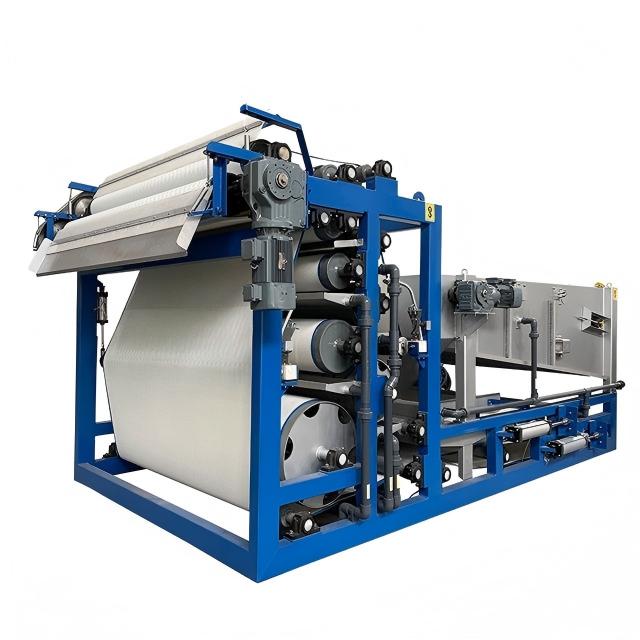
Belt Filter Press for Continuous Sludge Dewatering
Continuous sludge dewatering equipment combining gravity drainage, wedge-zone thickening, and pressure dewatering. Suitable for municipal and industrial sludge where stable throughput and continuous operation are required.
BELT FILTER PRESS FOR SLUDGE DEWATERING
PRODUCT OVERVIEW
HydroNovus belt filter presses provide continuous sludge thickening and dewatering through gravity drainage, wedge compression, and progressively increasing pressure between filter belts. The equipment is suited to projects requiring continuous throughput and visible adjustment of sludge conditioning and belt operation.
CORE FEATURES
• Continuous gravity, wedge, and pressure dewatering stages.
• Adjustable belt speed and tension for changing sludge conditions.
• Integrated belt washing and tracking arrangements.
• Flocculation system and polymer preparation can be included.
• Stainless-steel wetted components and project-specific construction options.
• Open equipment layout supports inspection and routine maintenance.
TECHNICAL PARAMETERS
Sludge throughput: model and sludge dependent
Dry-solids loading: required for model selection
Belt width: selected according to capacity
Feed concentration: confirm from operating or laboratory data
Belt speed and tension: adjustable within the selected model range
Wash-water requirement: calculated from belt width and operating schedule
Polymer conditioning: normally required and verified by testing
Cake solids and solids capture: dependent on sludge and operating conditions
APPLICATION SCENARIOS
• Municipal wastewater sludge
• Food and beverage processing sludge
• Pulp and paper wastewater
• Textile and dyeing wastewater sludge
• Mining and industrial mineral sludge after suitability review
• Plants requiring continuous dewatering operation
SELECTION INFORMATION
Please provide wet-sludge flow, feed solids, dry-solids load, sludge source, operating hours, target cake condition, wash-water availability, polymer information, site voltage, and installation space. Pilot testing or bench-scale conditioning tests are recommended for unfamiliar sludge.
FREQUENTLY ASKED QUESTIONS
Q: Why should capacity be stated as dry solids?
A: Wet-sludge flow alone can be misleading because concentration varies. Dry-solids load gives a more reliable basis for comparing belt widths and operating capacity.
Q: Is a belt press suitable for oily or sticky sludge?
A: It may be, but belt selection, polymer conditioning, wash-water pressure, and cleaning frequency must be evaluated through testing.
Q: What utilities are required?
A: The system normally requires electrical power, polymer solution, wash water, sludge feed, filtrate drainage, and space for cake discharge.
Q: Can auxiliary equipment be supplied?
A: Yes. The scope can include the feed pump, polymer system, mixer, compressor, wash-water pump, conveyor, platform, and control panel.
REQUEST ENGINEERING SUPPORT
Send your sludge analysis, flow and solids concentration, operating schedule, target cake condition, and site layout. HydroNovus will prepare a preliminary belt-press selection and equipment scope.