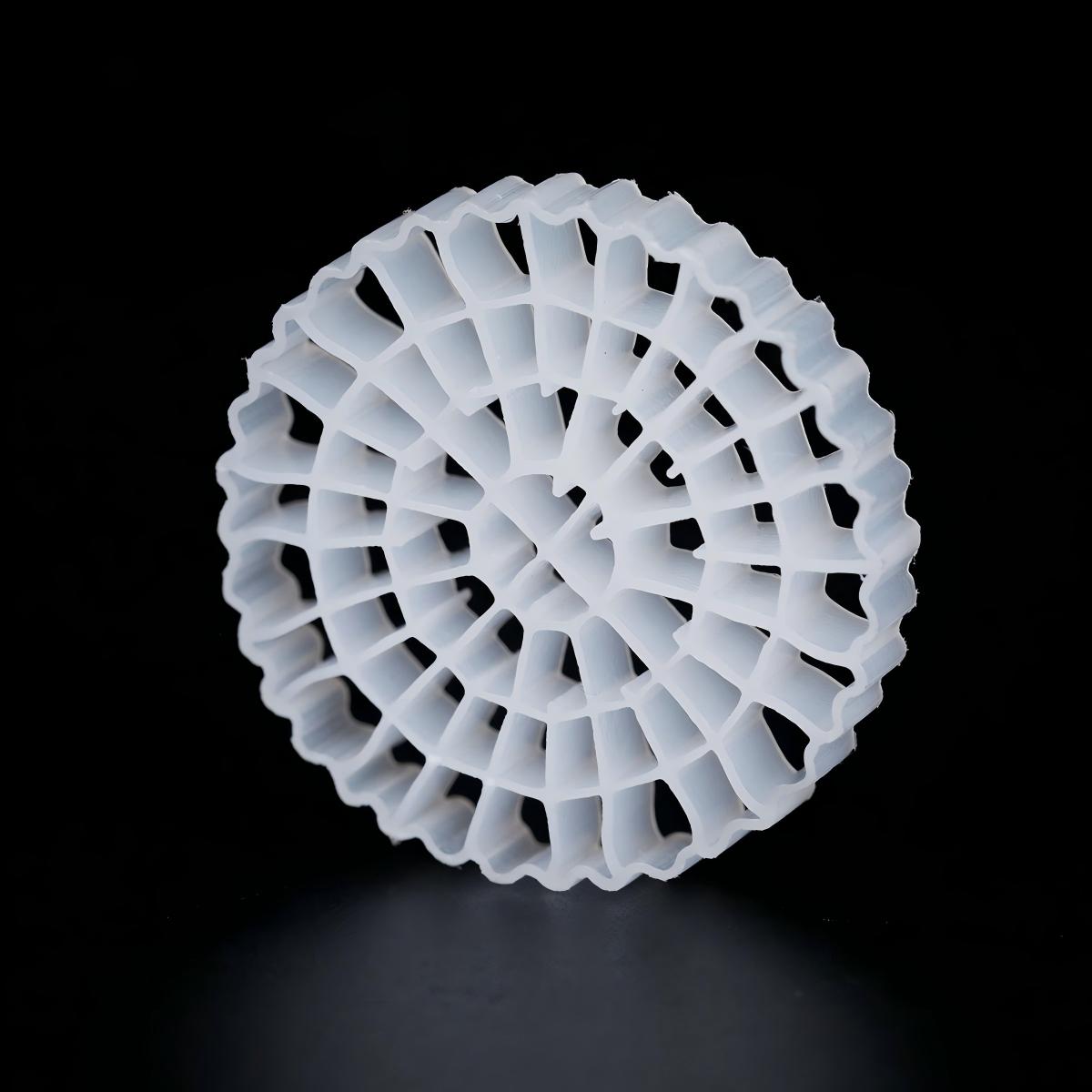
HDPE MBBR Media
HDPE MBBR Biofilter Media for Wastewater & RAS
Virgin HDPE biofilm carriers in multiple geometries for municipal wastewater, industrial effluent, packaged treatment plants, and recirculating aquaculture systems. Model selection is based on organic load, ammonia removal target, tank volume, and media fill ratio.
Specifications
- Material
- Virgin HDPE
- Typical Density
- 0.95–0.98 g/cm³
- Operating Method
- Freely moving carrier retained by outlet screens
- Available Models
- Multiple geometries and protected surface-area options
- Typical Fill Ratio
- Calculated from treatment load and reactor volume
- Applications
- Municipal, industrial, packaged WWTP, MBBR/IFAS and RAS
- Customization
- Model, color and packaging subject to project confirmation
HDPE MBBR BIOFILTER MEDIA
PRODUCT OVERVIEW
HydroNovus HDPE MBBR media provides protected surface area for attached-growth microorganisms in moving bed biofilm reactor systems. The carriers remain in continuous motion under aeration or mechanical mixing, helping biological treatment operate within a compact reactor volume. Multiple carrier geometries are available for municipal wastewater, industrial effluent, packaged plants, and recirculating aquaculture systems.
CORE FEATURES
• Virgin HDPE construction for stable density, impact resistance, and long-term operation.
• Protected internal channels support biofilm attachment while limiting excessive shear.
• Multiple sizes and geometries allow selection for carbon removal, nitrification, or combined treatment.
• Suitable for new MBBR systems and upgrades of existing activated-sludge tanks.
• Easy bulk handling; no fixed media frame is required inside the biological reactor.
TECHNICAL PARAMETERS
Material: Virgin HDPE
Typical density: approximately 0.95–0.98 g/cm³
Available size range: model dependent
Protected surface area: model dependent; confirm using the selected carrier datasheet
Typical media fill ratio: determined by treatment load, reactor volume, and mixing conditions
Operating method: freely moving carrier retained by outlet screens
Color and packaging: standard or project-specific options available
APPLICATION SCENARIOS
• Municipal sewage treatment and capacity upgrades
• Food and beverage wastewater
• Pulp and paper, textile, and other industrial effluent
• Recirculating aquaculture systems and biofilters
• Containerized and decentralized wastewater treatment plants
• IFAS and hybrid biological treatment processes
SELECTION INFORMATION
For model selection, please provide daily flow, influent and target COD/BOD, ammonia and total nitrogen, wastewater temperature, existing tank dimensions, available aeration capacity, and the planned process. HydroNovus can then recommend the carrier model, filling volume, retention screen, and preliminary aeration demand. Final biological design should be confirmed by the project engineer.
FREQUENTLY ASKED QUESTIONS
Q: Which MBBR model should I use?
A: The correct model depends on the treatment objective, organic and ammonia loading, reactor volume, wastewater temperature, and required biofilm protection. Surface area alone should not be used as the only selection criterion.
Q: Can MBBR media be added to an existing aeration tank?
A: Often yes. A retrofit normally requires hydraulic and biological checks, media-retention screens, sufficient mixing, and adequate oxygen transfer.
Q: How long does biofilm formation take?
A: Start-up time varies with temperature, wastewater characteristics, seeding, dissolved oxygen, and operating conditions. Performance should be evaluated through water-quality trends rather than a fixed number of days.
Q: Can you provide samples and model data?
A: Yes. Samples, model dimensions, packing density, and technical datasheets can be supplied for project evaluation.
REQUEST ENGINEERING SUPPORT
Send us your flow rate, influent data, discharge target, tank dimensions, and application. The HydroNovus team will help prepare a preliminary MBBR media selection and quotation.