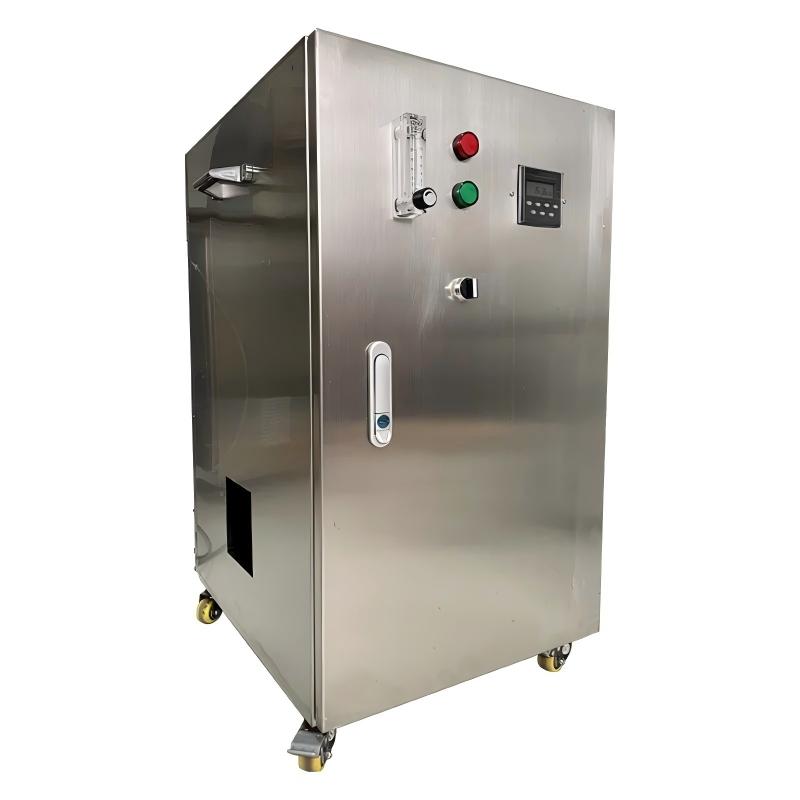
Ultra-Fine Nano Bubble Generators
Nano Bubble Generator for Water Treatment & RAS
Nano bubble generator for gas-liquid transfer and dissolved oxygen support in RAS and biological wastewater treatment. Models from 1 to 12 m³/h.
Nano Bubble Generator for Gas-Liquid Transfer
HydroNovus Nano Bubble Generators are compact gas-liquid transfer units designed for applications where dissolved oxygen support or fine-bubble gas dispersion is required.
Typical applications include recirculating aquaculture systems (RAS), biological wastewater treatment and selected high-oxygen-demand water treatment processes.
The equipment should not be selected from flow rate alone. Actual oxygen transfer depends on the gas source, inlet dissolved oxygen, water temperature, water chemistry, circulation flow, contact conditions and the oxygen demand of the process.
For biological systems, the first question is therefore not simply “How many cubic meters per hour can the generator handle?” It is “What oxygen duty does the process actually require?”
Where a Nano Bubble Generator Fits in the Treatment Process
A nano or micro/nano bubble generator is primarily a gas-liquid transfer device.
It does not replace upstream solids removal, biological process design or downstream polishing.
In a typical RAS system, the process may include:
Mechanical Solids Removal → Biological Filtration → Oxygenation / Gas Transfer → Recirculation
Where biological filtration is based on moving-bed technology, the oxygenation system should be evaluated together with the biological loading and MBBR biofilter media.
For industrial wastewater, the unit may be considered as part of an aerobic treatment or side-stream oxygen-transfer arrangement:
Pretreatment → Biological Treatment → Gas-Liquid Transfer / Oxygen Support → Final Separation
Whether the generator should operate continuously or only under peak oxygen demand depends on the process.
RAS and Aquaculture Applications
In recirculating aquaculture systems, dissolved oxygen demand changes with fish biomass, feed rate, temperature, stocking density and biological activity.
A nano bubble generator may be considered where the project requires additional gas-liquid contact within a recirculation loop or where the existing oxygenation arrangement needs to be evaluated for higher load conditions.
Typical project situations include:
- RAS expansion
- higher fish biomass or feed load
- hatchery and nursery systems
- oxygen support for biological filtration
- recirculation loops with limited available footprint
- retrofit of an existing oxygenation system
The generator should not be sized solely from total system volume.
For RAS selection, HydroNovus normally reviews recirculation flow, biomass, daily feed rate, water temperature, existing DO level, target DO and the existing aeration or oxygen supply system.
Biological Wastewater Treatment Applications
Aerobic biological treatment requires oxygen for microbial metabolism.
When oxygen transfer becomes a process limitation, the solution may involve conventional aeration, improved diffuser layout, additional gas-liquid transfer equipment, or a combination of these approaches.
Micro- and nanobubble technologies are being studied and applied for their ability to increase gas-liquid interfacial area and support oxygen transfer, but real performance depends strongly on operating conditions and system design.
Suitable applications may include:
- aerobic industrial wastewater treatment
- high-load biological treatment
- biological treatment upgrades
- side-stream oxygenation
- selected MBBR and biofilm treatment systems
- process tanks where additional gas-liquid transfer is required
For a biological wastewater project, COD or BOD load, ammonia load, temperature, reactor volume, operating DO and oxygen demand should be reviewed before equipment selection.
Nano Bubble Generator vs. Fine Bubble Diffusers
A nano bubble generator and a conventional diffuser system solve related—but not identical—engineering problems.
A conventional aeration system normally uses blowers and submerged fine bubble disc diffusers or fine bubble tube diffusers to introduce air directly into a treatment tank.
A nano bubble generator typically works through a recirculating gas-liquid contact process.
The better choice depends on:
- required oxygen transfer
- tank geometry and water depth
- existing blower system
- available recirculation flow
- gas source
- installation footprint
- energy requirement
- maintenance strategy
- new-build or retrofit conditions
For some projects, the two technologies may complement each other rather than compete directly.
HydroNovus therefore does not recommend replacing an existing diffuser system simply because a nano bubble unit is available. The process oxygen balance should be reviewed first.
Technical Specifications
(Our compact units are designed for seamless integration into your existing piping.)
Specification | H-001 | H-002 | H-003 | H-004 |
Flow rate (m³/h) | 1 | 2 | 4 | 12 |
Power (kw) | 0.37 | 0.75 | 1.5 | 3.0 |
Working Temp (°C) | 0 - 60 | 0 - 60 | 0 - 60 | 0 - 60 |
Concentration (mg/L) | >30 | >30 | >30 | >30 |
Bubble Size (μm) | 50nm - 20μm | 50nm - 20μm | 50nm - 20μm | 50nm - 20μm |
Gas-liquid mixing ratio | 1:0.1~0.2 | 1:0.1~0.2 | 1:0.1~0.2 | 1:0.1~0.2 |
Gas Dissolving Rate | >85% | >85% | >85% | >85% |
(Data source: Standard operational testing) | | | | |
What Determines Oxygen Transfer Performance?
Dissolved oxygen performance cannot be determined from generator model alone.
Important project conditions include:
Gas Source
Air and oxygen-enriched gas do not provide the same oxygen-transfer duty.
The available gas supply, pressure and purity should be confirmed before final selection.
Initial and Target Dissolved Oxygen
Raising water from a low initial DO level is different from maintaining DO close to saturation under continuous biological demand.
The target should therefore be expressed as an operating requirement rather than simply a maximum DO number.
Water Temperature
Oxygen solubility changes with temperature.
RAS systems and industrial wastewater plants operating at different temperatures may therefore require different gas-transfer strategies even when their water flow is similar.
Salinity and Water Chemistry
Freshwater, seawater and industrial wastewater do not behave identically.
Salinity, suspended solids, surfactants and other dissolved constituents may affect gas-liquid transfer and bubble behavior.
Process Oxygen Demand
In biological wastewater treatment, the equipment must ultimately respond to oxygen demand from organic degradation and, where applicable, nitrification.
In RAS, biomass, feed and biological filtration load are important inputs.
Why We Do Not Quote a Fixed “3-Minute Oxygenation Time”
The time required to raise dissolved oxygen depends on:
- water volume
- initial DO
- target DO
- temperature
- salinity
- gas source
- gas flow
- circulation rate
- biological oxygen consumption
For this reason, HydroNovus does not use a universal claim such as “complete oxygen saturation in three minutes.”
A meaningful comparison should be made under defined operating conditions.
This is considerably more useful to an EPC or system integrator than a catalogue oxygenation time that may not match the real project.
Is a Nano Bubble Generator a Disinfection System?
Not by itself.
Research has explored reactive oxygen species and other mechanisms associated with micro- and nanobubbles, and some applications investigate their role in oxidation and microbial control. However, results depend on generation method, gas type, water chemistry and treatment conditions.
HydroNovus therefore does not position this standard Nano Bubble Generator as a guaranteed sterilization or pathogen-removal system.
Where disinfection is required, the project should define:
- target organism
- required log reduction
- water quality
- contact time
- permitted disinfectant
- applicable regulatory standard
Dedicated UV, ozone, chlorine or another validated treatment process may still be required.
Information Required for Model Selection
For RAS / Aquaculture
Please provide:
- system volume
- recirculation flow
- fish species
- current or target biomass
- daily feed rate
- water temperature
- freshwater or seawater
- current DO
- target operating DO
- existing oxygen or aeration system
- available gas source
For Wastewater Treatment
Please provide:
- average and peak flow
- wastewater source
- COD / BOD
- ammonia where relevant
- temperature
- current biological process
- tank volume
- existing DO
- target DO
- existing aeration equipment
- available gas source
- purpose of the proposed upgrade
With this information, the generator can be evaluated as part of the complete biological and aeration system rather than selected as an isolated piece of equipment.
Typical Project Integration
RAS
Rotary Drum Filtration → Biological Filtration → Oxygenation / Gas Transfer → Recirculation
Where the main problem is biological capacity rather than oxygen transfer, the first step may be to evaluate the biofilter rather than simply adding more oxygen equipment.
Industrial Wastewater
Pretreatment → Biological Treatment → Oxygen Transfer → Secondary Separation
For higher-load wastewater, oxygen transfer should be reviewed together with organic loading, ammonia loading and reactor configuration.
This prevents the common mistake of treating a low-DO symptom without identifying the real process limitation.
FAQ
What is a nano bubble generator used for?
It is used to improve gas-liquid contact in water treatment systems. Typical HydroNovus applications include dissolved oxygen support in RAS, aquaculture and aerobic biological wastewater treatment.
Are nano bubbles better than fine bubble diffusers?
Not in every application.
The two systems use different gas-transfer arrangements. Tank depth, oxygen demand, available piping, blower system, recirculation flow and retrofit conditions determine which approach is more appropriate.
Can a Nano Bubble Generator replace my existing aeration system?
Possibly in some configurations, but this should not be assumed.
The existing oxygen demand, aeration capacity and operating conditions should be reviewed before removing or replacing equipment.
How quickly will the generator increase dissolved oxygen?
There is no single valid time for every project.
The rate depends on initial DO, target DO, water volume, temperature, gas source, circulation flow and ongoing oxygen consumption.
Can the unit be used with pure oxygen?
Gas compatibility and the proposed gas supply should be confirmed for the specific equipment configuration before selection.
Do not assume that operating conditions for air and pure oxygen are identical.
Does the generator sterilize water?
HydroNovus does not position the standard unit as a stand-alone sterilization system.
Where pathogen control or disinfection is required, a validated treatment process should be selected according to the required treatment target.
Need Help with Oxygenation System Selection?
Selecting the correct equipment starts with the oxygen requirement—not with the equipment model.
Send us your water flow, system volume, current and target DO, water temperature, biological load and existing aeration or oxygen system.
HydroNovus can evaluate whether the project is better suited to a Nano Bubble Generator, conventional fine-bubble aeration, or a combined approach.