Why Does MBBR Nitrification Consume So Much Alkalinity — and How Much Do I Need to Add?
Nitrification consumes about 7.14 mg alkalinity as CaCO3 per mg of ammonia oxidised. Work out your MBBR demand, spot the warning signs, and dose correctly.
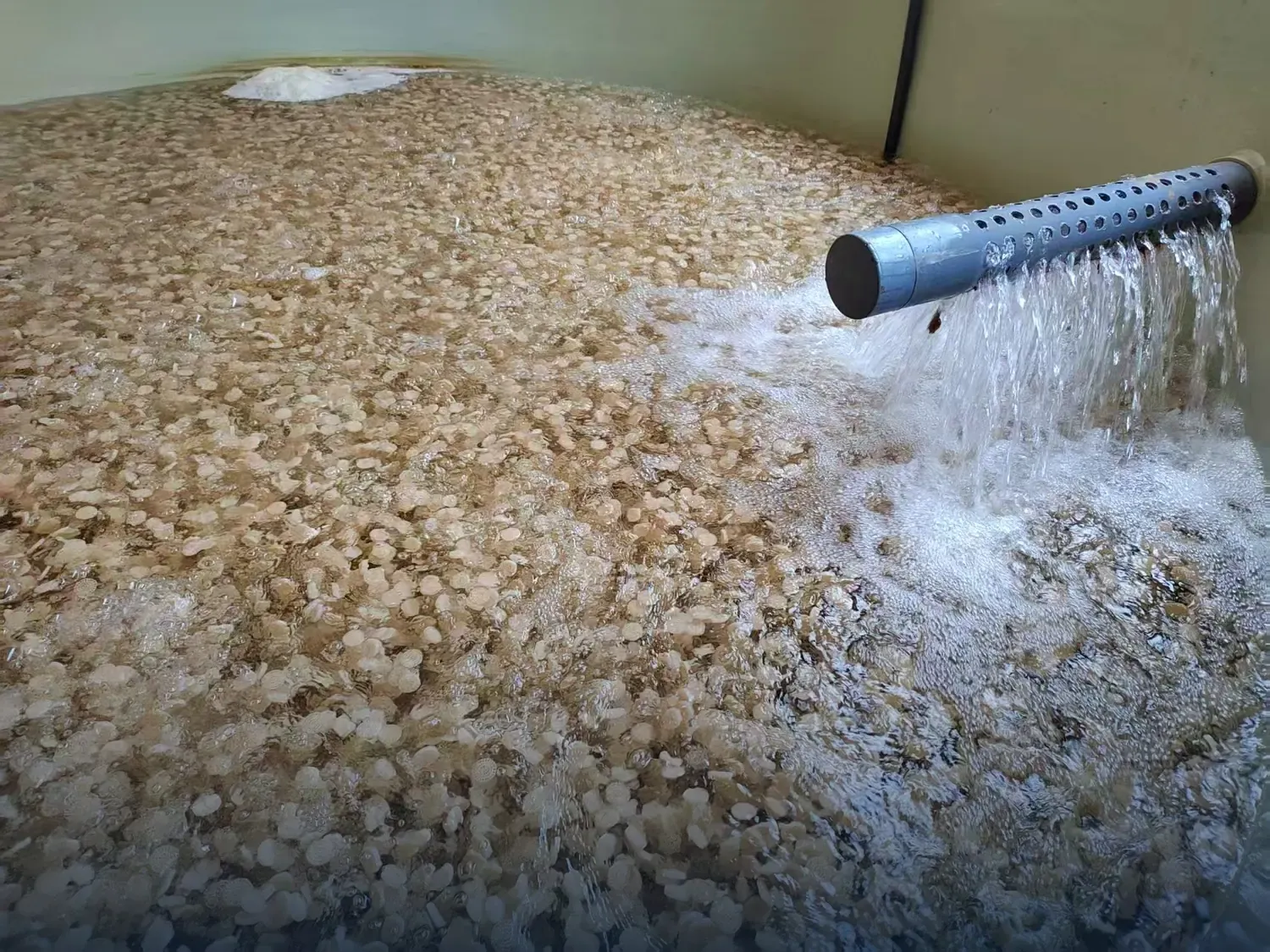
If your MBBR is nitrifying well and your alkalinity keeps falling, nothing is broken — that is what nitrification does. Every milligram of ammonia nitrogen your biofilm oxidises consumes about 7.14 mg of alkalinity, measured as CaCO3. If the incoming water does not carry enough alkalinity, pH drifts down, nitrification slows, and ammonia breaks through. The fix is arithmetic first, chemicals second: work out the demand from your ammonia load, compare it with the alkalinity you have, and only then decide how much to add.
Why nitrification consumes alkalinity
Nitrification is an acid-producing process: as ammonia-oxidising bacteria convert ammonium (NH4+) to nitrite and then nitrate, they release hydrogen ions, and alkalinity — mainly bicarbonate in most wastewaters — neutralises them. That is why alkalinity and pH move together in a nitrifying reactor.
The stoichiometry is fixed by the chemistry, not by the type of reactor:
- About 7.14 mg of alkalinity as CaCO3 is consumed for every 1 mg of ammonia nitrogen (NH4-N) fully oxidised to nitrate.
- About 4.57 mg of oxygen is consumed per mg of NH4-N oxidised, which is why a nitrifying MBBR also needs generous aeration — see our guide to MBBR aeration sizing.
This consumption rate applies whether the biomass sits on suspended flocs or on MBBR carriers. What makes it feel worse in an MBBR is that a well-loaded biofilm reactor can nitrify a large ammonia load in a small volume, so the alkalinity demand per cubic metre of tank can be high even when the chemistry is exactly the same as in any other nitrifying system. And remember: alkalinity consumption happens even when the process is working perfectly. A falling reading is not, by itself, a sign of failure — it becomes a problem only when alkalinity runs low enough for pH to fall.
How much alkalinity does your MBBR actually need?
Use this formula to estimate the daily demand — a planning calculation to confirm against your own laboratory data and process design.
Alkalinity demand (kg/day as CaCO3) = ammonia oxidised (kg N/day) × 7.14
Ammonia oxidised means the ammonia actually removed by nitrification, not the influent figure. Most designers start conservatively with the full influent load, then refine it with operating data.
Worked example (illustrative — substitute your own figures)
A plant treats 500 m³/day of wastewater with 60 mg/L of ammonia nitrogen, and the MBBR oxidises essentially all of it:
- Ammonia load = 500 m³/day × 60 g/m³ = 30 kg N/day
- Alkalinity demand = 30 × 7.14 = 214 kg/day as CaCO3
- If the incoming wastewater carries 250 mg/L of alkalinity, the supply is 500 × 250 g/m³ = 125 kg/day
- Shortfall = 214 − 125 = about 89 kg/day as CaCO3 that must be added or recovered
The table below shows the same calculation for a range of ammonia loads, so you can see how quickly the demand grows.
| Ammonia oxidised (kg N/day) | Alkalinity consumed (kg/day as CaCO3) | Equivalent as soda ash* (kg/day) |
|---|---|---|
| 10 | 71 | ~75 |
| 30 | 214 | ~227 |
| 50 | 357 | ~378 |
| 100 | 714 | ~756 |
| 200 | 1,428 | ~1,512 |
*Soda ash supplies roughly 0.94 kg of alkalinity as CaCO3 per kg of product; confirm with your supplier's product data. Compare chemicals on cost per kg of alkalinity, not cost per kg of product.
The practical question is always the balance: alkalinity in, minus alkalinity consumed, minus the residual you want to keep. Most operators aim to keep a residual of roughly 50–100 mg/L as CaCO3 in the reactor effluent as a safety margin, so a short-term load spike does not push pH down before anyone notices. That residual is a rule of thumb to be confirmed by process design, not a specification.
What happens when alkalinity runs out
Nitrification is pH-sensitive: activity falls off noticeably below about pH 7.0. In an under-dosed MBBR the sequence is predictable:
- Alkalinity falls first. pH may look normal for a while because the remaining alkalinity still buffers the water.
- pH starts to drift down. Once residual alkalinity is nearly gone, small additional acid production causes large pH swings.
- Nitrification slows. Ammonia removal drops, and effluent ammonia climbs — often the first thing the operator notices.
- Nitrite can accumulate. Nitrite-oxidising bacteria are typically more pH-sensitive than ammonia oxidisers, so a partial stall often shows up as a nitrite spike first.
If effluent ammonia is rising after a capacity increase or load change, check alkalinity and pH before blaming the media or aeration — our MBBR ammonia troubleshooting guide puts alkalinity near the top of the diagnostic order.
Low pH can also look like a media problem when it is not. HNS MBBR media is 100% virgin HDPE, density 0.96–0.98, service life over 15 years, biofilm formation 3–15 days — the carriers are unaffected, and a biofilm that went quiet because pH fell will usually recover once alkalinity and pH are restored, without any media change.
Where alkalinity comes back: denitrification
Nitrification is not the only reaction that matters. Denitrification — converting nitrate back to nitrogen gas in an anoxic zone — returns about 3.57 mg of alkalinity as CaCO3 per mg of nitrate nitrogen reduced, roughly half of what nitrification consumed. A plant that nitrifies and denitrifies in sequence therefore needs only about half the net alkalinity of a nitrification-only plant, for the same ammonia load.
The catch: a standard single-stage aerated MBBR has little or no anoxic volume, so most of that recovery does not happen inside the MBBR itself. Count it only if your plant has a downstream anoxic tank or a pre-denitrification zone; otherwise dose for the full nitrification demand.
How to add alkalinity in practice
There is no single best chemical; the choice depends on price, handling, what else the water needs, and what your operators can dose reliably.
- Soda ash (sodium carbonate). The most common choice for MBBR plants. Easy to handle as a solution, adds alkalinity without adding much hardness, and raises pH gently.
- Sodium bicarbonate. Milder pH effect; useful where pH is already high. Usually more expensive per unit of alkalinity.
- Lime (calcium hydroxide). Cheap per unit of alkalinity, but adds hardness, can scale, and needs careful handling.
- Caustic soda (sodium hydroxide). Effective as a liquid, but raises pH sharply and is hazardous to handle; used where pH correction is also needed.
Dose upstream of the MBBR or into a well-mixed point, so the biofilm sees evenly distributed alkalinity — dosing at one spot inside the reactor can create local high-pH zones. Link the dosing pump to a pH or alkalinity reading so the dose tracks the load instead of running at a fixed rate while the influent changes.
What to measure before you dose
Do not dose on the basis of a single pH reading. Measure these four things, and record them together so the trend is visible:
- Influent and effluent alkalinity (mg/L as CaCO3) — the balance is the decision.
- pH in the reactor — the early warning; a slow downward drift matters more than one low reading.
- Influent and effluent ammonia, nitrite and nitrate — these set the alkalinity demand.
- Influent flow and ammonia load — demand follows the load, so a dosing rate that was right last month can be wrong after a production change.
If you are planning an MBBR retrofit or capacity increase, this calculation belongs in the project data pack — our MBBR retrofit data checklist lists the influent data a supplier needs before sizing, and alkalinity is on it because a retrofit that nitrifies more ammonia will consume more alkalinity.
Frequently asked questions
Why is my MBBR alkalinity very high — is that a problem?
High influent alkalinity is usually not a problem — it is a buffer that protects pH during nitrification. What operators usually mean is that it is falling fast, or that pH is behaving oddly. Check whether the residual is still above roughly 50 mg/L as CaCO3: if the residual is healthy and pH is stable, high influent alkalinity is an asset, not a fault.
How much alkalinity does an MBBR need per mg of ammonia?
About 7.14 mg of alkalinity as CaCO3 per mg of ammonia nitrogen oxidised to nitrate. Denitrification returns about 3.57 mg per mg of nitrate nitrogen reduced, so a plant that fully nitrifies and denitrifies needs roughly 3.57 mg net per mg of ammonia. Use your own ammonia load and measured alkalinity to work out the balance, and confirm the dosing rate with operating data.
Can low alkalinity stop MBBR nitrification?
Yes. When alkalinity is exhausted, pH falls and nitrifying bacteria slow down sharply below about pH 7.0; ammonia breakthrough and nitrite accumulation follow. Restoring alkalinity and pH normally restores nitrification without any media change.
Should I add alkalinity before or after the MBBR?
Add it upstream of the MBBR, or into a well-mixed point ahead of the reactor, so the biofilm sees stable, evenly distributed alkalinity. Dosing after the reactor protects nothing in the MBBR itself. If you also have a downstream denitrification step, remember it returns about half the alkalinity — factor that recovery into the dose rather than dosing for the full demand twice.
Need a quantity or sizing check?
Contact us for a free sizing, media quantity and sample check — send your flow, ammonia load and influent alkalinity, and we will work out the alkalinity balance and the MBBR media volume for your project.