Industry Solutions
MBBR Retrofit: What Data Engineers Need Before Increasing Treatment Capacity
Before increasing MBBR capacity, identify the actual bottleneck. Use this practical data checklist to review biological load, reactor volume, media, aeration, hydraulics and downstream constraints.
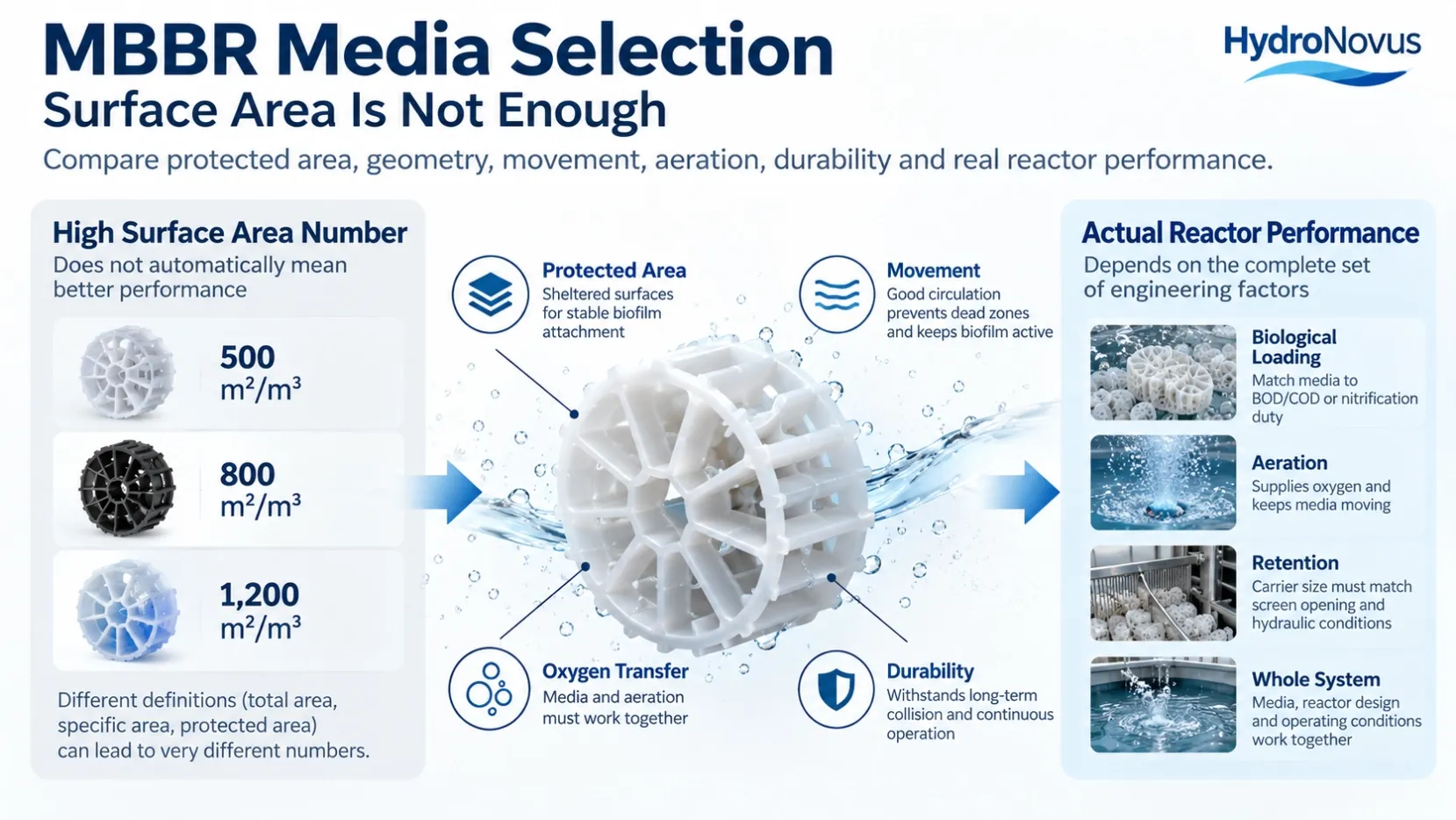
When an existing wastewater treatment plant needs more capacity, adding more MBBR media can look like the quickest solution.
Sometimes it is part of the right retrofit.
Sometimes it is not.
An overloaded biological stage may actually be limited by oxygen transfer, hydraulic conditions, solids carryover, media movement, downstream separation, or a change in wastewater characteristics. Increasing the carrier volume without identifying the limiting factor can add cost without solving the real problem.
A useful MBBR retrofit study therefore starts with a different question:
What is preventing the existing system from treating the new load reliably?
This article provides a practical data checklist for answering that question before media volume or retrofit equipment is selected.
Start With the Capacity Gap, Not the Media Fill Ratio
The first step is to define both the current operating condition and the required future duty.
“Capacity needs to increase by 30%” is not enough information on its own.
Engineers need to understand what that increase represents:
- higher average wastewater flow;
- higher peak flow;
- higher organic concentration;
- increased ammonia load;
- longer production hours;
- a new production line;
- tighter discharge limits;
- seasonal loading;
- or a combination of several changes.
Two plants can have the same daily flow increase but require very different retrofit strategies.
If flow rises while wastewater strength remains similar, hydraulic capacity may become important.
If flow stays almost unchanged but BOD, COD, or ammonia increases significantly, the main issue may be biological loading and oxygen demand.
The retrofit basis should therefore describe both hydraulic and pollutant loading changes.
1. Establish the Current and Future Flow
Collect more than one flow value.
Useful information includes:
- current average daily flow;
- current peak hourly or peak production flow;
- normal operating hours per day;
- weekly or seasonal variation;
- planned future average flow;
- expected future peak flow;
- known batch discharges or production peaks.
Average flow is useful for calculating daily load, but peak conditions can expose problems that average figures hide.
Short hydraulic peaks may affect carrier retention screens, tank mixing, downstream clarification, and equalization even when the daily average appears acceptable.
If the plant has an equalization tank, include its working volume and operating pattern in the review.
2. Quantify the Biological Load Entering the MBBR
Flow alone does not define MBBR duty.
For an existing plant, collect representative influent data for the biological stage, not only raw wastewater data if significant pretreatment occurs upstream.
Depending on the application, useful parameters may include:
- BOD;
- COD;
- soluble COD where available;
- ammonia or TAN;
- total nitrogen where relevant;
- TSS;
- pH;
- alkalinity for nitrification projects;
- wastewater temperature;
- oil, grease, salinity, or other project-specific characteristics.
The objective is to estimate the load reaching the biological reactor under normal and peak operating conditions.
Where wastewater quality varies significantly, a range is more useful than a single laboratory result.
For example:
COD = 350–520 mg/L
provides more engineering information than:
COD = 410 mg/L
if the process regularly experiences substantial variation.
3. Confirm the Treatment Target
Capacity cannot be evaluated without a defined outlet requirement.
Record:
- current effluent performance;
- required discharge or downstream target;
- BOD/COD target;
- ammonia target;
- total nitrogen target where applicable;
- any internal reuse requirement;
- any new permit or customer requirement driving the retrofit.
This distinction matters because increasing flow while maintaining the same carbon-removal target is different from increasing flow while also adding nitrification.
The biological duty may change much more than the hydraulic flow suggests.
4. Document the Existing Reactor
For each biological tank being considered for retrofit, collect:
- internal tank dimensions;
- normal operating water depth;
- effective liquid volume;
- number of biological stages;
- inlet and outlet arrangement;
- existing baffles;
- freeboard;
- access limitations;
- available space around the tank;
- photos and drawings where available.
Do not rely only on the original design volume.
Confirm the actual operating liquid volume.
Internal structures, operating level, unused sections, or later modifications may make the effective reactor volume different from the nominal civil volume.
5. Confirm What Media Is Already Installed
If the system already uses MBBR carriers, document:
- media type;
- carrier dimensions;
- media material;
- installed media volume;
- estimated current fill ratio;
- known protected surface-area data;
- media age;
- visible media condition;
- carrier movement;
- damaged or lost media;
- evidence of fouling, scaling, or abnormal biomass accumulation.
Do not assume that adding carrier is automatically possible just because there is physical space in the tank.
Higher media volume changes the amount of carrier that must be mixed and retained. It may also change the air required for movement and the hydraulic behavior around screens and outlet structures.
For detailed media-volume calculations, use the separate HydroNovus guide on calculating MBBR media from load, surface loading, media area, and reactor volume.
6. Review Aeration and Oxygen Capacity
Aeration is one of the most important retrofit checks.
In an aerobic MBBR, the aeration system has to support both biological oxygen demand and adequate carrier movement.
Collect:
- operating dissolved oxygen;
- DO variation during peak load;
- blower model and rated capacity;
- actual operating airflow where known;
- blower discharge pressure;
- available spare blower capacity;
- diffuser type;
- diffuser quantity;
- diffuser layout;
- operating water depth;
- air-pipe arrangement;
- diffuser condition and maintenance history;
- visual observation of media movement.
A reactor can have sufficient nominal media surface area and still be oxygen limited.
Similarly, a blower may appear large enough on paper while diffuser fouling, pressure losses, poor grid distribution, or deeper operating water reduce the useful air delivered to the reactor.
Before increasing media volume, ask:
Can the existing aeration system support the additional biological duty and maintain acceptable media movement?
7. Check Mixing and Carrier Movement
Poor media circulation can reduce the effective use of the reactor.
During a site inspection, look for:
- stagnant corners;
- media accumulating against screens;
- uneven carrier distribution;
- excessive surface accumulation;
- media remaining on the tank floor;
- strongly uneven aeration;
- areas with visibly different biofilm condition.
These observations help separate a media-quantity problem from a mixing-distribution problem.
If significant zones of the reactor are not effectively mixed, increasing the quantity of carrier may make circulation more difficult rather than improving performance.
8. Check the Media Retention System
Any MBBR retrofit that changes flow or carrier volume should include a retention-screen review.
Collect:
- screen type;
- screen opening;
- total open area;
- screen dimensions;
- carrier dimensions;
- normal water level difference across the screen;
- fouling history;
- cleaning method;
- observed media accumulation;
- current and future peak flow.
The outlet screen must retain the selected carrier without creating an unacceptable hydraulic restriction.
If future flow increases significantly, the existing screen may become a hydraulic bottleneck even when the biological tank itself has spare treatment potential.
9. Review Upstream Solids Control
The biological reactor should not be evaluated in isolation.
Higher solids carryover can change oxygen demand, biomass behavior, screen fouling, and downstream sludge production.
Check the condition and capacity of upstream processes such as:
- screening;
- primary settling;
- DAF;
- drum filtration;
- equalization;
- oil and grease removal;
- other pretreatment relevant to the wastewater.
For industrial wastewater in particular, a production change may increase not only biodegradable load but also TSS, grease, chemicals, or intermittent shock loads.
A retrofit assessment should confirm what is actually reaching the MBBR.
10. Check the Downstream Process Before Increasing Biological Capacity
A biological retrofit can move the bottleneck downstream.
Depending on the process arrangement, review:
- secondary clarification;
- flotation;
- filtration;
- sludge handling;
- return and wasting arrangements where applicable;
- downstream hydraulic capacity.
If the biological stage removes more load but produces more solids than the downstream system can handle, overall plant performance may still be limited.
Capacity should therefore be evaluated at the system level, not only at the MBBR tank.
11. Confirm Whether the Existing Process Is Really MBBR or IFAS
This distinction matters during retrofit evaluation.
In a conventional MBBR, attached biomass on the carriers performs the biological treatment while the carriers are retained inside the reactor.
In IFAS, attached-growth media and suspended activated sludge operate in the same biological system.
An IFAS retrofit therefore requires additional review of suspended-solids inventory, sludge age, return sludge, clarifier loading, and associated activated-sludge operating conditions.
Before calculating additional carrier volume, confirm the actual process configuration.
A Practical MBBR Retrofit Data Checklist
Data Group | Information to Collect | What It Helps Determine |
|---|---|---|
Flow | Average, peak, operating hours, future flow | Hydraulic duty |
Wastewater Load | BOD, COD, ammonia/TAN, TSS, temperature and relevant characteristics | Biological duty |
Treatment Target | Current effluent and future outlet requirement | Required removal |
Reactor | Dimensions, water depth, effective volume, staging | Available process volume |
Existing Media | Type, volume, fill ratio, condition, movement | Existing attached-growth capacity |
Aeration | DO, blower, airflow, pressure, diffuser system | Oxygen and mixing limitation |
Retention | Screen type, area, openings, fouling history | Media retention and hydraulic capacity |
Upstream Process | Screening, equalization, solids or grease removal | Load entering MBBR |
Downstream Process | Clarifier, filtration, sludge handling | System-level capacity |
Operating History | Effluent trends, failures, seasonal or production changes | Actual limiting condition |
Use a Bottleneck-First Retrofit Workflow
A practical assessment can follow this sequence:
Step 1 — Observe
Document the current operating problem.
Is the issue poor COD removal, ammonia breakthrough, unstable effluent, insufficient capacity, high DO demand, screen blockage, or another symptom?
Step 2 — Quantify
Convert flow and concentration data into actual current and future loads.
Separate average conditions from peak conditions.
Step 3 — Identify the Limiting Stage
Determine whether the strongest evidence points toward:
- biological surface-area limitation;
- oxygen-transfer limitation;
- poor carrier mixing;
- hydraulic limitation;
- retention-screen limitation;
- upstream pretreatment limitation;
- downstream separation limitation;
- or several constraints at the same time.
Step 4 — Evaluate Retrofit Options
Only after the bottleneck is understood should the project consider options such as:
- additional carrier media;
- additional reactor volume;
- aeration upgrade;
- retention-screen modification;
- pretreatment improvement;
- process staging;
- IFAS conversion;
- or another process modification.
Step 5 — Verify the Whole System
Check that solving one limitation will not simply transfer the bottleneck to another part of the plant.
When Can More MBBR Media Help?
Additional carrier may be worth evaluating when:
- biological surface area is genuinely limiting treatment;
- sufficient reactor volume is available;
- aeration can support the increased duty;
- carrier movement remains acceptable;
- retention screens can accommodate the media and design flow;
- upstream and downstream systems have adequate capacity.
When Is Adding More Media Unlikely to Solve the Problem?
Adding more media alone may not address the root cause when:
- dissolved oxygen is consistently inadequate;
- blower or diffuser capacity is limiting;
- media movement is already poor;
- the reactor has major hydraulic short-circuiting;
- the retention screen is hydraulically constrained;
- excessive solids or grease reach the biological stage;
- downstream clarification or solids handling is overloaded;
- wastewater characteristics have changed significantly;
- the real problem is process control rather than available biofilm area.
The purpose of the retrofit review is therefore not to maximize filling percentage.
It is to identify which part of the treatment system needs additional capacity.
What to Send for a Preliminary MBBR Retrofit Review
For an initial HydroNovus review, provide as much of the following as available:
- current and future flow;
- influent BOD/COD;
- ammonia or TAN;
- TSS;
- wastewater temperature;
- required effluent target;
- reactor dimensions and water depth;
- existing media type and volume;
- operating DO;
- blower information;
- retention-screen details;
- recent effluent data;
- description of the current operating problem;
- photos or drawings of the biological tank.
Missing information can be identified during the preliminary review rather than converted into unverified design assumptions.
Planning an MBBR Capacity Upgrade?
If an existing biological system needs more capacity, start by defining the bottleneck before deciding how much media to add.
Send HydroNovus the current flow and wastewater data, treatment target, reactor dimensions, installed media information, aeration data, and a description of the operating problem.
We can provide a preliminary MBBR retrofit and capacity review covering the likely limiting factors, media considerations, aeration and mixing checks, retention requirements, and the additional project data needed before detailed engineering.
Final process design, civil design, local code review, and project-specific performance guarantees should be confirmed by the responsible project engineer.