Industry Solutions
How to Calculate MBBR Media Volume: Load, SALR, Fill Ratio and Reactor Volume
Learn how pollutant load, SALR, protected surface area, media volume and fill ratio work together in preliminary MBBR sizing—and why tank volume alone is not enough.
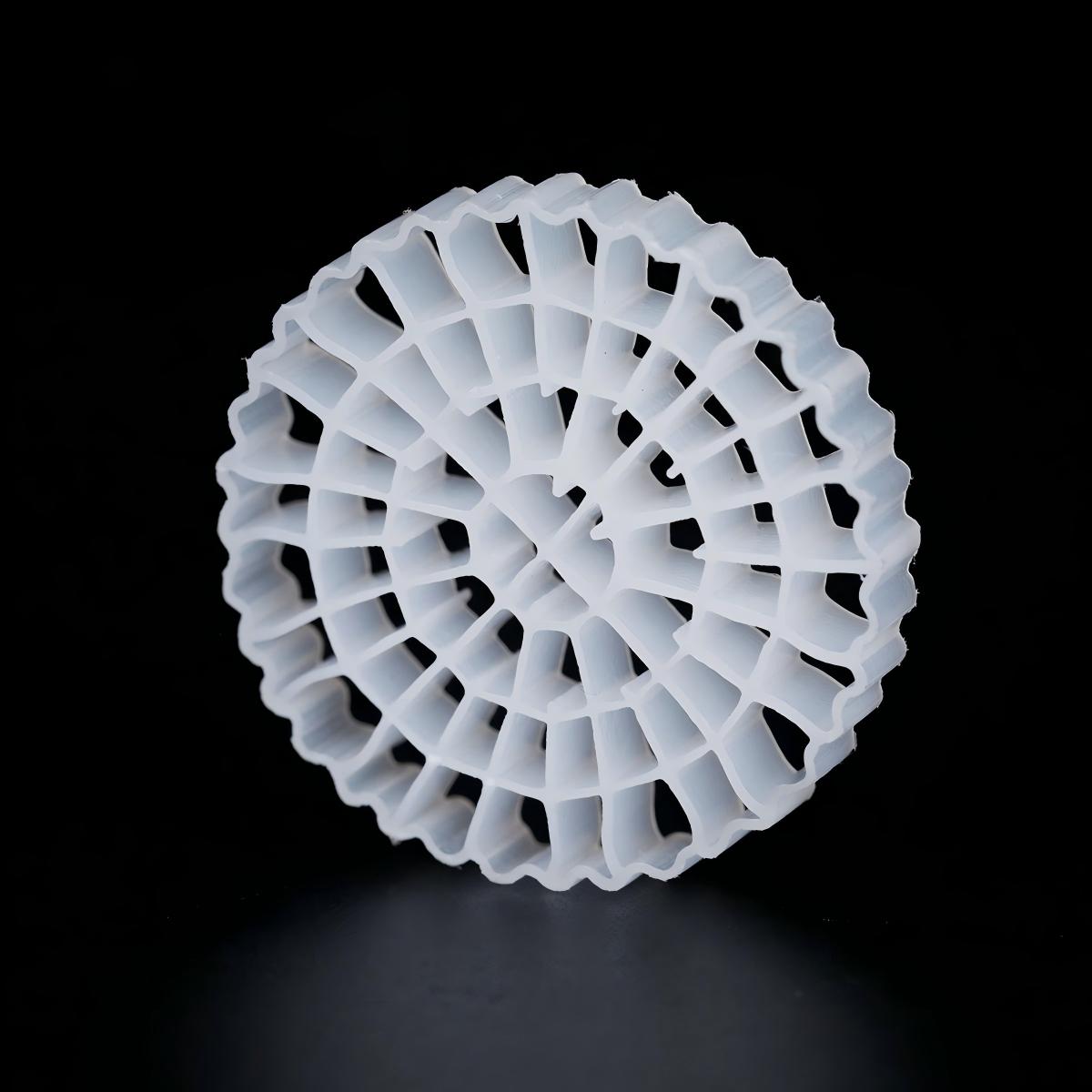
MBBR media quantity should not be selected by tank volume or a standard filling percentage alone.
The amount of carrier required depends first on the biological load that must be treated, the treatment objective and the biofilm surface area available on the selected carrier.
Only after these conditions are defined should the required media volume and resulting fill ratio be calculated.
Quick Answer
A preliminary MBBR calculation normally follows this sequence:
Pollutant Load → Design SALR → Required Biofilm Surface Area → Media Volume → Fill Ratio → Reactor Check
Tank volume and fill ratio are therefore results of the biological design process, not a substitute for it.
For carbon removal, ammonia removal and combined treatment, different loading criteria may be required. Temperature, dissolved oxygen, wastewater characteristics and treatment stage also affect the design basis.
The 8 Data Groups Needed Before MBBR Sizing
Project Data | What to Provide | Why It Matters |
|---|---|---|
Flow | Average and peak flow | Determines daily pollutant loading |
Influent Quality | BOD/COD, NH4-N/TAN and relevant wastewater data | Defines the biological load |
Treatment Target | Required BOD/COD and ammonia outlet | Defines the load to be removed |
Temperature | Normal and minimum operating temperature | Biological reaction rates are temperature dependent |
Reactor Volume | Effective liquid volume and tank dimensions | Determines the resulting media fill ratio |
Existing Process | MBBR, activated sludge, IFAS or retrofit | Changes how the biological stage should be evaluated |
Aeration / DO | Existing DO, blower and diffuser information | Biofilm activity and carrier movement require adequate oxygen and mixing |
Carrier Data | Protected design surface area and geometry | Converts required surface area into media volume |
1. Start With Pollutant Load, Not Media Volume
The first step is to determine how much pollutant reaches the biological stage.
For a specific constituent:
Applied Load (kg/day) = Flow (m³/day) × Concentration (mg/L) ÷ 1,000
If the purpose is to calculate the load that must actually be removed:
Removal Load (kg/day) = Flow × (Influent Concentration − Target Concentration) ÷ 1,000
For example, if a plant treats:
- Flow = 500 m³/day
- Influent BOD = 180 mg/L
- Target BOD = 30 mg/L
then:
BOD Removal Load = 500 × (180 − 30) ÷ 1,000 = 75 kg BOD/day
That 75 kg/day is more useful for biological sizing than simply saying:
“The tank is 40 m³.”
The same reactor volume can face very different biological loads at different plants.
2. What Is SALR?
SALR means Surface Area Loading Rate.
In MBBR design, it describes how much pollutant load is applied to each square metre of biofilm carrier surface area over time.
It is commonly expressed as:
- g BOD/m²·day
- g COD/m²·day
- g NH4-N/m²·day
The basic relationship is:
SALR = Pollutant Load ÷ Available Biofilm Surface Area
Rearranging the equation gives:
Required Biofilm Surface Area = Pollutant Load ÷ Design SALR
If pollutant load is expressed in kg/day, convert it to g/day before dividing by a SALR expressed in g/m²·day.
Important
There is no single universal SALR that should be copied into every MBBR project.
The appropriate design value depends on factors such as:
- treatment objective
- carbon removal or nitrification duty
- wastewater characteristics
- reactor staging
- temperature
- dissolved oxygen
- upstream treatment
- required effluent quality
- design margin
This is why an online calculator can be useful for preliminary checks but should not replace project-specific biological design.
3. Carbon Removal and Nitrification Should Not Be Treated as the Same Calculation
A reactor designed mainly for organic-load reduction is not necessarily governed by the same loading criterion as a reactor where ammonia removal is critical.
For carbon removal, the calculation may focus on BOD or biodegradable COD loading.
For nitrification, the critical calculation may instead focus on ammonia nitrogen removal.
A project requiring both may need:
- staged reactors
- different loading criteria for different zones
- additional carrier area
- different DO conditions
- different design margins
Therefore, the question should not simply be:
“How many cubic metres of MBBR media do I need?”
It should first be:
What biological duty must this carrier surface accomplish?
4. Convert Required Surface Area Into Media Volume
Once the required biofilm surface area has been calculated, it can be converted into carrier volume.
The relationship is:
Media Volume (m³) = Required Biofilm Surface Area (m²) ÷ Carrier Protected Design Surface Area (m²/m³)
For example, suppose the biological calculation requires:
10,000 m² of biofilm surface area
and the selected carrier provides:
500 m²/m³ of protected design surface area
then:
Media Volume = 10,000 ÷ 500 = 20 m³
This calculation is straightforward.
The more difficult engineering question is whether the selected surface-area value and design loading basis are appropriate for the project.
5. Protected Surface Area Matters More Than a Marketing Number
MBBR carrier datasheets may refer to terms such as:
- total surface area
- specific surface area
- protected surface area
- effective surface area
These terms should not automatically be treated as interchangeable.
The surface area used for biological sizing should correspond to the area that is realistically available for stable biofilm growth under the intended operating conditions.
A carrier with a very high quoted total surface area is not automatically the best carrier for every project.
Carrier selection should also consider:
- geometry
- protected internal structure
- biofilm accessibility
- carrier movement
- wastewater solids
- potential clogging
- mechanical durability
- density
- retention-screen requirements
- aeration and mixing conditions
This is why surface area alone should not be used as the only MBBR selection criterion.
6. Calculate the Resulting Fill Ratio
After media volume is known, the fill ratio can be calculated.
Fill Ratio (%) = Media Volume ÷ Effective Reactor Volume × 100
For example:
- Media volume = 20 m³
- Effective reactor volume = 40 m³
then:
Fill Ratio = 20 ÷ 40 × 100 = 50%
The arithmetic is simple.
However, this does not mean that 50% is automatically the correct design for another project.
The acceptable fill ratio must still allow:
- free carrier movement
- effective mixing
- oxygen transfer
- hydraulic passage
- reliable media retention
- maintenance access
Different carrier geometries and reactor arrangements may have different practical limits.
7. Why “Use 50% Media” Is Not a Design Method
A common shortcut is to start with a standard media filling percentage.
For example:
“The tank is 100 m³, so use 50 m³ of media.”
This reverses the engineering logic.
The more reliable sequence is:
Treatment Load ↓ Design SALR ↓ Required Biofilm Area ↓ Selected Carrier Surface Area ↓ Required Media Volume ↓ Resulting Fill Ratio
Only then should the engineer ask whether that fill ratio is practical for the reactor.
If the calculated media requirement produces an impractical filling ratio, the project may need to reconsider:
- reactor volume
- process staging
- loading assumptions
- carrier selection
- pretreatment
- aeration capacity
- retrofit strategy
8. A Worked Calculation — Arithmetic Example Only
The following example is intended to demonstrate the calculation sequence. The assumed SALR and carrier surface area are illustrative values, not universal HydroNovus design recommendations.
Step 1 — Biological Load
Assume:
- Flow = 500 m³/day
- Influent BOD = 180 mg/L
- Target BOD = 30 mg/L
Required BOD removal:
500 × (180 − 30) ÷ 1,000 = 75 kg/day
or:
75,000 g/day
Step 2 — Required Biofilm Surface Area
For this arithmetic example only, assume the project engineer has selected:
Design SALR = 10 g BOD/m²·day
Then:
Required Area = 75,000 ÷ 10 = 7,500 m²
Step 3 — Required Media Volume
Assume the selected carrier has:
Protected design surface area = 500 m²/m³
Then:
Media Volume = 7,500 ÷ 500 = 15 m³
Step 4 — Resulting Fill Ratio
If the reactor effective volume is:
30 m³
then:
Fill Ratio = 15 ÷ 30 × 100 = 50%
The calculation produces a preliminary media volume and fill ratio.
It does not yet prove that the biological design is complete.
The engineer must still check temperature, oxygen supply, reactor hydraulics, carrier movement, retention screens, peak loading and other process conditions.
9. Existing Tank Retrofit: Calculate Capacity Before Adding More Media
MBBR is often considered when an existing biological tank needs more treatment capacity but civil expansion is difficult.
In a retrofit project, adding more carrier is not automatically the first solution.
First check:
- current reactor volume
- existing media type and volume
- current fill ratio
- existing BOD/COD loading
- ammonia loading
- wastewater temperature
- operating DO
- blower capacity
- diffuser condition
- outlet retention screen
- current effluent performance
- actual reason for underperformance
Additional media increases available biofilm area, but it can also increase the aeration and mixing requirement.
If the reactor already has insufficient oxygen transfer or poor carrier movement, simply increasing the filling percentage may not solve the underlying problem.
10. Aeration Is Part of the MBBR Calculation
Aeration serves two important functions in an aerobic MBBR:
- supplying oxygen to the biofilm
- keeping the carriers moving through the reactor
Therefore, media calculations should not be separated from aeration review.
Useful information includes:
- reactor water depth
- current dissolved oxygen
- blower capacity
- available air pressure
- diffuser type
- diffuser quantity and layout
- wastewater oxygen demand
- ammonia load
- current carrier movement
A biological calculation may indicate enough carrier surface area while the real system remains oxygen limited.
For retrofit projects in particular, the question should be:
Can the existing aeration system support the additional biological load and media volume?
11. Do Not Forget the Media Retention Screen
Moving carriers must remain inside the biological reactor.
The outlet retention system therefore needs to be considered together with media selection.
Important checks include:
- carrier dimensions
- screen opening
- design flow
- peak flow
- screen approach velocity
- fouling potential
- screen area
- installation position
- maintenance access
Adding media without checking an existing retention screen can create hydraulic or operational problems even when the biological calculation itself is correct.
Common MBBR Calculation Mistakes
Mistake | Better Approach |
|---|---|
Selecting media by tank volume alone | Calculate biological load first |
Starting from a standard fill percentage | Derive media volume from required surface area |
Using total SSA without checking its definition | Use the appropriate protected/design surface area |
Using one SALR for every wastewater | Select loading criteria for the actual treatment duty |
Treating BOD removal and nitrification as identical | Evaluate carbon and ammonia duties separately |
Ignoring minimum temperature | Include actual seasonal design conditions |
Adding more media without checking aeration | Review oxygen transfer and carrier mixing |
Ignoring the retention screen | Check screen capacity and carrier dimensions |
Assuming the highest SSA media is automatically best | Evaluate geometry, accessibility, movement and process fit |
Guaranteeing performance from media quantity alone | Review the complete biological process |
What Data Should You Send Before Requesting an MBBR Media Calculation?
Hydraulic Data
- average flow
- peak flow
- operating hours
Wastewater Quality
- influent BOD
- influent COD
- target BOD/COD
- ammonia or TAN
- target ammonia
- total nitrogen where relevant
- pH
- temperature
Existing Biological Process
- process type
- reactor dimensions
- effective reactor volume
- number of stages
- existing media model
- existing media quantity
Aeration
- operating DO
- blower capacity
- blower pressure
- diffuser type
- diffuser layout
- water depth
Retrofit Information
If this is an existing plant, also provide:
- current treatment problem
- current effluent results
- current production/load
- planned capacity increase
- photos or drawings of the reactor
- retention-screen information
Recommended Project Submission Format
Status | Example |
|---|---|
Confirmed | Flow = 600 m³/day |
Confirmed | Reactor volume = 90 m³ |
Range | BOD = 350–480 mg/L |
Target | NH4-N < project discharge requirement |
Existing | 25 m³ carrier installed |
Missing | Minimum winter temperature |
To Be Checked | Existing blower spare capacity |
Separating confirmed, variable and missing data helps prevent preliminary assumptions from becoming design facts.
Frequently Asked Questions
How much MBBR media should I put in a tank?
There is no universal percentage that applies to every tank. Required media volume should be calculated from biological load, design surface loading and selected carrier surface area, then checked against the available reactor volume.
What is MBBR fill ratio?
Fill ratio is the carrier volume divided by the effective reactor volume, expressed as a percentage.
Is higher MBBR media surface area always better?
No. The quoted surface area must be interpreted together with whether the area is protected and usable for stable biofilm growth, as well as carrier geometry, mixing, wastewater characteristics and operating conditions.
Can I calculate MBBR media from COD alone?
A preliminary organic-load calculation may use appropriate COD information, but the correct design basis depends on biodegradability and treatment objectives. BOD, ammonia and other process data may also be required.
How is MBBR media calculated for ammonia removal?
The same general surface-area method can be used, but the calculation should be based on the ammonia load to be removed and an appropriate nitrification surface-loading criterion. Temperature and dissolved oxygen are particularly important.
Can I add more MBBR media to an existing aeration tank?
Often this can be considered, but the retrofit should first check biological load, available reactor volume, aeration capacity, carrier movement and the media retention system.
Can HydroNovus provide a preliminary media-volume calculation?
Yes. Provide the flow, influent and target wastewater data, reactor dimensions, temperature, aeration information and treatment objective. Missing values should be identified before final design assumptions are made.
Related Equipment and Technical Resources
Planning a New MBBR or Biological Retrofit?
Do not start with a filling percentage.
Send HydroNovus your flow, BOD/COD, ammonia load, treatment target, temperature, reactor dimensions and aeration information.
We can first review the biological duty, estimate the required carrier surface area and media volume, and then evaluate the resulting filling ratio together with aeration and retention requirements.
Existing plant? Send the current reactor dimensions, installed media volume and present treatment problem for a preliminary retrofit review.