Can You Put MBBR Media in an SBR Tank? When It Works — and When It Doesn't
MBBR media can work in an SBR tank as a hybrid system — but only with retention screens, decant protection and the right fill ratio.
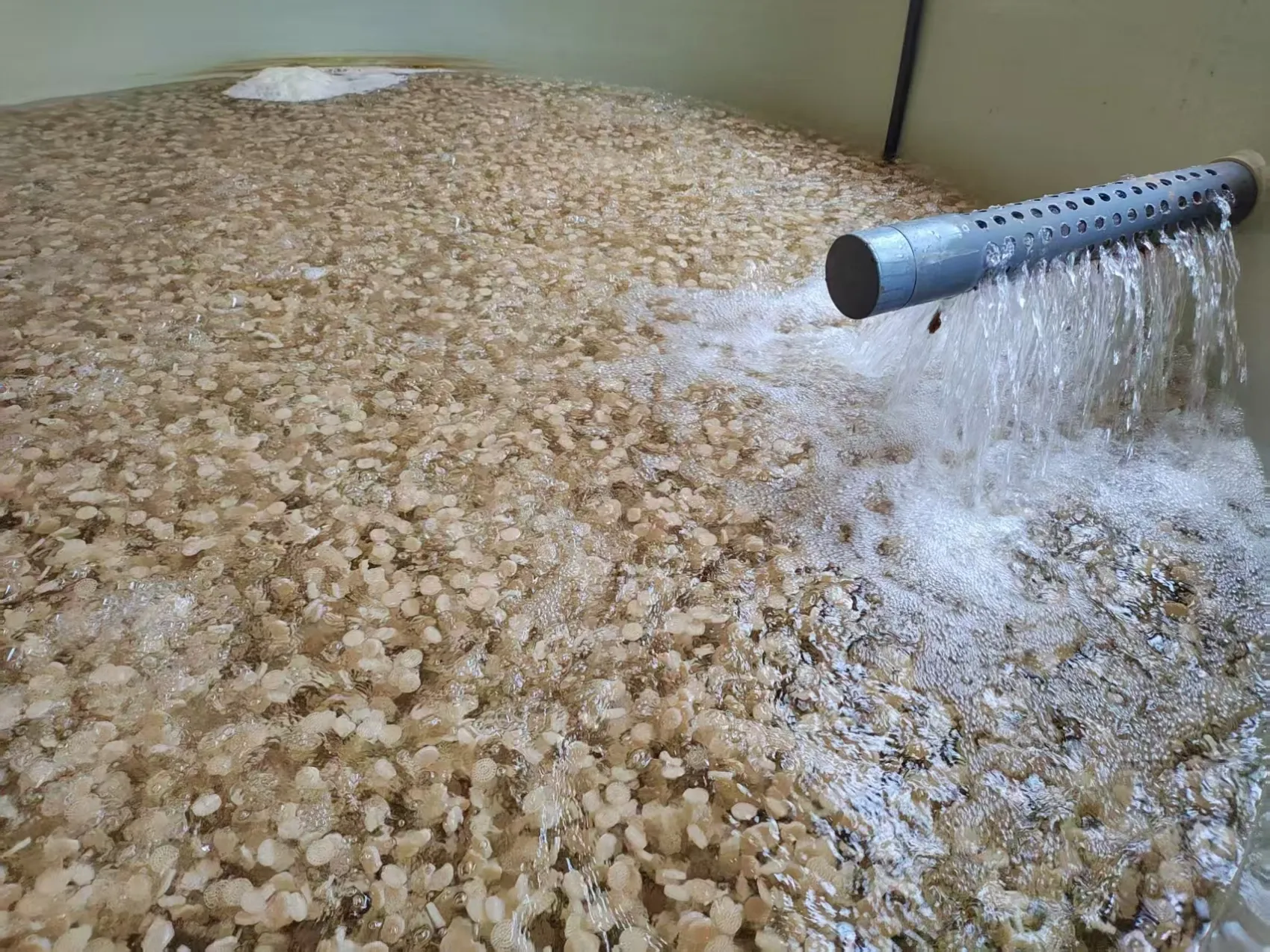
Yes — you can put MBBR media in an SBR tank. The combination is called a hybrid SBR-MBBR, sometimes an IFAS-SBR: a real configuration used where an existing SBR needs more biological capacity without a new tank. But it is not a drop-in upgrade. An SBR and an MBBR run on different operating logic, and the media only helps if four things are handled properly: keeping the media in the tank, protecting the decanter, keeping the carriers moving, and choosing a fill ratio the cycle can support. Get those four right and the hybrid can be a good retrofit; get any one wrong and the media becomes a liability.
What changes when you add media to an SBR
A conventional SBR works in cycles — fill, react, settle, decant — with the same tank doing everything in sequence, and the suspended biomass has to sink during the settle phase so clear water can be drawn off.
Adding MBBR carriers changes that picture in three ways:
- Part of the biomass now lives on the carriers. The biofilm keeps working through the whole cycle, including during fill, and is not washed out during decant — the reactor holds more active biomass than the suspended sludge alone.
- The carriers must stay in the tank through every phase. During decant, anything floating near the outlet leaves with the water unless it is stopped.
- The settle phase works differently: the carriers do not settle. The suspended sludge still has to settle around them, and the carriers occupy volume the sludge used to occupy.
In short, you are adding a fixed-film process to a batch process, and the tank has to be modified to serve both.
When it makes sense
A hybrid SBR-MBBR is worth considering in these situations:
- You need more capacity from the same tank. The plant's load has grown, the SBR is at its limit, and there is no space or budget for a new basin — carriers increase the biomass inventory without increasing the tank volume.
- Nitrification is the bottleneck. Biofilm holds slow-growing nitrifying bacteria that are easily washed out of a suspended system under variable loads. Carriers give them a stable home through load swings and short cycles.
- The load varies a lot. Biofilm stays in the tank between cycles, so a hybrid typically handles shock loads and intermittent operation better than a suspended-only SBR.
- You want a buffer before a bigger upgrade. Media can be added as an interim step, and the operating data tells you how much capacity a later expansion really needs.
When it does not make sense
There are tanks where adding media creates more problems than it solves:
- The decanter cannot be protected. If the decanting device draws from a zone the carriers can reach and there is no practical way to screen it, media will escape — in a downstream pipe or in the effluent, that is a failure, not a nuisance.
- The tank is small and the cycle is short. With rapid cycles the biofilm has little time to do useful work between decants, and the screens and mixing take up a disproportionate share of the volume.
- Mixing is weak. Carriers that do not move do not work well — if the existing aeration or mixing cannot keep them in suspension, they pile up in dead zones.
- The suspended sludge is already hard to settle. Adding carriers does not fix poor settleability — if the sludge does not settle cleanly now, it will not settle cleanly with carriers in the way.
In those cases, fix the underlying problem first or choose a different upgrade route — media is not a remedy for a decanter, mixing or settling problem. Our MBBR retrofit data checklist covers the influent and tank data needed before sizing any retrofit of this kind.
The four things you must get right
1. Retention screens
Every outlet the carriers could reach — decanter, overflow, drain — needs a screen sized to the carrier dimensions. Our guide to MBBR media retention screen sizing explains the principles: the screen must stop the carriers, pass the design flow without excessive head loss, and be cleanable without draining the tank. In an SBR the screen sees intermittent flow, so the peak decant rate — not the average flow — sets the screen area.
2. Decant protection
The decanter needs a guard: a screened decant zone, a stilling baffle that keeps carriers away from the draw-off point, or a decanter that draws from below the floating carrier layer. Test it at the highest decant rate before committing — a carrier that escapes once will escape again, and recovering media from downstream pipework is slow, unpleasant work.
3. Aeration and mixing
During the react phase the carriers need to be evenly distributed and moving — check the existing aeration grid against the carrier load: enough air to fluidise the media at the chosen fill ratio, without so much turbulence that the biofilm is scoured off faster than it grows. During fill and settle the air is off and the carriers settle to the bottom; that is normal. What matters is that they re-suspend evenly when aeration restarts, with no dead corners. If the tank leaves dead zones, fix that before the media goes in.
4. Fill ratio
MBBR media is normally used at 15–65% filling ratio; in a hybrid SBR, start at the lower end. A modest fill ratio leaves room for the sludge to settle, keeps the decant zone clear, and leaves margin to add more later. Starting high is the most common mistake: it maximises the screening and mixing problems before you have any operating experience with the hybrid.
| Factor | Conventional SBR | Hybrid SBR-MBBR |
|---|---|---|
| Biomass location | Suspended sludge only | Sludge + biofilm on carriers |
| Capacity limit | Sludge inventory, settleability | Sludge inventory + carrier surface area |
| Decant risk | Sludge washout if settling is poor | Media escape if screens fail |
| Nitrification stability | Sensitive to load swings, short cycles | Biofilm buffers nitrifiers through swings |
| What to watch | Sludge settling, decanter | Screens, carrier distribution, decant protection |
| Typical first step | — | Low fill ratio, one tank, monitor full cycles |
Media choice and startup
Use the same selection logic as for any MBBR: HNS MBBR media is 100% virgin HDPE, density 0.96–0.98, service life over 15 years. Verified protected surface areas: MBBR19 >650, MBBR37 >800, MBBR40 >900, MBBR64 >1,200, MBBR76 >1,600, MBBR04 >900, MBBR05 >1,000, MBBR06 >800 m²/m³. Choose on the surface area your load needs and the carrier size your screens can retain — a smaller carrier needs a finer screen, so media choice and screen design are one decision.
Startup follows the normal MBBR pattern: biofilm formation typically takes 3–15 days, and the reactor should run through several full SBR cycles at the intended fill ratio before performance is judged — see our MBBR startup and biofilm commissioning guide. Expect ammonia removal to improve over the first two to three weeks as the biofilm matures; do not judge the hybrid on the first few cycles.
A practical sequence for trying it
- Collect the data. Flow, load, cycle times, settling behaviour, decanter type and tank dimensions. Measure anything unknown before ordering media.
- Design the screens and the decant guard first. These are the long-lead items and the main failure point — size them on the peak decant rate.
- Start with one tank at a low fill ratio. Run a full set of cycles at normal load and watch media retention, carrier distribution when aeration restarts, and effluent quality against the pre-media baseline.
- Decide on evidence. If retention is clean, distribution is even and ammonia removal has improved, consider raising the fill ratio or converting the next tank. If media escapes or piles up, fix the screens and mixing before adding more.
Frequently asked questions
Can we put any type of media in an SBR tank?
No — not any type. The media must be a buoyant carrier designed to be retained by screens, such as HDPE MBBR carriers, sized so your screens can reliably stop it. Heavy media that sinks and cannot be re-suspended, or media that breaks apart under aeration, is unsuitable. Check carrier dimensions against the screen aperture before ordering.
Will MBBR media shorten the SBR aeration time?
Not by itself. Media increases the biomass in the tank, which increases capacity, but it does not reduce the oxygen the load requires or the time the sludge needs to settle. Treat shorter cycles as something to test with operating data after the biofilm has matured — any claim of a fixed percentage cut should be treated with suspicion unless backed by data from a comparable plant.
Do I need to change the SBR cycle times when adding media?
Usually the cycle structure stays the same at first — the react phase simply has more biomass working in it. Running a longer fill or shorter react phase is an optimisation for later, based on operating data, not a day-one change.
What fill ratio should I start with in an SBR?
Start low, within the normal 15–65% range and towards the lower end — around 20–30% — so settling and decanting are not crowded out while you learn how the hybrid behaves. Add more only after retention and distribution prove themselves over a full set of cycles.
Need a quantity or sizing check? Contact us for a free sizing, media quantity and sample check — send your tank dimensions, cycle times and load, and we will work out whether a hybrid SBR-MBBR fits and how much media you need.