Industry Solutions
30 μm vs 70–75 μm Drum Filter for RAS: Which Screen Size Should You Choose?
Compare 30 μm and 70–75 μm drum filter screens for RAS. Learn how particle size, flow, solids load, backwash frequency and downstream biofiltration affect micron selection.
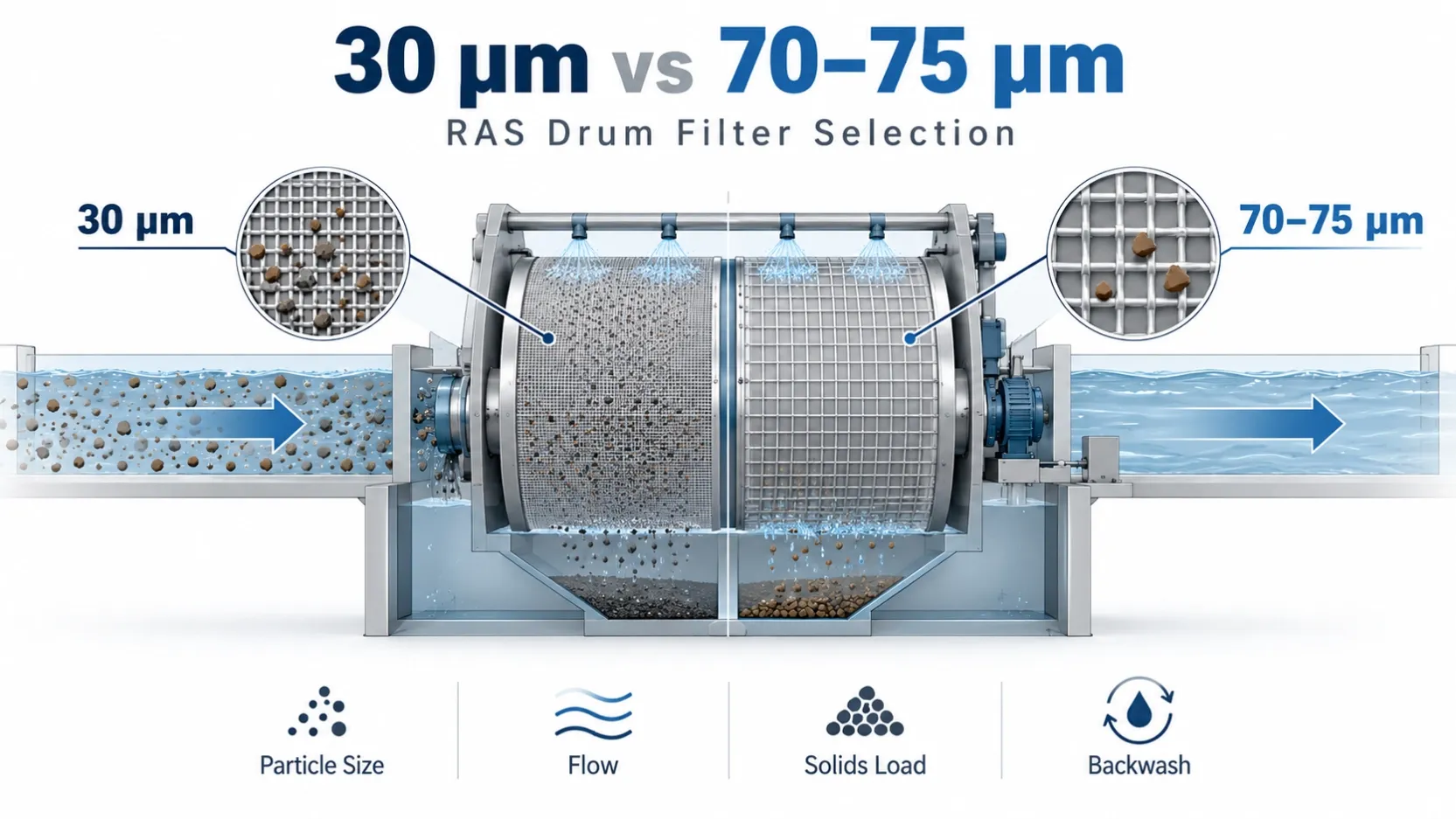
Choosing a drum-filter screen for a recirculating aquaculture system is not simply a matter of selecting the smallest micron number available.
A finer screen can retain smaller particles before they continue through the RAS, but it can also increase hydraulic resistance, screen loading, backwash frequency and wash-water demand.
The better question is:
What particle size needs to be removed, at what flow and solids load, before the water reaches the downstream biological and oxygenation stages?
Quick Answer
A 30 μm drum-filter screen provides finer mechanical separation than a 70–75 μm screen, but finer is not automatically better for every RAS.
Micron selection should consider particle-size distribution, recirculation flow, TSS and solids load, fish species and feed, required water quality, available screen area, backwash frequency and the load that can be accepted by the downstream biofilter.
For many projects, the best screen is the one that provides sufficient solids control without creating unnecessary hydraulic or backwash burden.
The 8 Data Groups to Check Before Selecting Drum-Filter Micron
Project Data | What to Provide | Why It Matters |
|---|---|---|
Recirculation Flow | Normal and peak flow in m³/h | Determines the hydraulic duty through the screen |
Solids Load | TSS, feed rate and available solids data | Indicates how quickly the screen may load |
Particle Characteristics | Approximate particle size and solids type | Helps determine whether finer screening will provide useful additional capture |
Fish / Production Stage | Species, biomass, hatchery or grow-out | Affects waste production and water-quality priorities |
Screen Micron | Existing or proposed opening | Determines the nominal mechanical separation range |
Downstream Biofilter | Type, loading and current performance | Solids escaping the drum filter continue into later treatment stages |
Backwash Conditions | Trigger, pressure, available wash water | Finer screens may require more frequent cleaning under the same solids duty |
Treatment Target | Current problem and desired improvement | Defines whether the objective is solids control, water clarity, biofilter protection or another issue |
1. What Does “30 μm” or “75 μm” Actually Mean?
The micron rating describes the nominal opening size of the screen.
A 30 μm screen has smaller openings than a 70–75 μm screen and can therefore retain a greater portion of finer particles under appropriate operating conditions.
However, a drum filter does not separate particles according to micron rating alone.
Actual performance is also influenced by:
- particle shape
- particle deformability
- solids concentration
- screen condition
- hydraulic loading
- cake formation on the screen
- backwash cycle
- flow distribution across the available screen area
This is why two RAS installations using the same nominal mesh can behave differently.
2. Smaller Micron Does Not Automatically Mean Better RAS Performance
A common assumption is:
“If 75 μm works, 30 μm must be better.”
That is too simple.
A finer screen can reduce the amount of small particulate material that continues through the recirculation loop, but the finer opening also gives water less open area to pass through when solids accumulate.
Depending on the application, this can result in:
- faster screen loading
- a greater water-level differential
- more frequent drum rotation
- more frequent backwashing
- greater wash-water use
- reduced hydraulic margin if screen area is insufficient
The engineering objective is therefore not to select the smallest possible micron.
It is to select a screen that provides the required solids removal while maintaining reliable hydraulic operation.
3. 30 μm vs 70–75 μm: What Changes?
The following comparison is a selection guide, not a universal performance guarantee.
Selection Factor | 30 μm Screen | 70–75 μm Screen |
|---|---|---|
Nominal Opening | Finer | Coarser |
Fine-Particle Capture Potential | Higher | Lower |
Hydraulic Resistance as Screen Loads | Generally more sensitive | Generally more tolerant |
Backwash Frequency Under Similar Solids Duty | May be higher | May be lower |
Wash-Water Demand | May increase if backwash cycles increase | May be lower under the same duty |
Required Screen Area | Must be checked carefully | Often provides more hydraulic margin for the same area |
Solids Passed Downstream | Potentially less fine particulate matter | Potentially more fine particulate matter |
Typical Reason to Consider | Finer solids control is genuinely required | General mechanical solids removal with greater hydraulic tolerance |
The correct choice depends on the system.
A 30 μm screen may make sense where finer particulate control has a clear process benefit.
A 70–75 μm screen may be more appropriate where the priority is reliable high-flow solids removal without unnecessarily increasing backwash duty.
4. Particle-Size Distribution Matters More Than the Micron Number Alone
The filter can only remove particles that reach the screen in a retainable form.
RAS solids may include:
- uneaten feed
- fecal particles
- biofilm fragments
- fine suspended organic material
- algae or other biological solids
- particles generated by pumping and hydraulic shear
If most of the relevant solids are already larger than the existing screen opening, changing from 75 μm to 30 μm may provide less improvement than expected.
If a meaningful fraction of the solids lies below the existing screen rating, finer screening may provide a clearer benefit.
Where micron selection is critical, useful information can include:
- TSS
- particle-size distribution where available
- feed type and daily feed rate
- visual water-clarity problems
- existing screen performance
- solids escaping to the biofilter
- backwash frequency
The decision should be based on the solids actually present in the system rather than the micron number alone.
5. Mechanical Solids Removal Affects the Biofilter
The rotary drum filter is normally an upstream mechanical-separation stage.
Its job is not to remove dissolved ammonia.
However, solids that remain in the recirculating water can break down, contribute to oxygen demand and increase the organic load reaching later treatment stages.
A typical RAS treatment sequence may be:
Fish Tank ↓ Mechanical Solids Removal ↓ Biological Filtration ↓ Aeration / Oxygen Transfer ↓ Water Return
This means micron selection should not be evaluated as an isolated equipment decision.
If the current problem is excessive solids entering the biological stage, finer mechanical separation may be worth evaluating.
If the main problem is ammonia removal while solids control is already adequate, changing the drum-filter micron may not address the actual limitation.
Where biological capacity is the main issue, review the HDPE MBBR Biofilter Media for Wastewater & RAS and the biological operating conditions instead of assuming that a finer mechanical screen will solve the problem.
6. Flow Rate Alone Is Not Enough to Size a Drum Filter
A request such as:
“I need a 100 m³/h drum filter.”
is only the beginning of equipment selection.
The drum must pass the required water flow while its screen is progressively loaded with solids between cleaning cycles.
Useful hydraulic information includes:
- normal recirculation flow
- peak flow
- gravity-fed or pumped arrangement
- inlet water level
- allowable head loss
- available installation level
- number of operating hours
- required standby or redundancy
The same nominal flow can require different filtration areas if the solids loading, screen micron and acceptable water-level differential are different.
Therefore, flow capacity stated in a catalogue should not be separated from the specified screen micron and solids duty.
7. Finer Screens Can Change Backwash Duty
As solids accumulate, the available open area of the screen decreases.
The water-level difference across the drum increases until the cleaning cycle is triggered.
A typical cleaning sequence is:
Screen Loads With Solids ↓ Water-Level Differential Increases ↓ Drum Rotates ↓ Backwash Nozzles Clean the Screen ↓ Captured Solids Enter the Waste Trough
When a finer screen loads more rapidly, the filter may need to clean more frequently.
This affects more than the screen itself.
The project should also consider:
- backwash-pump duty
- wash-water source
- nozzle condition
- waste-trough capacity
- sludge discharge
- frequency of cleaning cycles
- total wastewater generated by backwashing
A finer micron setting is therefore also an operational decision.
8. Feed Rate and Biomass Help Explain the Solids Duty
RAS mechanical filtration should be connected to fish production conditions.
Useful information includes:
- fish species
- current biomass
- target biomass
- daily feed rate
- feed type
- production stage
- mortality or unusual solids events
- expected future production increase
A filter selected only from the current water flow may become undersized if the same RAS later operates at substantially higher biomass and feed loading.
For an expansion project, both hydraulic flow and future solids production should be reviewed.
9. When Should 30 μm Be Considered?
A 30 μm screen may be worth evaluating when:
- fine suspended solids are a confirmed water-quality concern
- the existing coarser screen allows excessive fine particulate matter downstream
- hatchery or sensitive production stages require tighter solids control
- the downstream process benefits from lower particulate loading
- sufficient filtration area is available
- the backwash system can support the expected cleaning frequency
This does not mean 30 μm should automatically replace a coarser screen.
The expected benefit should be weighed against hydraulic and operational consequences.
10. When May 70–75 μm Be the Better Choice?
A 70–75 μm screen can be a practical choice when:
- the main objective is removal of larger suspended solids and waste feed
- high recirculation flow requires good hydraulic margin
- existing downstream treatment can tolerate the remaining finer particles
- wash-water consumption needs to be controlled
- the system already achieves acceptable water quality at this filtration level
- a finer screen would add operating burden without solving a defined process problem
The correct question is therefore not:
“Which micron is best?”
It is:
“Which micron provides enough solids control for this RAS without creating unnecessary hydraulic and backwash load?”
Common Drum-Filter Selection Mistakes
Mistake | Better Approach |
|---|---|
Choosing the smallest available micron | Match micron to actual solids and treatment objective |
Selecting from flow rate alone | Review flow, solids load, micron and filtration area together |
Ignoring particle-size distribution | Determine what particles actually need to be captured |
Ignoring backwash frequency | Include wash-water and cleaning duty in selection |
Assuming finer screening solves ammonia problems | Check the biological treatment stage separately |
Using current biomass only | Consider future biomass and feed loading |
Ignoring head loss | Confirm gravity level, water-level differential and hydraulic margin |
Forgetting sludge discharge | Plan how backwash solids will be collected and handled |
What Data Should You Send Before Requesting a RAS Drum Filter?
Hydraulic Data
- normal recirculation flow
- peak flow
- gravity or pumped feed
- available water level
- allowable head loss
Solids Data
- TSS if available
- current water-clarity issue
- existing filtration micron
- particle-size information if available
- current backwash frequency
Aquaculture Data
- fish species
- system volume
- current biomass
- target biomass
- daily feed rate
- production stage
Existing Mechanical Filtration
- current filter type
- current screen micron
- existing drum dimensions or model
- current operational problem
- photos or drawings where available
Downstream Process
- biofilter type
- existing solids load reaching the biofilter
- aeration / oxygenation system
- current water-quality problem
Site Conditions
- freshwater or seawater
- available footprint
- voltage and frequency
- wash-water source
- preferred construction material
- required automation level
Recommended Project Submission Format
Status | Example |
|---|---|
Confirmed | Recirculation flow = 120 m³/h |
Confirmed | Existing screen = 75 μm |
Target | Reduce fine particulate carryover |
Existing | MBBR biofilter downstream |
Range | Daily feed = 180–220 kg/day |
Missing | Particle-size distribution |
To Be Checked | Backwash-water availability |
Separating confirmed data, target conditions and missing information helps avoid choosing a finer screen for the wrong reason.
Frequently Asked Questions
Is a 30 μm drum filter always better than a 75 μm filter?
No. A 30 μm screen can retain finer particles, but it may also increase hydraulic resistance and backwash frequency. Selection should depend on solids characteristics, required water quality, flow and the available filtration area.
What micron screen is normally used for RAS?
RAS applications use a range of microscreen sizes. The correct value depends on species, solids characteristics, recirculation flow, production stage and treatment target. A standard catalogue micron should not automatically become the project design value.
Will changing from 75 μm to 30 μm reduce ammonia?
Not directly. A drum filter removes particulate material rather than dissolved ammonia. Better solids removal may reduce organic loading on downstream treatment, but ammonia control remains primarily a biological-process issue.
Does a finer screen reduce drum-filter flow capacity?
For a given filter geometry and solids duty, a finer screen can reduce hydraulic margin as the screen loads. Final flow capacity should therefore be confirmed for the selected screen micron rather than assumed from a model name alone.
Does 30 μm require more backwashing?
It can under the same solids conditions because the finer screen may load more quickly. Actual cleaning frequency depends on solids load, screen area, backwash controls and operating conditions.
What data are required to select a RAS drum filter?
At minimum, provide normal and peak recirculation flow, existing or target micron, fish species, biomass, daily feed, available TSS or solids data, current filtration arrangement, freshwater/seawater condition and the main water-quality problem.
Related Equipment and Technical Resources
Selecting a Drum Filter for a New or Existing RAS?
Do not select the screen from flow and micron alone.
Send HydroNovus your normal and peak recirculation flow, existing or target micron, TSS or solids information, fish species, biomass, feed rate and current filtration problem.
We can review the required mechanical-separation duty first and then discuss an appropriate drum size and screen specification.
Existing RAS? Send the current drum-filter model, screen micron, flow and the problem you are trying to solve.