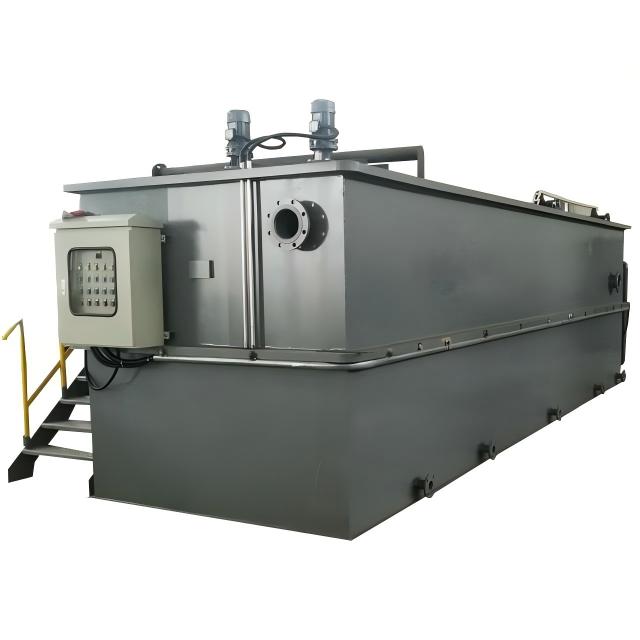
DAF (Dissolved Air Flotation) Systems
Dissolved Air Flotation System for Wastewater Treatment
Compact DAF equipment for removing suspended solids, fats, oils, grease, and chemically conditioned floc. The system can be configured around wastewater flow, solids loading, influent quality, chemical program, and discharge target.
DISSOLVED AIR FLOTATION SYSTEM
PRODUCT OVERVIEW
HydroNovus dissolved air flotation systems separate suspended solids, fats, oils, grease, and chemically formed floc from wastewater. Recycle water is pressurized and mixed with air; after pressure release, fine bubbles attach to particles and carry them to the surface for skimming. The system is configured according to actual hydraulic and solids loading.
CORE FEATURES
• Compact clarification process for difficult-to-settle solids.
• Recycle pressurization and air-dissolving system selected for stable bubble generation.
• Adjustable surface skimmer and sludge collection arrangement.
• Chemical mixing and flocculation stages can be integrated when required.
• Carbon steel, stainless steel, or project-specific construction options.
• Access platform, control panel, pumps, and instrumentation available as a packaged system.
TECHNICAL PARAMETERS
Design flow: project specific
Influent solids and oil loading: required for sizing
Recycle ratio: selected according to wastewater and separation target
Operating pressure: matched to the air-dissolving system
Tank material: coated carbon steel, SS304, SS316L, or project-specific option
Chemical dosing: PAC, PAM, pH adjustment, or process-specific program when required
Sludge removal: surface skimmer with hopper or collection chamber
Automation: manual, semi-automatic, or PLC-controlled
APPLICATION SCENARIOS
• Food and beverage wastewater
• Slaughterhouse and meat-processing effluent
• Dairy and edible-oil wastewater
• Pulp and paper wastewater
• Textile, printing, and dyeing effluent
• Petrochemical and oily wastewater
• Pretreatment before biological treatment or membrane systems
SELECTION INFORMATION
Please provide average and peak flow, influent TSS, COD, oil and grease, pH, temperature, expected discharge target, chemical-treatment information, operating hours, and available installation space. Jar testing is recommended when chemical coagulation and flocculation performance is uncertain.
FREQUENTLY ASKED QUESTIONS
Q: Can DAF remove dissolved COD?
A: DAF mainly removes suspended or floatable material. Dissolved pollutants normally require coagulation, oxidation, biological treatment, adsorption, or another suitable process.
Q: Is chemical dosing always required?
A: Not always. It depends on particle size, emulsion stability, wastewater chemistry, and the required removal target. Jar tests help determine whether coagulant or polymer is needed.
Q: How is the DAF capacity selected?
A: Capacity is based on both hydraulic loading and solids loading. Peak flow, recycle flow, sludge production, flotation area, and skimmer capacity must be checked together.
Q: Can HydroNovus supply a complete packaged unit?
A: Yes. The scope can include the DAF tank, recycle pump, air-dissolving system, skimmer, dosing and flocculation equipment, electrical controls, and access platform.
REQUEST ENGINEERING SUPPORT
Send your wastewater analysis, flow profile, discharge target, available footprint, and preferred material. HydroNovus will prepare a preliminary DAF configuration and quotation.