Industry Solutions
Air-to-Solids Ratio in DAF: How Much Air Do Your Solids Actually Need?
Learn the air-to-solids ratio formula for DAF, work through a sizing example, and see what to change when float is thin or solids carry over.
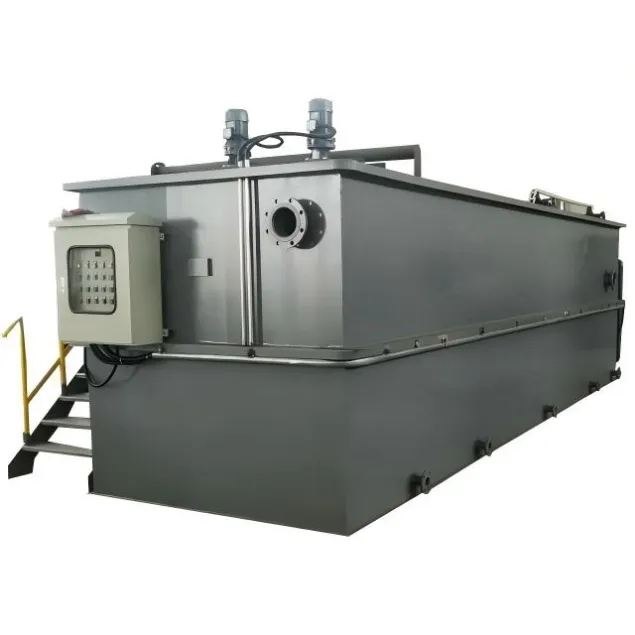
The air-to-solids ratio, or A/S ratio, is the mass of air released in a DAF unit divided by the mass of solids it has to float — kilograms of air per kilogram of solids. Too low, and there are not enough bubbles to lift the solids. Too high, and you are spending energy and recycle capacity on air the process does not need. Most DAF designs land in a typical first-pass range of roughly 0.02–0.06 kg air per kg solids, and the exact figure is calculated from the saturator pressure, the recycle rate, and the solids load — not guessed from a rule of thumb.
This article works through the standard A/S formula term by term, shows a worked example, and explains what to change when the float is thin or the effluent carries solids.
What the air-to-solids ratio actually measures
A DAF unit floats solids by attaching tiny air bubbles to them. The bubbles come from water saturated with air under pressure in the saturator, then released to atmospheric pressure in the flotation tank. When the pressure drops, the dissolved air comes out of solution as fine bubbles, which attach to flocculated solids and carry them to the surface.
The A/S ratio answers one question: for every kilogram of solids entering the unit, how many grams of air are available to lift it? Two plants with the same flow can need very different ratios — a dilute stream at 100 mg/L needs far less air than a concentrated one at 1,000 mg/L, even though the volume is the same. That is why the ratio is expressed per kilogram of solids rather than per cubic metre of water: it follows the load, not the flow.
It also explains why the A/S ratio and the recycle ratio are related but not the same thing. Recycle ratio is a flow ratio; the A/S ratio is a mass ratio that depends on recycle flow, saturator pressure, and solids concentration together. Our guide to DAF recycle ratio and saturator pressure covers the recycle side of that relationship in detail.
The A/S formula, term by term
The standard design formula is:
A/S = 1.3 × Sa × (f × P − 1) × R ÷ X
Each term has a plain meaning: Sa is air solubility at atmospheric pressure, in mg/L, and it depends on temperature: roughly 23 mg/L at 10 °C, 19 mg/L at 20 °C, and 16 mg/L at 30 °C — warmer water holds less air, so the same saturator delivers less air in summer than in winter. f is saturator efficiency, the fraction of full saturation actually achieved, typically 0.5–0.8; a well-maintained saturator runs toward the upper end, fouled packing pulls it down. P is absolute pressure in the saturator, in atmospheres — absolute, not gauge: 4 bar gauge is about 5 atmospheres absolute, and mixing the two up is the most common arithmetic mistake in this calculation. R is the recycle ratio, recycle flow divided by influent flow, as a decimal (30% recycle is R = 0.30). X is influent suspended solids in mg/L, measured at the DAF inlet after chemical dosing — including the chemical sludge formed by coagulation, not only the raw-water solids. 1.3 is a constant that converts the dissolved-air volume into a mass basis at standard conditions.
One warning: the formula tells you how much air is released, not how much attaches to solids. That also depends on coagulation and floc quality — a correct A/S ratio with poor floc still gives poor flotation. The jar-testing guide for coagulation before DAF is the companion check whenever the chemistry is in doubt.
Worked example
Take a typical industrial case — the numbers show the arithmetic, not a design recommendation.
- Air solubility at 20 °C: Sa = 18.7 mg/L
- Saturator efficiency: f = 0.8
- Saturator pressure: 4 bar gauge, so P = 5 atmospheres absolute
- Recycle ratio: R = 0.30 (30%)
- Influent solids: X = 500 mg/L
Step by step:
- Effective saturation term: f × P − 1 = 0.8 × 5 − 1 = 3.0
- Air released per litre of recycle water: 1.3 × 18.7 × 3.0 = 72.9 mg/L
- Air per litre of influent: 72.9 × 0.30 = 21.9 mg/L
- Divide by the solids: 21.9 ÷ 500 = 0.044 kg air per kg solids
That sits inside the typical first-pass range of 0.02–0.06, so the design point looks reasonable on this check. If the same plant ran at 1,000 mg/L of solids with nothing else changed, the ratio would halve to 0.022 — still inside the range, but at the thin end, and worth a closer look at the float quality.
What moves the ratio — and by how much
Changing one variable at a time from the worked example shows where the leverage is. Solids load is the strongest single driver: a plant that doubles production without touching the DAF settings halves its A/S ratio overnight. And saturator condition matters as much as the headline settings — a saturator at f = 0.6 instead of 0.8 loses a third of its air, with no change visible on the pressure gauge.
Change from the worked example | New value | A/S ratio |
|---|---|---|
Base case (worked example) | — | 0.044 |
Recycle cut from 30% to 20% | R = 0.20 | 0.029 |
Solids load doubled | X = 1,000 mg/L | 0.022 |
Saturator efficiency down to 0.6 | f = 0.6 | 0.029 |
Too low or too high — what goes wrong
Too low. Too little air shows up in the tank before it shows up in the lab results: the float forms in patches and leaves open water, skimming removes little, unfloated particles leave with the treated flow, and solids that should have been floated off travel on to the biological stage or the dewatering line, where they cost more to handle. A unit sized near the bottom of the range also has no margin when influent solids spike. If cloudy effluent is the symptom, our DAF troubleshooting guide for cloudy effluent and solids carryover walks through the full diagnosis, of which a low A/S ratio is one branch.
Too high. More air is not free, and past a point it stops helping. Higher recycle means a bigger recycle pump running longer, and higher saturator pressure means more energy — both paid every hour the unit operates. Excess air can disturb the separation zone and break fragile floc, while very high recycle raises the hydraulic load, shortens float drainage time, and wets the sludge blanket. Once every solid has bubbles attached, extra air has nothing left to lift. The right question is therefore not "how high can we push the ratio" but "what is the lowest ratio that holds float quality at our worst solids load?"
How to raise or lower the ratio in practice
Three levers are available:
1. Recycle rate — the easiest lever. Turning up recycle is a control-room change, not a hardware change: the first thing to try when the float thins, and the first to trim back once the load falls. The cost is pump energy and extra hydraulic load.
2. Saturator pressure — the second lever. Raising pressure releases more air per litre of recycle water, within the saturator and pump ratings. Check efficiency first: if packing is fouled, cleaning it can recover more air than raising the pressure.
3. Saturator efficiency — the maintenance lever. A saturator that has drifted from f = 0.8 to f = 0.6 silently removes a third of the air supply, so regular inspection and cleaning is the cheapest way to hold the ratio where the design put it.
Reduce the solids load itself where possible. Better upstream screening, flow equalisation, and steady chemical dosing all lower X. For a new unit, the data needed to size the ratio is the same data sheet used to size the unit as a whole, covered in our DAF system sizing data guide.
The A/S ratio is not the whole design
A correct A/S ratio is necessary but not sufficient. Hydraulic loading — flow per square metre of flotation area — decides whether the water spends long enough in the tank for bubbles to attach and rise; a correct air ratio in a hydraulically overloaded tank still fails. Solids loading can also govern before the air ratio does, especially on high-solids streams.
The ratio also says nothing about floc quality. If coagulation is wrong — wrong chemical, wrong dose, or wrong pH — bubbles have nothing solid to attach to. The polymer dosing system guide for DAF and sludge dewatering covers the chemical side of the same process.
When the ratio, the loading checks, and the chemistry all line up, the HydroNovus dissolved air flotation system is the equipment this calculation sizes. Sizing, including the A/S check, is arranged case by case — send the stream data and the calculation above can be run on real numbers.
FAQ
What is a good air-to-solids ratio for DAF? A typical first-pass range is roughly 0.02–0.06 kg of air per kg of solids. Confirm the exact figure by process design and by observing float quality at the real solids load.
How do I calculate the A/S ratio? Use A/S = 1.3 × Sa × (f × P − 1) × R ÷ X, where Sa is air solubility in mg/L, f is saturator efficiency (typically 0.5–0.8), P is absolute pressure in atm, R is recycle ratio as a decimal, and X is the feed solids concentration in mg/L.
Can the A/S ratio be too high? Yes. Above roughly 0.06, each extra kilogram of air buys less — the float is already thick and dry, and the extra recycle and pressure cost energy without improving effluent quality, so the ratio should be matched to the load instead of maximised.
Need the A/S ratio checked on your stream?
Send us the stream data — flow, solids, and what your float and effluent look like now — via our contact page. We will run the A/S calculation on your numbers and tell you whether air, chemistry, or hydraulics is the constraint.