Industry Solutions
What Data Is Required to Size a DAF System for Industrial Wastewater?
Learn what flow, TSS, oil and grease, chemistry and sludge data are required before sizing a DAF system for industrial wastewater—and why flow rate alone is not enough.
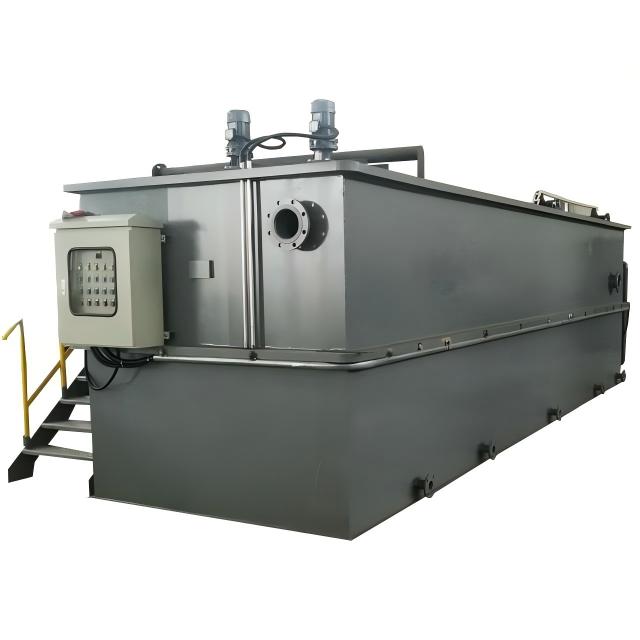
Industrial wastewater DAF systems should not be selected from flow rate alone.
Two plants may both treat 50 m³/h, yet require very different DAF configurations because their suspended-solids load, oil and grease content, wastewater variability, chemical conditioning and downstream treatment objectives are different.
Before selecting a DAF model, the first step is therefore to define the hydraulic load, solids load, flotation duty and process conditions.
Quick Answer
To make a preliminary DAF selection, start with average and peak flow, TSS, oil and grease where relevant, wastewater variability, pH and temperature, chemical-treatment conditions, required effluent quality and the expected sludge load.
Flow determines only part of the hydraulic requirement. TSS and other floatable solids determine the solids load, while coagulation and flocculation performance affect how readily contaminants can be separated.
The 8 Data Groups to Check Before DAF Selection
Project Data | What to Provide | Why It Matters |
|---|---|---|
Flow | Average flow, peak flow, operating hours | Defines hydraulic duty and peak operating condition |
Suspended Solids | Influent TSS and expected variation | Determines the solids mass entering the DAF |
Oil & Grease | O&G / FOG concentration where relevant | Important for food, meat, dairy, oily and similar wastewater |
Wastewater Chemistry | pH, temperature and relevant contaminants | Can affect coagulation, floc formation and flotation conditions |
Chemical Treatment | Existing or proposed coagulant/flocculant | Affects whether suitable floatable flocs can be formed |
Treatment Target | Required outlet TSS, O&G or downstream requirement | Defines what the DAF is expected to accomplish |
Sludge | Expected float solids and sludge handling method | DAF also creates a sludge-handling requirement |
Process Position | What comes before and after the DAF | Determines whether DAF is pretreatment, polishing or another process stage |
1. Start With Average Flow — But Do Not Stop There
The first number normally provided in a DAF inquiry is flow rate.
It is necessary, but it is not sufficient.
For a continuous industrial wastewater plant, the supplier should know both the normal operating flow and the maximum flow that the DAF may actually receive.
A factory producing wastewater for only 8 or 12 hours per day can have a very different instantaneous flow from another plant reporting the same daily wastewater volume over 24 hours.
An equalization tank can also change the design condition substantially. If wastewater is collected and discharged to the DAF at a controlled rate, the flotation unit may see a much more stable hydraulic load than the production process itself.
A useful inquiry should therefore distinguish between:
Daily wastewater volume → operating hours → average feed rate → expected peak feed rate
2. Convert TSS Into an Actual Solids Load
A DAF is separating solids and floatable material, so the amount of material entering the unit matters just as much as the water flow.
A simple first check is:
Solids Load (kg/h) = Flow (m³/h) × TSS (mg/L) ÷ 1,000
For example, consider two plants that both require a DAF for 50 m³/h.
Condition | Plant A | Plant B |
|---|---|---|
Flow | 50 m³/h | 50 m³/h |
TSS | 200 mg/L | 2,000 mg/L |
Approx. TSS Load | 10 kg/h | 100 kg/h |
The hydraulic flow is identical, but the incoming suspended-solids load differs by a factor of ten.
This is why selecting a DAF simply from a catalogue capacity such as “50 m³/h” can be misleading.
Important
If TSS changes significantly between production shifts, cleaning cycles or product batches, provide a range rather than only one laboratory result.
3. Tell the Supplier Whether the Wastewater Contains Oil or Grease
DAF is often considered where wastewater contains suspended solids together with fats, oils, grease or other floatable material.
Typical applications may include food processing, slaughterhouses, dairy, edible-oil processing, metalworking and selected oily industrial wastewater streams.
For these applications, useful project data include both TSS and an available oil-and-grease or FOG measurement, together with information about whether the oil is free, dispersed or strongly emulsified.
A wastewater stream containing easy-to-float free oil is not the same separation problem as a stable emulsion that requires chemical destabilization before flotation.
Therefore, “oily wastewater” by itself is not enough information for equipment selection.
4. Coagulation and Flocculation Can Change the DAF Duty
Many industrial DAF systems work together with chemical conditioning.
Coagulants can destabilize fine or colloidal material, while flocculants help form larger aggregates that can interact more effectively with the flotation process.
The actual response depends on the wastewater.
The DAF should therefore not be selected by assuming that one fixed PAC or polymer dosage will work for every project.
Useful information includes:
- current chemical program
- dosing point
- approximate dosage, if known
- pH adjustment
- previous jar-test results, if available
- actual operating experience
Practical Rule
Do not use a chemical dose copied from another wastewater plant as the design basis for a new project.
Where wastewater characteristics are uncertain, representative testing should be used to evaluate conditioning before final performance expectations are set.
HydroNovus also provides automatic polymer dosing systems for projects where chemical preparation and dosing are part of the treatment process.
5. Where Does the DAF Sit in the Treatment Process?
DAF equipment should always be evaluated as part of a treatment train.
Typical Industrial Wastewater Pretreatment
Industrial Effluent ↓ Screening ↓ Equalization ↓ pH Adjustment ↓ Coagulation / Flocculation ↓ DAF ↓ Biological Treatment ↓ Final Treatment / Discharge or Reuse
Sludge Side Stream
DAF Float Sludge ↓ Sludge Storage / Thickening ↓ Conditioning ↓ Dewatering
For a broader view of how these stages work together, see Industrial Effluent Treatment Plant Process Design.
6. Define What the DAF Is Expected to Achieve
“Need a DAF” is not yet a complete process requirement.
The engineer needs to know what comes after the DAF and why the flotation stage is being installed.
For one project, the objective may be to reduce suspended solids and oil before biological treatment.
For another, the objective may be to reduce the loading on an existing treatment system.
In another project, the DAF may be used after chemical precipitation or as a polishing separation step.
The target should therefore be expressed as:
Influent condition → required DAF outlet condition → downstream process
This is more useful than asking for a generic “removal efficiency”.
HydroNovus does not recommend fixing a guaranteed removal percentage before the wastewater characteristics, chemical response and treatment target have been reviewed.
7. What Happens After the Project Data Is Collected?
Once the wastewater data are available, preliminary DAF selection normally involves several related checks.
Engineering Check | Main Question |
|---|---|
Hydraulic Loading | Is there sufficient flotation area for the design and peak water flow? |
Solids Loading | Can the flotation zone handle the incoming solids mass? |
Air-to-Solids Condition | Is sufficient dissolved air available relative to the solids that must be floated? |
These parameters interact with one another, which is another reason a nominal flow-rate catalogue selection is not enough.
The final values should be based on the actual wastewater duty and selected DAF configuration rather than copied from a generic online table.
Common DAF Selection Mistakes
Mistake | Better Approach |
|---|---|
Selecting only by m³/h | Check hydraulic and solids loading together |
Providing only COD | Also provide TSS, O&G where relevant and treatment target |
Ignoring peak flow | Confirm production cycle and actual feed pattern |
Assuming a fixed chemical dosage | Use project-specific chemical or jar-test information |
Ignoring wastewater temperature | Include actual operating temperature |
Treating DAF as an isolated machine | Review upstream conditioning and downstream treatment |
Forgetting float sludge | Define sludge collection and downstream handling |
Requesting guaranteed efficiency before testing | First characterize the wastewater and separation duty |
What Should You Send Before Requesting a DAF Quotation?
For a useful preliminary DAF review, send the following project information in one package.
Flow
- daily wastewater volume
- average flow
- peak flow
- operating hours
Wastewater
- TSS
- oil and grease / FOG where relevant
- COD and BOD if available
- pH
- temperature
- wastewater source
Process
- upstream screening or equalization
- existing chemical treatment
- downstream biological or polishing process
Treatment Target
- required outlet condition
- discharge or reuse requirement
- reason the DAF is being added
Sludge
- current or planned float-sludge handling method
- downstream thickening or dewatering arrangement if known
Site Conditions
- available footprint
- installation constraints
- electrical standard
- preferred automation level
If some values are not yet available, mark them as Missing rather than estimating them as confirmed project data.
Recommended Project Submission Format
Status | Example |
|---|---|
Confirmed | Average flow = 30 m³/h |
Range | TSS = 800–1,400 mg/L |
Target | Reduce solids load before biological stage |
Missing | Peak flow not yet measured |
To Be Tested | Polymer type and dosage |
This small distinction makes technical discussions faster and reduces the risk of selecting equipment from assumed data.
Frequently Asked Questions
Can I select a DAF system from flow rate alone?
No. Flow is required for hydraulic sizing, but TSS, oil and grease where relevant, peak conditions, chemical conditioning and treatment targets also affect the flotation duty.
Is COD enough to size a DAF?
No. COD is useful for understanding the overall wastewater load, but it does not directly show how much suspended or floatable material must be separated. TSS and other relevant solids or oil data are still required.
Does every DAF require polymer?
Not necessarily in exactly the same way. The required coagulation and flocculation program depends on wastewater characteristics and the separation target. Chemical selection should therefore be evaluated for the actual wastewater rather than assumed.
Should DAF be installed before biological treatment?
It often serves as industrial pretreatment where solids, oil or chemically separable material need to be removed before biological treatment, but the correct process position depends on the overall treatment objective.
Can HydroNovus select a DAF if some data are missing?
A preliminary discussion is possible, but the missing information should be identified explicitly. Final model selection or performance commitments should wait until the critical wastewater and hydraulic conditions are sufficiently defined.
Technical basis and project limitations
The worked flow-and-TSS values in this guide are illustrative mass-balance calculations, not DAF performance guarantees. US EPA technical guidance identifies solids and hydraulic loading, air-to-solids ratio, operating pressure, recycle ratio and chemical aids as relevant DAF variables. Project data should cover representative operating states or production batches, not only one convenient sample. Sources: US EPA dissolved-air-flotation technical reference; US EPA centralized-waste-treatment development document.
Related Equipment and Technical Resources
Planning a DAF System for Industrial Wastewater?
Do not start with a model number.
Send us your flow, TSS, oil and grease data, wastewater source, chemical-treatment information and required outlet condition.
HydroNovus can provide a preliminary, non-binding data-gap and treatment-duty review, identifying missing inputs and the DAF configuration questions that require project-specific confirmation. This is not a final design or performance guarantee.
Project data available? Send the wastewater analysis and process flow for a preliminary review.