From Jar Test to Full-Scale DAF Dosing: How to Scale Up the Dose
Scale a DAF jar test dose to full scale: convert mg/L to kg/day using flow, set the pump rate, and trim the dose at commissioning.
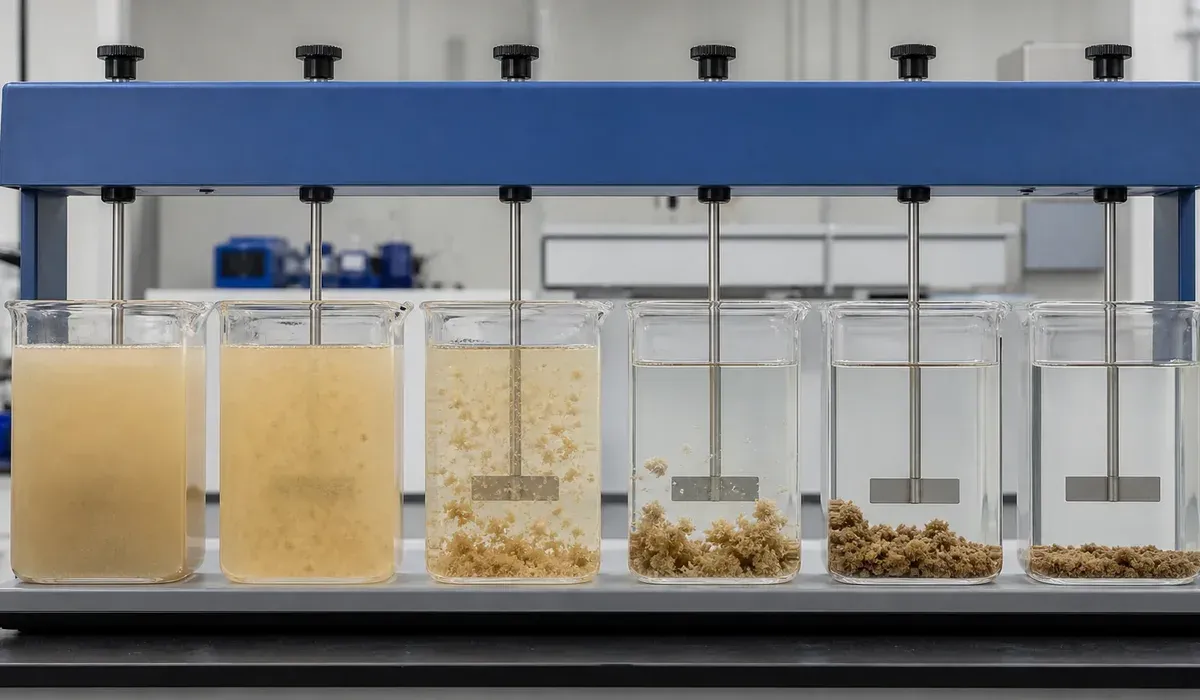
A jar test gives you a dose in milligrams per litre. The plant needs a number in kilograms per day and a pump setting in litres per hour. The conversion itself is simple arithmetic: dose (mg/L) multiplied by flow (m³/day) gives product use directly in grams per day. What is not simple is expecting the jar-test dose to be exactly right at full scale — treat it as the starting point for commissioning, then trim it in small steps while watching the float blanket and the treated water.
If you have not run the bench test yet, start with our guide to jar testing before DAF, which covers pH, coagulant and polymer selection on the bench. This article picks up where that one stops: turning the winning beaker into a plant dosing rate.
What exactly did the jar test give you?
Before converting anything, be clear about what your jar-test number refers to, because three different numbers are often confused:
- Product dose or active dose? A jar test recorded as “40 mg/L PAC” may mean 40 mg/L of the commercial liquid product, or 40 mg/L expressed as active content. Commercial coagulants vary in strength, so the two are not interchangeable. Convert using the same basis the jar test used, and write that basis on the dosing sheet.
- Coagulant and polymer are separate numbers. Scale each one independently. The coagulant is usually dosed as supplied; the polymer is dosed as a made-down solution, so its conversion has an extra step (see the worked example).
- The dose belongs to one wastewater sample. It reflects the pH, temperature, solids and oil load of the sample you tested. If production changes, the number ages — more on that below.
Getting the chemical to the plant also depends on the dosing hardware being sized for the rate you calculate; our article on chemical dosing system sizing covers pump range, tank volume and make-down capacity.
The conversion: from mg/L to kg/day to a pump setting
The core formula is:
Product use (kg/day) = dose (mg/L) × flow (m³/day) ÷ 1,000
This works because 1 mg/L is the same as 1 g/m³. Multiply grams per cubic metre by cubic metres per day and you get grams per day; divide by 1,000 for kilograms.
| Step | Calculation | What you get |
|---|---|---|
| 1. Confirm the dose basis | Jar-test dose, stated as product or as active content | A dose in mg/L you can trust |
| 2. Convert to daily product use | Dose (mg/L) × flow (m³/day) ÷ 1,000 | Product use in kg/day |
| 3. Convert to an hourly rate | kg/day ÷ operating hours per day | kg/h the pump must deliver |
| 4. For made-down polymer | Dry polymer (kg/day) ÷ solution strength (e.g. 0.2% = 0.002) | Solution use in kg/day (≈ L/day) |
| 5. Set the pump | Solution L/day ÷ operating hours | Pump setting in L/h |
| 6. Verify against the pump curve | Check the setting sits inside the pump's controllable range, not at its extreme ends | A rate the pump can actually hold |
Use the flow the dosing system will actually see. If the DAF runs 16 hours a day rather than 24, the hourly pump rate must be based on 16 hours even though the daily product total is unchanged. If flow varies strongly through the day, pace the dosing to flow where the controls allow it, rather than fixing one rate against a swinging load.
Worked example (example values only)
The following numbers are example values chosen to show the arithmetic — they are not a recommendation for any specific wastewater.
- Jar-test result (example): coagulant dose 40 mg/L as commercial product; polymer dose 1.5 mg/L as dry polymer.
- Plant flow (example): 600 m³/day, DAF operating 24 h/day.
Coagulant:
40 mg/L × 600 m³/day ÷ 1,000 = 24 kg/day of product, i.e. 1.0 kg/h. The dosing pump is set to deliver that rate, corrected for the product's density if the pump is calibrated volumetrically.
Polymer:
1.5 mg/L × 600 m³/day ÷ 1,000 = 0.9 kg/day of dry polymer.
Made down at 0.2% solution strength (example): 0.9 ÷ 0.002 = 450 kg/day of solution, roughly 450 L/day, or about 19 L/h at the dosing point.
Note how the polymer number moves if the make-down strength changes: the same 0.9 kg/day of dry polymer at 0.1% strength becomes 900 L/day of solution. The dry-polymer rate is the invariant; the solution rate is whatever your make-down unit produces. Our article on polymer dosing for DAF and sludge dewatering covers make-down and dosing arrangements in more detail.
Why the jar dose rarely transfers exactly
Even with perfect arithmetic, the plant is not a row of beakers. Expect the full-scale optimum to sit somewhat above or below the jar figure, for reasons that have nothing to do with calculation errors:
- Batch versus continuous mixing. In a beaker, the coagulant is flash-mixed into the whole sample at once and every particle sees roughly the same conditions. In a continuous system, mixing depends on the injection point, pipe or mixer conditions and contact time before flotation. Poor mixing wastes chemical; the jar cannot tell you that.
- Flow and load variation. The jar test is a snapshot. Production wastewater swings with shifts, washdowns and batch discharges, so a dose tuned to the average sample under-doses the peaks and over-doses the quiet periods.
- Polymer make-down and ageing. Bench polymer is usually fresh and fully dissolved. Plant solution may be under-mixed, over-aged in the tank, or degraded by excessive shear in pumps and pipes — all of which make the same nominal dose behave weaker at full scale.
- Temperature differences. A sample tested warm in the laboratory behaves differently from cold wastewater in winter; floc formation and float behaviour both shift.
- Sample representativeness. If the jar sample was taken from a settling tank outlet rather than the raw stream, or during a clean production run, the dose belongs to that water — not to the worst water the DAF will see.
Which coagulant you are scaling matters here as well; our companion guide to choosing a coagulant for DAF — PAC, ferric or alum explains how the products differ in strength and handling, which is exactly why the dose basis in step 1 has to be explicit. (That companion article was published earlier today in this same batch, so its URL is already live.)
Trimming the dose during commissioning
The following is common commissioning practice, to be confirmed against your own plant and chemical supplier's guidance:
- Start at the jar-test dose. It is the best evidence-based starting point you have.
- Change one variable at a time, in small steps — a few percent of the dose at a time is typical — and hold each step long enough for the change to travel through the system and show itself in the float and the treated water.
- Watch the float and the water, not just the pump display. A float blanket that forms well, holds together and skims cleanly, over visibly clearer treated water, is the signal you are close. A thin, broken float with cloudy water suggests under-dosing or a mixing problem; heavy chemical use with no visible improvement suggests the limit is elsewhere — check pH and mixing before adding more chemical.
- Record every step. Note dose, flow, pH and what the float looked like. Within a few days this log becomes your operating window, and it is far more valuable than the original jar sheet.
- Treat large deviations as a diagnosis prompt. If the plant needs far more chemical than the jar test predicted, suspect mixing, injection point, polymer quality or a changed wastewater before accepting the higher dose as normal.
The dosing rate you settle on also feeds chemical storage and consumption planning for the DAF system itself, so it is worth recording alongside the plant's other operating data.
When to go back to the bench
Re-run the jar test rather than endlessly trimming when: production changes the wastewater character; a new chemical product or supplier replaces the old one; the seasons change operating temperature significantly; or the float behaviour changes in a way dose adjustments cannot correct. A fresh set of beakers is cheaper than weeks of guessing at the pump.
Frequently asked questions
How do I convert a jar test dose in mg/L to kg/day?
Multiply the dose in mg/L by the flow in m³/day and divide by 1,000. Because 1 mg/L equals 1 g/m³, the result is the product use in kg/day, on the same basis (product or active) as the jar-test dose.
Should the full-scale dose be higher than the jar test dose?
Not automatically. Continuous mixing, flow variation and polymer condition can push the real optimum either way. Start at the jar dose and trim in small steps during commissioning, judging by float quality and treated-water appearance.
How do I scale up a polymer dose from a jar test?
Scale the dry polymer first: dose (mg/L) × flow (m³/day) ÷ 1,000 gives kg/day of dry polymer. Then divide by your make-down strength (for example 0.002 for a 0.2% solution) to get the solution volume the pump must deliver per day.
Why is my DAF using more chemical than the jar test predicted?
The usual causes are mixing and injection conditions, polymer that is under-dissolved or aged, flow and load peaks the sample did not capture, and temperature differences. Check those before accepting a permanently higher dose.
Next step
If you are sizing a new installation or re-checking the dosing on an existing one, send us your jar-test results, flow and operating hours through the contact page — we will run a free sizing, quantity and sample check against your numbers and flag anything that does not add up before you commit to a dosing setup.