Diffuser Membrane Replacement: EPDM vs Silicone — and When to Retrofit Another Brand's Body
EPDM vs silicone diffuser membranes: when to replace, clean or retrofit another brand's body — sizes, costs and compatibility checks.
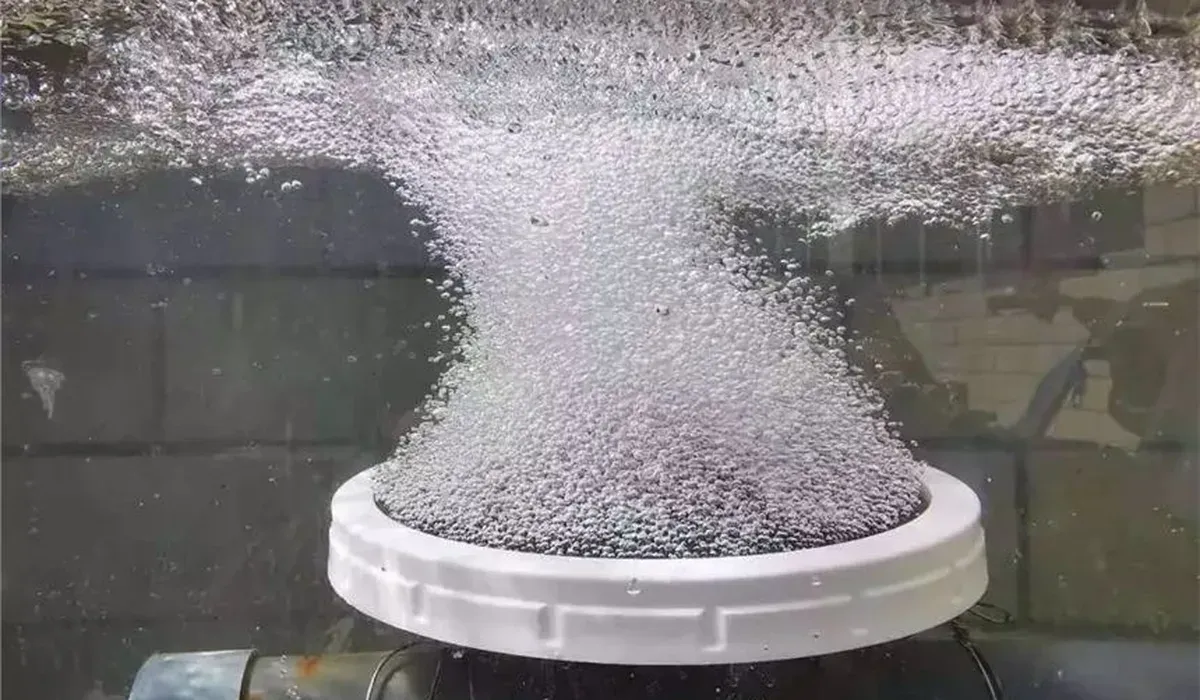
Replace the membrane when it can no longer hold fine bubbles at normal pressure — not on a calendar date alone. In most municipal and industrial basins, a disc membrane lasts 3 to 7 years in normal duty — the conservative peer band. EPDM is the right default for most plants. Silicone earns its higher price only where the wastewater attacks EPDM. A membrane from another brand fits only if diameter, air connection, and seat all match — measure all three first.
Signs the Membrane Is Finished
Rising dynamic wet pressure is the earliest reliable warning. When the blower must push harder to deliver the same airflow, the slits are stiffening, scaling, or partly blocked. Log pressure at a fixed airflow against the commissioning baseline. A slow climb is ageing; a sudden jump may still be reversible.
Big bubbles are the visible confirmation. When slits tear, stretch, or stay open, air escapes in coarse bursts. Oxygen transfer falls, because coarse bubbles have far less surface area, and the blower works harder for less dissolved oxygen. Uneven dissolved oxygen tells the same story: one grid delivers, the next does not, and the operator raises airflow everywhere. See fine-bubble diffuser fouling troubleshooting.
Suppliers disagree on membrane life, and sometimes with themselves. One quotes 5 to 8 years in one place and 8 to 10 in another; another claims more than 10. Those are supplier claims, usually for clean water and gentle duty. The 3-to-7-year band used here is the conservative end of what peers publish.
Clean or Replace? A Decision Rule
Clean first when the decline is recent, the membrane is within its expected life, and the cause is on the surface. Scale, biofilm, and grease build up outside the membrane and inside the slits. Acid cleaning can dissolve carbonate scale, and an air purge can clear loose deposits. If pressure returns near baseline, it was fouling — adjust the cleaning interval.
Replace when cleaning does not restore performance. Clean one grid and measure pressure and bubble pattern before and after. If the cleaned membrane still runs well above baseline, still makes coarse bubbles, or still leaks at the edge, its rubber has aged past recovery. The same applies after chemical damage: solvents or hot oil change the rubber itself, and no wash reverses that. Age is a tiebreaker — a year-six membrane with partial recovery is due for planned replacement, while a year-two one with the same symptoms means something in the water is attacking it.
Membrane-Only vs Whole-Diffuser Replacement: The Cost Math
Membrane-only replacement wins whenever the body is sound. The body is the expensive, awkward part to change: breaking pipe connections, handling the full diffuser, often lifting a grid. A membrane is a rubber part with a retaining ring or clamp. Swapping it reuses the plate, the support, and the connection, and it can be done during a normal shutdown without touching the air header.
Whole-diffuser replacement is right in four cases: a damaged body, a failed retaining system, a connection that no longer matches, or a design whose spares are no longer made.
Judge total cost, not unit price. A membrane-only change costs the membrane plus labour and a share of the shutdown. A whole-diffuser change adds the body, the fitting, and more handling — but it resets every wear point at once. The wrong economy saves on the part and spends it on a second shutdown when the reused body fails. If more than a third of a grid's bodies show damage or worn seats, price the job both ways.
Choosing the Membrane Material
Match the rubber to the water first, then compare price and life.
| Material | Where it fits | Watch out for |
|---|---|---|
| EPDM | Standard for municipal wastewater and most industrial effluents; lowest price | Oils, greases, and hydrocarbon solvents, which can swell it |
| Silicone | Hot wastewater, wide temperature swings, plants where EPDM ages too fast | Higher price; wears faster under abrasion |
| PTFE-coated | Sticky or scaling wastewater where fouling is the main cost — the coating resists deposits | Higher price; damage to the coating removes the benefit |
| Polyurethane | Abrasive, high-solids duty where toughness matters most | Narrower chemical resistance; check compatibility first |
EPDM is the default because it covers the most common case at the lowest cost. Its weakness is oils, fats, and petroleum products, so a plant with a regular grease load should not choose EPDM on price alone.
Silicone is the upgrade for heat and chemical margin, staying flexible over a wider temperature range. Buy it when EPDM is failing early from heat or from a chemical the plant cannot remove upstream — not as a general upgrade. It costs more.
PTFE-coated and polyurethane membranes are specialist choices. A PTFE coating fights fouling where scale or sticky deposits drive replacement; a torn coating is just an expensive membrane underneath. Polyurethane suits abrasive, high-solids water, but its chemical range is narrower — check it against the actual effluent, and trial one grid before committing a whole basin.
What to Measure Before Retrofitting Another Brand's Body
A membrane made for one maker's body will not necessarily fit another's, even when both are called a "9-inch disc diffuser." The names describe a size class, not a standard. Measure the body with the diffuser out of the water and clean.
Start with the diameter. Disc diffusers are commonly sold as 7-inch, 9-inch, and 12-inch units; tube diffusers commonly as 62 mm and 91 mm. Those numbers describe the membrane, not the seat, and two "9-inch" membranes can differ by several millimetres at the seal. Measure the seat diameter with calipers and ask the supplier for the sealing diameter of their membrane, not just its nominal size. A membrane a few millimetres too large wrinkles and leaks at the edge; one too small never reaches the seat.
Next, the air connection. Bodies connect to the header by a threaded nipple, a saddle clamp, or a push fitting, and thread size and pitch differ between makers. A membrane-only retrofit does not change the connection, which is why it is usually the safer retrofit: the body stays, so the pipework stays. Fitting another brand's whole diffuser is harder — confirm the thread, the sealing face, and the height above the header.
Then inspect the membrane seat: the surface the membrane seals against. Look for scoring, warping, and mineral buildup, and any step or groove the original membrane was shaped to match. Some bodies use a flat seat, others a shaped one a membrane must follow; a membrane made for one will not seal on the other. Photograph the seat, measure its diameter and depth, and send both to the supplier before ordering.
Finally, check the retaining system. The ring or clamp must match the membrane's edge thickness and the body's groove. A ring from the original maker may not grip a thicker replacement membrane, and a membrane that pulls off by hand at low pressure will lift in service. Order retaining parts with the membranes if they are worn; they are cheap, and a failed ring wastes a good membrane. When every dimension matches, a cross-brand retrofit can save sound bodies. When any one does not, stay with the original maker's membrane — or replace the body as well. See fine-bubble disc vs tube diffuser selection and retrievable aeration systems.
A Practical Replacement Sequence
Survey before the shutdown: inspect a sample from each grid and measure the seats and connections on the worst grid — that grid decides the order. Order membranes, rings, and gaskets together, with a small surplus. During the shutdown, clean the air header before fitting new membranes. Then fit, pressurise, and watch the bubble pattern on air before refilling; a leak found on air is a ten-minute fix, under water it is a second shutdown. Finally, record the baseline.
If pressure stays high on every grid with new membranes, the problem is upstream of the diffuser. See MBBR aeration sizing and aeration basin foam types, causes and fix.
FAQs
How long should a diffuser membrane last?
Plan on 3 to 7 years in normal municipal or industrial duty — the conservative peer band. Suppliers publish longer figures: one quotes 5 to 8 years in one place and 8 to 10 in another, and another claims more than 10. Those are supplier claims, usually for clean water and gentle duty.
Can I clean a diffuser membrane instead of replacing it?
Yes, when the problem is fouling on the surface rather than ageing of the rubber. Acid cleaning can remove carbonate scale, and an air purge or washdown can clear loose deposits. Clean a sample first and measure pressure before and after. If pressure returns close to baseline and bubbles even out, cleaning was the right call. If pressure stays high or bubbles stay coarse, replace the membrane.
Is silicone always better than EPDM?
No. Silicone is better where heat or chemical attack ages EPDM too fast, because it stays flexible over a wider temperature range. In ordinary municipal wastewater, EPDM performs well at a lower price, and silicone can wear faster in abrasive duty. Choose silicone for a named reason, not as a general upgrade.
Can I fit another brand's membrane on my existing diffuser body?
Sometimes, but only when the dimensions match. Measure the seat diameter, the air connection, and the retaining system, and confirm the replacement's sealing diameter and edge thickness before ordering. Disc sizes 7, 9, and 12 inches and tube sizes 62 and 91 mm are size classes, not standards. If any dimension does not match, stay with the original maker's membrane or replace the body as well.
For help matching a membrane to your existing diffuser bodies, or for a membrane-only quotation against your measured dimensions, contact HNS Watertech with the disc or tube size, the seat diameter, and a photo of the connection — we will confirm the fit before quoting.