Industry Solutions
Fine Bubble Diffuser Fouling: Why Pressure Rises and Oxygen Transfer Falls
Learn why fine bubble diffuser pressure rises, oxygen transfer falls and airflow becomes uneven—and what to check before replacing the aeration system.
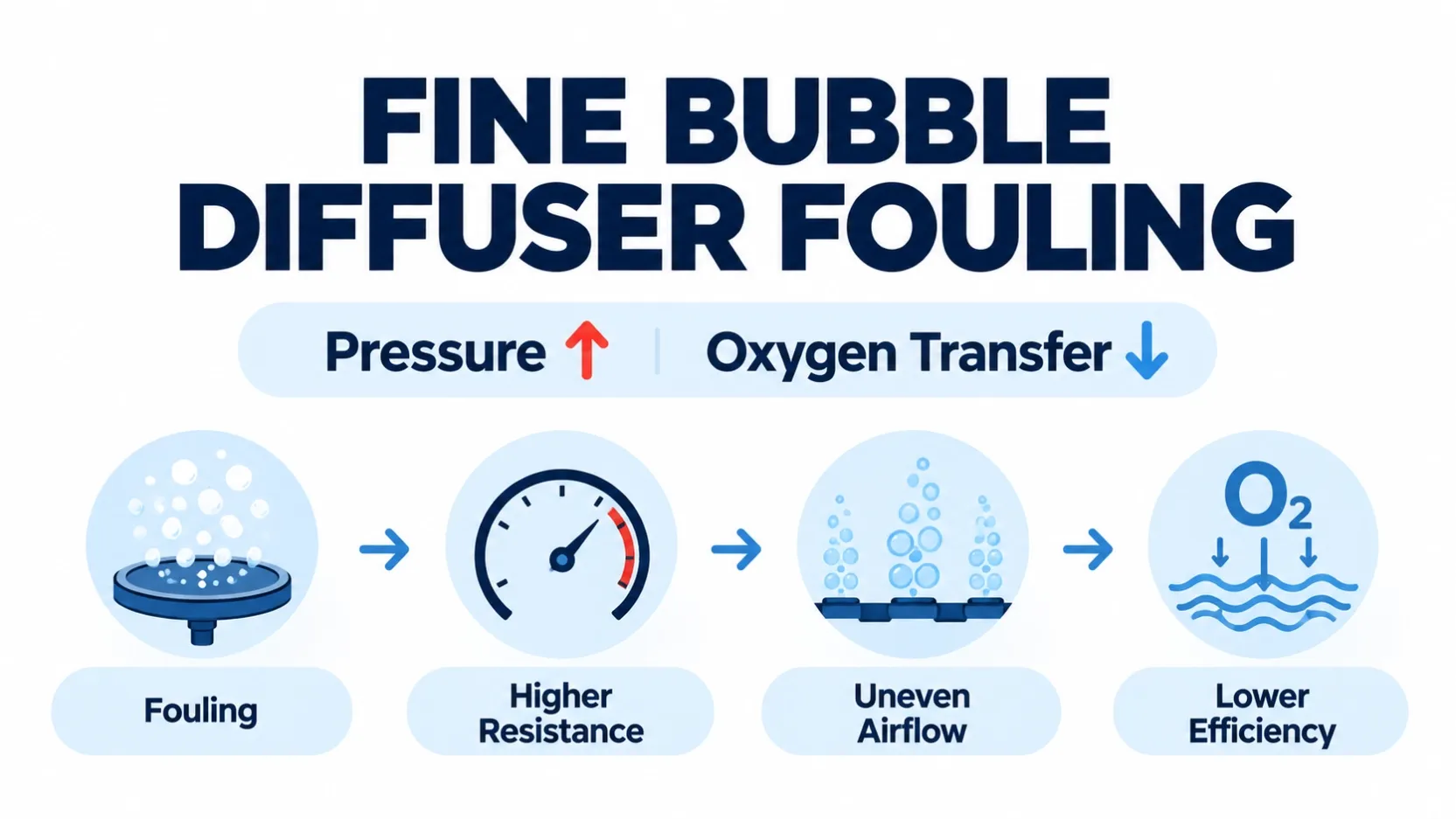
Fine Bubble Diffuser Fouling: Why Pressure Rises and Oxygen Transfer Falls
Fine bubble aeration systems are designed to transfer oxygen efficiently by releasing large numbers of small bubbles into wastewater.
But after months or years of operation, many plants begin to notice a familiar pattern:
- blower pressure rises
- airflow becomes uneven
- dissolved oxygen becomes harder to maintain
- energy consumption increases
- some diffuser zones appear weak or inactive
The immediate conclusion is often:
“The blower is too small.”
But the blower may not be the real problem.
The restriction may be developing at the diffuser membrane or inside the aeration system itself.
Quick Answer
When fine bubble diffusers become fouled, more pressure is required to push air through the membrane. At the same time, bubble distribution can become uneven and oxygen-transfer performance may decline.
The correct response is not automatically to install a larger blower.
First determine whether the problem comes from:
diffuser fouling, membrane aging, air-pipe restriction, poor airflow distribution, insufficient cleaning or an actual increase in process oxygen demand.
Why Diffuser Pressure Matters
A fine bubble diffuser creates resistance to airflow.
The blower must provide enough pressure to overcome several components:
Water Depth + Pipe Loss + Valve Loss + Diffuser Pressure Loss
If any one of these increases, the blower operating pressure increases.
The water depth normally changes very little.
Pipe losses also tend to remain relatively predictable unless valves, pipelines or headers become blocked.
But diffuser resistance can gradually increase as membranes become fouled or aged.
This is why rising blower discharge pressure can be an important maintenance signal.
What Happens When a Diffuser Becomes Fouled?
Fine bubble diffuser membranes contain many small openings that allow compressed air to pass into the wastewater.
During operation, these openings can gradually become affected by:
- biological growth
- mineral scaling
- chemical precipitation
- grease or oil
- suspended solids
- deposits from industrial wastewater
As deposits accumulate, airflow through the membrane becomes more difficult.
More pressure is then required to produce the same airflow.
Eventually, the aeration pattern may become visibly uneven.
Some diffusers continue operating normally while others produce fewer bubbles or larger bubbles.
Pressure Can Rise Before Operators Notice a DO Problem
Diffuser deterioration does not always begin with an immediate drop in dissolved oxygen.
The blower may initially compensate by operating at a higher pressure.
This means the plant can continue achieving its DO target while using more energy.
The early warning sequence can therefore look like this:
Diffuser Resistance Increases
↓
Blower Pressure Increases
↓
Energy Demand Increases
↓
Air Distribution Becomes Less Uniform
↓
Oxygen Transfer Begins to Decline
↓
DO Control Becomes Difficult
By the time operators notice low DO, the aeration system may have been operating inefficiently for some time.
Why Fouling Can Reduce Oxygen Transfer
Fine bubble aeration depends partly on producing many relatively small bubbles.
Small bubbles provide a large gas–liquid contact area and typically remain in the water longer than large bubbles.
When diffuser openings become fouled or damaged, the resulting bubble pattern may change.
Possible effects include:
- fewer active membrane openings
- uneven airflow
- larger bubbles
- localized high airflow
- inactive diffuser areas
- poorer tank mixing
The system may therefore consume more blower energy while delivering less effective oxygen transfer.
This is an important distinction:
More air supplied does not always mean more oxygen transferred efficiently.
Common Causes of Fine Bubble Diffuser Fouling
Biological Fouling
Wastewater contains microorganisms that can grow on submerged surfaces.
Biofilm can develop on the membrane surface and gradually restrict diffuser openings.
This is especially relevant in biological wastewater-treatment tanks where biomass concentration is high.
Mineral Scaling
Inorganic minerals can precipitate and form deposits on diffuser membranes.
Scaling risk depends on factors such as:
- wastewater chemistry
- hardness
- alkalinity
- pH
- temperature
- dissolved mineral concentration
Different industrial wastewater streams can therefore create very different fouling conditions.
Chemical Precipitation
Chemical dosing upstream of the aeration tank can also contribute to deposits.
Examples may include precipitated:
- metal salts
- phosphorus-removal chemicals
- lime-related deposits
- other inorganic solids
The full treatment process should therefore be reviewed when unexplained diffuser scaling appears.
Oil and Grease
Wastewater containing oils, fats or grease can affect membrane surfaces.
This is particularly relevant in some food-processing, industrial and high-FOG wastewater applications.
Pretreatment performance may therefore influence long-term aeration reliability.
Membrane Aging Is Different From Fouling
Not every diffuser problem can be solved by cleaning.
Diffuser membranes operate continuously under:
- pressure
- stretching
- wastewater exposure
- chemical exposure
- temperature variation
Over time, the membrane material can change.
Depending on the membrane material and operating conditions, aging may cause:
- loss of elasticity
- hardening
- permanent deformation
- cracking
- uneven opening behaviour
A heavily aged membrane may still have poor performance after deposits are removed.
Therefore, operators should distinguish between:
Fouling → potentially cleanable
and
Material aging → may require membrane or diffuser replacement
EPDM and Silicone Membranes Behave Differently
Fine bubble diffusers are commonly supplied with EPDM or silicone membranes.
Neither material is universally superior.
Selection depends on wastewater chemistry and operating conditions.
HydroNovus supplies both options through its Fine Bubble Disc Diffuser – EPDM & Silicone and Fine Bubble Tube Diffuser – EPDM or Silicone ranges.
When replacing existing membranes, do not select material only by purchase price.
Review:
- wastewater chemistry
- oil or solvent exposure
- temperature
- cleaning method
- operating pressure
- previous failure mode
The best replacement material depends on what caused the original diffuser problem.
How to Recognize a Fouled Aeration System
Several symptoms often appear together.
Observation | Possible Interpretation |
|---|---|
Blower pressure gradually increases | Diffuser or piping resistance may be increasing |
DO decreases at similar airflow | Oxygen-transfer efficiency may have declined |
Airflow becomes uneven across tank | Distribution or diffuser resistance differs by zone |
Large bubbles appear locally | Membrane damage or abnormal opening behaviour |
Some diffuser areas appear inactive | Severe fouling, valve issue or blocked lateral |
Blower energy rises | System is working harder to overcome resistance |
Pressure rises after long operating period | Fouling or membrane aging becomes more likely |
One zone differs strongly from others | Check valves, headers and diffuser condition locally |
One measurement alone is rarely enough.
Pressure, airflow, dissolved oxygen and visual aeration pattern should be considered together.
Do Not Assume the Diffuser Is Always the Problem
High pressure can also come from other parts of the aeration system.
Before replacing diffusers, check:
Air Filters
A blocked blower intake filter reduces system performance and can affect blower operation.
Air Headers and Laterals
Internal corrosion, deposits or foreign material can restrict airflow.
Valves
Partially closed, damaged or incorrectly balanced valves can produce large differences between aeration zones.
Condensate
Water accumulation inside air piping can create additional resistance or uneven airflow.
Blower Condition
The blower itself should also be checked against its operating curve and maintenance condition.
This prevents unnecessary diffuser replacement when the real problem lies elsewhere.
Is the Process Simply Demanding More Oxygen?
Another common diagnostic mistake is to assume that declining DO always means the aeration hardware has deteriorated.
The biological oxygen demand may have increased.
Possible reasons include:
- higher wastewater flow
- higher BOD/COD
- increased ammonia load
- higher production
- changed wastewater composition
- increased biomass concentration
- seasonal temperature changes
Therefore, compare current plant loading with the conditions under which the aeration system was originally selected.
If process load has increased substantially, even clean diffusers may no longer provide sufficient oxygen-transfer capacity.
A Practical Troubleshooting Sequence
A useful diagnostic sequence is:
Step 1 — Compare Blower Pressure
Check current discharge pressure against historical operation.
Step 2 — Check Airflow
Determine whether total airflow has changed.
Step 3 — Check DO
Compare dissolved oxygen across different reactor zones.
Step 4 — Observe Bubble Distribution
Look for large bubbles, dead zones or visibly weak diffuser areas.
Step 5 — Check Valves and Piping
Confirm air distribution and eliminate obvious mechanical restrictions.
Step 6 — Review Wastewater Loading
Determine whether biological oxygen demand has increased.
Step 7 — Inspect Diffusers
If possible during maintenance shutdown, inspect the membrane for fouling, scaling, hardening or damage.
Only after these checks should the plant decide whether it needs:
- cleaning
- membrane replacement
- complete diffuser replacement
- air-distribution adjustment
- blower upgrade
- aeration-system redesign
Cleaning vs Replacement
Cleaning may make sense when the diffuser structure remains mechanically sound and the main problem is removable fouling.
Replacement becomes more appropriate when:
- membranes are severely aged
- elasticity has been lost
- cracking is visible
- diffuser bodies are damaged
- pressure loss remains high after cleaning
- bubble distribution remains poor
- the existing diffuser no longer matches process requirements
A plant should compare cleaning cost, downtime and expected remaining service life against replacement cost.
Disc Diffuser or Tube Diffuser?
Both designs can provide fine bubble aeration.
The better choice depends on tank geometry, installation arrangement and maintenance strategy.
Disc Diffusers
Often used in grid-style bottom aeration systems and can provide flexible diffuser layouts.
Tube Diffusers
Can provide greater membrane area per individual diffuser and may suit certain header and tank layouts.
The decision should be made together with:
- required airflow
- tank dimensions
- water depth
- diffuser density
- maintenance access
- wastewater characteristics
Aeration Is Also Critical in MBBR Systems
In an aerobic MBBR reactor, the aeration system performs two important functions:
oxygen transfer and media movement.
If diffuser performance declines, an MBBR system may therefore experience both:
- reduced biological oxygen availability
- poorer carrier circulation
This makes aeration condition particularly important when evaluating existing MBBR performance.
For media-selection considerations, see Why Specific Surface Area Alone Is Not Enough to Select MBBR Media.
For preliminary carrier-volume calculations, see How to Calculate MBBR Media Volume: Load, SALR, Fill Ratio and Reactor Volume.
Data Needed Before Recommending Replacement Diffusers
Before replacing an existing aeration system, collect:
Item | Information Needed |
|---|---|
Application | Municipal, industrial, MBBR, equalization, etc. |
Tank dimensions | Length, width, effective water depth |
Existing diffuser | Disc/tube, size, quantity, membrane |
Airflow | Total and per diffuser if available |
Blower | Flow, pressure, quantity |
Current pressure | Normal operating discharge pressure |
DO | Current dissolved oxygen |
Wastewater | BOD/COD, ammonia, TSS, pH, temperature |
Problem | High pressure, low DO, uneven bubbles, membrane damage |
Operating age | Approximate diffuser service time |
Cleaning history | Method and frequency |
Without these data, simply replacing the diffuser with another model may reproduce the same problem.
Common Aeration Retrofit Mistakes
Mistake | Better Approach |
|---|---|
Installing a larger blower immediately | Identify where pressure loss increased first |
Replacing membranes without inspecting wastewater chemistry | Determine the fouling mechanism |
Selecting diffusers only by lowest price | Compare pressure loss, membrane material and operating conditions |
Ignoring tank geometry | Design the full diffuser layout |
Assuming more airflow solves low DO | Check oxygen demand and transfer efficiency |
Cleaning severely aged membranes repeatedly | Compare remaining life with replacement |
Changing diffuser type without checking blower pressure | Match diffuser and blower operating conditions |
Frequently Asked Questions
Why is my blower pressure increasing?
Possible causes include diffuser fouling, membrane aging, blocked piping, valve restrictions or other increases in system resistance. Compare historical pressure and inspect the full air-distribution system before replacing equipment.
Can dirty diffusers reduce oxygen-transfer efficiency?
Yes. Fouling can restrict membrane openings, create uneven airflow and change bubble distribution, which can reduce effective oxygen transfer.
Should I increase blower pressure to compensate?
Increasing pressure may temporarily maintain airflow, but it does not remove the underlying restriction and may increase energy consumption. The cause of the pressure increase should be identified first.
Can fine bubble diffusers be cleaned?
Many fouling conditions can potentially be cleaned, depending on membrane material and deposit type. The cleaning method must be compatible with the membrane and diffuser material.
When should diffuser membranes be replaced?
Replacement should be considered when membranes are permanently hardened, cracked, deformed, mechanically damaged or remain inefficient after appropriate cleaning.
Which is better, EPDM or silicone?
The correct choice depends on wastewater chemistry, temperature, chemical exposure and operating conditions. Neither material is automatically better for every project.
Before Replacing Your Aeration System
A rising blower pressure does not automatically mean you need a bigger blower.
And falling dissolved oxygen does not automatically mean you need more diffusers.
The first task is to identify whether the limitation comes from:
process load, diffuser fouling, membrane aging, air distribution or blower capacity.
If you are evaluating an existing aeration system, send HydroNovus:
- tank dimensions and water depth
- diffuser type and quantity
- blower flow and pressure
- current operating pressure
- dissolved oxygen
- wastewater characteristics
- service age
- photos or video of the current bubble pattern