Industry Solutions
Why Specific Surface Area Alone Is Not Enough to Select MBBR Media
Learn why MBBR media should not be selected by surface area alone. Compare protected area, geometry, density, movement, aeration, retention and biological loading.
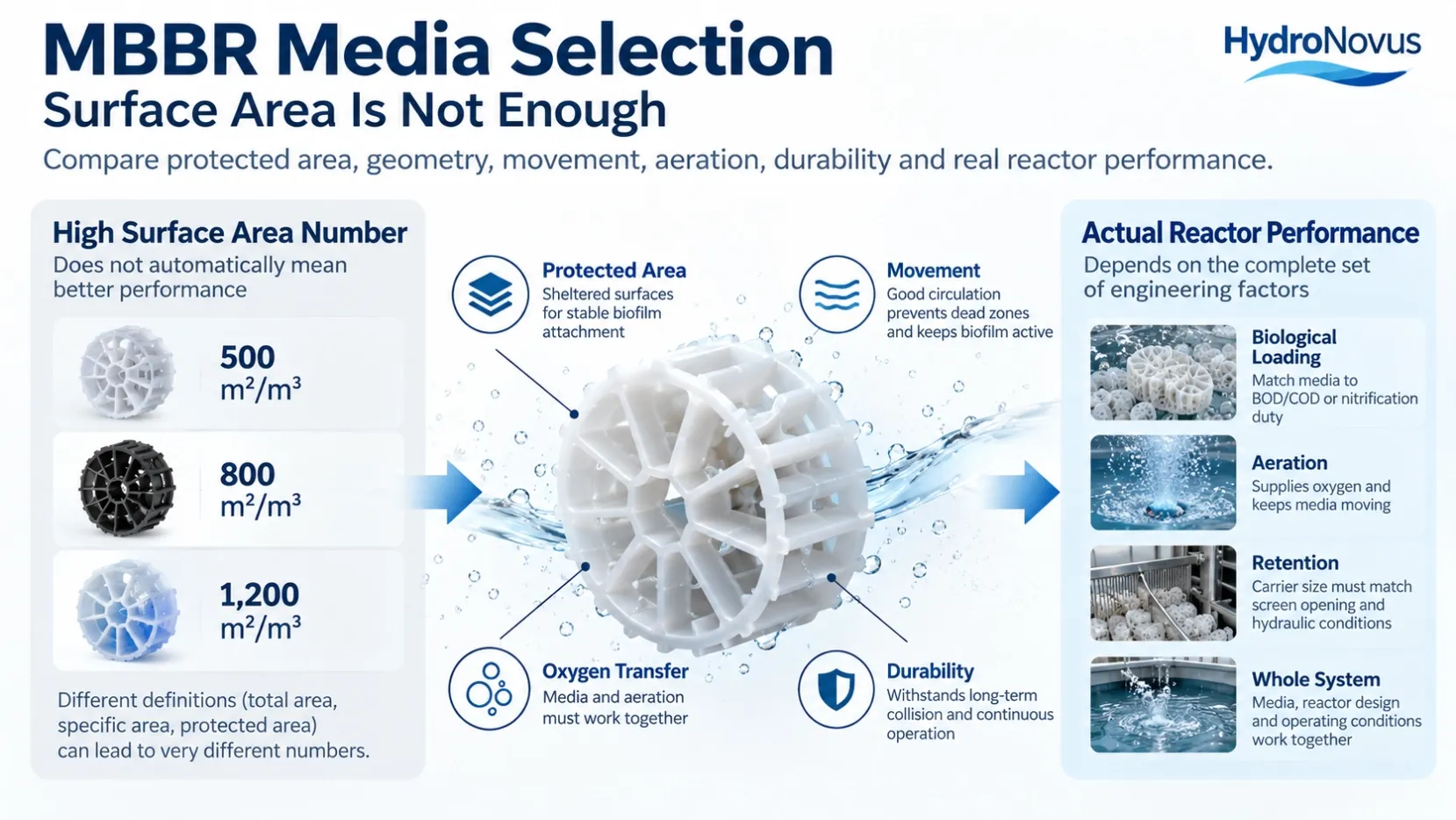
MBBR media is often compared using one number:
specific surface area, expressed in m²/m³.
It is an important parameter, but it should not be used as the only basis for carrier selection.
Two carriers may advertise very different surface-area values while also differing in geometry, protected area, movement, density, biofilm accessibility, mechanical durability and interaction with the aeration system.
The better question is therefore not:
Which MBBR media has the highest surface area?
It is:
Which carrier provides the biological surface, movement and operating characteristics required by this reactor?
Quick Answer
Higher specific surface area does not automatically mean better MBBR performance.
When comparing carriers, check what the quoted surface-area value actually represents, then evaluate protected biofilm area, carrier geometry, density, movement, aeration requirements, retention-screen compatibility, durability and the biological loading of the project.
Surface area tells you how much potential carrier area exists.
It does not tell you, by itself, how effectively that area will operate inside the actual reactor.
The 8 Factors to Compare Before Selecting MBBR Media
Selection Factor | What to Check | Why It Matters |
|---|---|---|
Surface Area Definition | Total, specific, protected or effective area | Different definitions can produce very different numbers |
Protected Biofilm Area | Sheltered internal carrier surfaces | Helps support stable attached biofilm |
Carrier Geometry | Diameter, depth, internal structure, openings | Affects biofilm accessibility and movement |
Density | Carrier density relative to water | Influences suspension and mixing |
Media Movement | Fluidization and distribution in the reactor | Poor movement can create dead zones |
Aeration Requirement | Oxygen transfer and mixing demand | Media and aeration must work together |
Mechanical Durability | Material, wall thickness and wear resistance | Carriers continuously collide during operation |
Retention Requirement | Carrier size vs screen opening and hydraulic duty | Prevents media loss without excessive head loss |
1. First Ask: What Does the Surface-Area Number Mean?
A supplier may state:
500 m²/m³
Another may state:
800 m²/m³
Another may advertise:
1,200 m²/m³ or more
It is tempting to assume that the highest number represents the highest biological capacity.
That conclusion can be misleading if the surface-area definitions are different.
MBBR datasheets may refer to:
- total surface area
- specific surface area
- protected surface area
- effective surface area
- nominal surface area
These terms should not automatically be treated as equivalent.
Before comparing two carriers, ask:
What exactly is included in the quoted m²/m³ value?
A meaningful comparison requires comparable definitions.
2. Protected Surface Area Is Different From Total Geometric Area
The outer and inner surfaces of an MBBR carrier do not necessarily experience the same operating conditions.
Carriers continuously move and collide inside the reactor.
Exposed external surfaces can experience stronger abrasion and shear, while recessed internal structures provide more protected locations for biofilm attachment.
That is why protected surface area is an important engineering concept when evaluating MBBR media.
The objective is not simply to maximize every square millimetre of plastic surface.
The objective is to provide usable surface where an active biofilm can develop under the intended reactor conditions.
Procurement Question
When comparing media quotations, ask the supplier:
Is the stated surface area total area or protected/design biofilm area?
If two suppliers are using different definitions, their numbers should not be directly compared.
3. Surface Area Only Becomes Useful When Combined With Biological Loading
The biological process determines how much carrier surface is actually required.
A preliminary design normally follows:
Wastewater Flow ↓ Pollutant Load ↓ Treatment Target ↓ Design Surface Loading ↓ Required Biofilm Area ↓ Media Volume
Therefore, carrier selection should begin with the biological duty.
For example, an MBBR may primarily be used for:
- BOD removal
- biodegradable COD removal
- ammonia nitrification
- combined carbon and ammonia treatment
- polishing
- biological retrofit
These duties should not automatically use the same design loading.
The relevant question becomes:
How much appropriate carrier surface is required for this biological load?
rather than:
Which carrier has the biggest number on its datasheet?
For the calculation sequence itself, see: How to Calculate MBBR Media Volume: Load, SALR, Fill Ratio and Reactor Volume
4. Carrier Geometry Influences More Than Surface Area
Carrier geometry determines how the media behaves in the reactor.
Important characteristics include:
- diameter
- carrier depth
- internal fins
- protected cells
- opening size
- wall thickness
- overall shape
A geometry designed only to maximize theoretical surface area can create other operating compromises.
For example, very small internal passages may be more sensitive to solids accumulation in some wastewater applications.
A dense or complex internal structure may also affect:
- water exchange
- oxygen penetration
- substrate transfer
- biofilm thickness
- carrier cleaning by shear
- long-term movement
Therefore, surface area and geometry should be evaluated together.
5. More Biofilm Is Not Automatically Better
The purpose of MBBR media is to support an active biofilm, not simply the maximum possible mass of attached biomass.
Substrate and oxygen must move from the bulk water into the biofilm.
If the biofilm becomes excessively thick, transport into deeper layers can become more difficult.
The continuously moving carrier helps create shear, which contributes to biofilm renewal.
This creates an important design balance:
Biofilm attachment + mass transfer + controlled shear
A carrier should therefore provide suitable protected locations for biofilm while still allowing water, substrate and oxygen to reach the active biological layer.
6. Media Movement Is Part of Carrier Performance
MBBR stands for Moving Bed Biofilm Reactor.
The word “moving” matters.
In an aerobic MBBR, the carriers should circulate throughout the reactor instead of:
- remaining at the surface
- accumulating in corners
- settling in dead zones
- forming stagnant media clusters
Good media movement helps expose the biofilm to:
- wastewater substrate
- dissolved oxygen
- changing hydraulic conditions
Carrier geometry and density both influence this movement.
The reactor itself also matters.
Media that moves well in one tank may behave differently in another because of:
- water depth
- tank shape
- diffuser arrangement
- aeration intensity
- filling ratio
- internal structures
Therefore, carrier movement should be considered as a media + reactor + aeration problem.
7. Density Influences Fluidization
MBBR carriers are normally designed to remain close to neutral buoyancy when operating with developed biofilm.
If a carrier is too buoyant, it may accumulate near the water surface.
If it is too heavy, more mixing energy may be needed to keep it moving.
But the dry-media density printed on a datasheet is still only one part of the picture.
Operating behaviour also changes after biofilm develops.
When comparing media, consider:
- raw carrier density
- carrier geometry
- expected biofilm development
- aeration pattern
- reactor hydraulics
The goal is not to select the lightest carrier.
The goal is stable, distributed movement under actual operating conditions.
8. Aeration and MBBR Media Must Be Selected Together
In an aerobic MBBR, aeration generally performs two jobs:
1. Supply oxygen to the microorganisms
2. Keep the carrier bed moving
Therefore, changing carrier type or increasing media quantity can affect aeration requirements.
Questions to check include:
- Is the existing blower capacity sufficient?
- Is enough air pressure available at operating water depth?
- Are the diffusers correctly positioned?
- Does the carrier circulate throughout the reactor?
- What dissolved oxygen is actually maintained?
- Will additional media reduce movement?
- Is the system carbon-removal or nitrification limited?
A project can theoretically have enough carrier surface area and still perform poorly if oxygen transfer or media mixing is inadequate.
This is particularly important in retrofit projects.
9. The Highest Surface Area May Not Be the Best Retrofit Media
When an existing tank has limited volume, selecting a higher-surface-area carrier may appear to be the easiest way to increase biological capacity.
Sometimes it can help.
But the retrofit should first identify the real limitation.
Possible limitations include:
- insufficient biofilm area
- insufficient aeration
- poor carrier movement
- excessive organic load
- low water temperature
- insufficient alkalinity for nitrification
- poor upstream solids removal
- hydraulic short-circuiting
- inadequate media retention
- overloading during peak production
If the existing process is oxygen-limited, replacing the media with a carrier quoting a larger m²/m³ value does not automatically solve the system problem.
Better Retrofit Question
What is currently limiting biological capacity?
Only after answering that question should higher-surface-area media be evaluated.
10. Wastewater Solids Can Affect Carrier Selection
Industrial wastewater and RAS systems do not all deliver the same solids environment to the biological reactor.
Relevant conditions can include:
- suspended solids
- fibers
- fats and oils
- biological flocs
- precipitated chemicals
- fine particulate material
Carrier geometry should therefore be considered together with upstream solids removal.
Media with small internal openings may behave differently in relatively clean secondary treatment than in wastewater containing significant suspended or fibrous material.
This is another reason a carrier cannot be selected from surface-area data alone.
11. Mechanical Durability Matters Over the Life of the Reactor
MBBR media continuously moves and collides with:
- other carriers
- tank surfaces
- screens
- internal structures
The carrier is therefore both a biological component and a mechanical component.
Useful quality checks include:
- polymer material
- manufacturing consistency
- wall thickness
- dimensional consistency
- structural integrity
- deformation resistance
- long-term wear resistance
A very high advertised surface area provides little value if the carrier geometry deforms or wears excessively during operation.
12. Do Not Forget the Media Retention Screen
Carrier selection affects the reactor outlet.
The retention screen must allow the required water flow to leave the reactor while keeping the carriers inside.
Before changing carrier size or type, check:
- carrier diameter
- smallest carrier dimension
- retention-screen opening
- screen area
- normal flow
- peak flow
- approach velocity
- fouling condition
- cleaning access
A smaller carrier may require a smaller screen opening.
That can influence hydraulic resistance and maintenance.
Therefore:
Carrier selection and retention-screen design are connected decisions.
MBBR Media Comparison: What Matters Beyond m²/m³?
Datasheet Item | Should You Check It? | Is It Enough Alone? |
|---|---|---|
Specific Surface Area | Yes | No |
Protected Surface Area | Yes | No |
Media Dimensions | Yes | No |
Density | Yes | No |
Material | Yes | No |
Fill Ratio | Yes | No |
Mechanical Strength | Yes | No |
Retention Requirement | Yes | No |
Aeration Requirement | Yes | No |
Biological Loading | Essential | No |
Complete Reactor Conditions | Essential | This is the real design context |
Common MBBR Media Selection Mistakes
Mistake | Better Approach |
|---|---|
Buying the carrier with the highest m²/m³ | First confirm how surface area is defined |
Comparing total area with protected area | Compare equivalent technical definitions |
Selecting media before calculating biological load | Define treatment duty first |
Ignoring carrier movement | Evaluate media together with aeration and tank geometry |
Assuming more biofilm is always better | Consider mass transfer and biofilm control |
Ignoring wastewater solids | Match carrier geometry to actual wastewater conditions |
Selecting solely by price per m³ | Compare required biological area and system impact |
Ignoring retention screens | Check carrier size and screen hydraulics together |
Adding higher-SSA media to a failing reactor | Identify the true process limitation first |
What Should You Ask an MBBR Media Supplier?
Before comparing quotations, ask for:
Carrier Specifications
- carrier dimensions
- material
- density
- surface-area definition
- protected/design surface area
- weight or pieces per unit volume where relevant
Application Conditions
Provide the supplier with:
- wastewater source
- average and peak flow
- BOD/COD
- ammonia or TAN
- required outlet quality
- temperature
- reactor volume
- existing process
Aeration Information
For an existing reactor:
- blower capacity
- operating pressure
- water depth
- diffuser type
- dissolved oxygen
- current carrier movement
Retrofit Information
Also provide:
- current media type
- current media volume
- existing fill ratio
- current treatment limitation
- reactor drawings or dimensions
- retention-screen information
Recommended Comparison Format
Instead of comparing quotations like this:
Supplier | Surface Area | Price |
|---|---|---|
A | 500 m²/m³ | — |
B | 800 m²/m³ | — |
C | 1,200 m²/m³ | — |
use a more complete comparison:
Parameter | Media A | Media B | Media C |
|---|---|---|---|
Surface-Area Definition | ? | ? | ? |
Protected Area | ? | ? | ? |
Geometry | ? | ? | ? |
Density | ? | ? | ? |
Material | ? | ? | ? |
Recommended Operating Conditions | ? | ? | ? |
Retention Requirement | ? | ? | ? |
Project Fit | To be reviewed | To be reviewed | To be reviewed |
A larger number becomes useful only when its definition and project relevance are clear.
Frequently Asked Questions
Is higher MBBR surface area always better?
No. Higher surface area can reduce the media volume required for a given biological-area target, but the surface must be biologically usable and the carrier must still provide appropriate movement, mass transfer, durability and reactor compatibility.
What is protected surface area in MBBR media?
Protected surface area generally refers to carrier surfaces located within sheltered parts of the media geometry where attached biofilm is less directly exposed to mechanical abrasion and shear.
Can I compare MBBR media using m²/m³?
Yes, but only when the quoted surface-area values use comparable definitions. A total geometric surface area should not automatically be compared directly with another carrier's protected or design surface area.
Does smaller MBBR media mean better performance?
Not necessarily. Smaller carriers may provide more geometric area per unit volume, but carrier size also influences movement, internal openings, retention screens, mechanical properties and operating behaviour.
Can high-surface-area media increase the capacity of an existing tank?
It may help when available biofilm area is the actual limiting factor. Before a retrofit, check biological loading, aeration, temperature, carrier movement, hydraulic conditions and retention-screen capacity.
What information is needed before choosing MBBR media?
At minimum, provide flow, wastewater characteristics, treatment target, temperature, reactor dimensions and biological duty. For an existing system, also provide current media, aeration and operating problems.
Related Equipment and Technical Resources
Comparing MBBR Media for a New or Existing Reactor?
Do not start by comparing the largest surface-area number.
Send HydroNovus your flow, biological load, treatment target, reactor dimensions, temperature and aeration conditions.
We can first determine what the biological stage requires and then evaluate carrier surface area, media quantity, movement and reactor compatibility together.