Industry Solutions
HPU vs HDPE MBBR Media for RAS Retrofit: Which Fits a Space-Limited Biofilter?
For a space-limited RAS retrofit, HPU sponge media and HDPE MBBR carriers solve different design problems. Compare surface area, mixing, solids control and retrofit requirements.
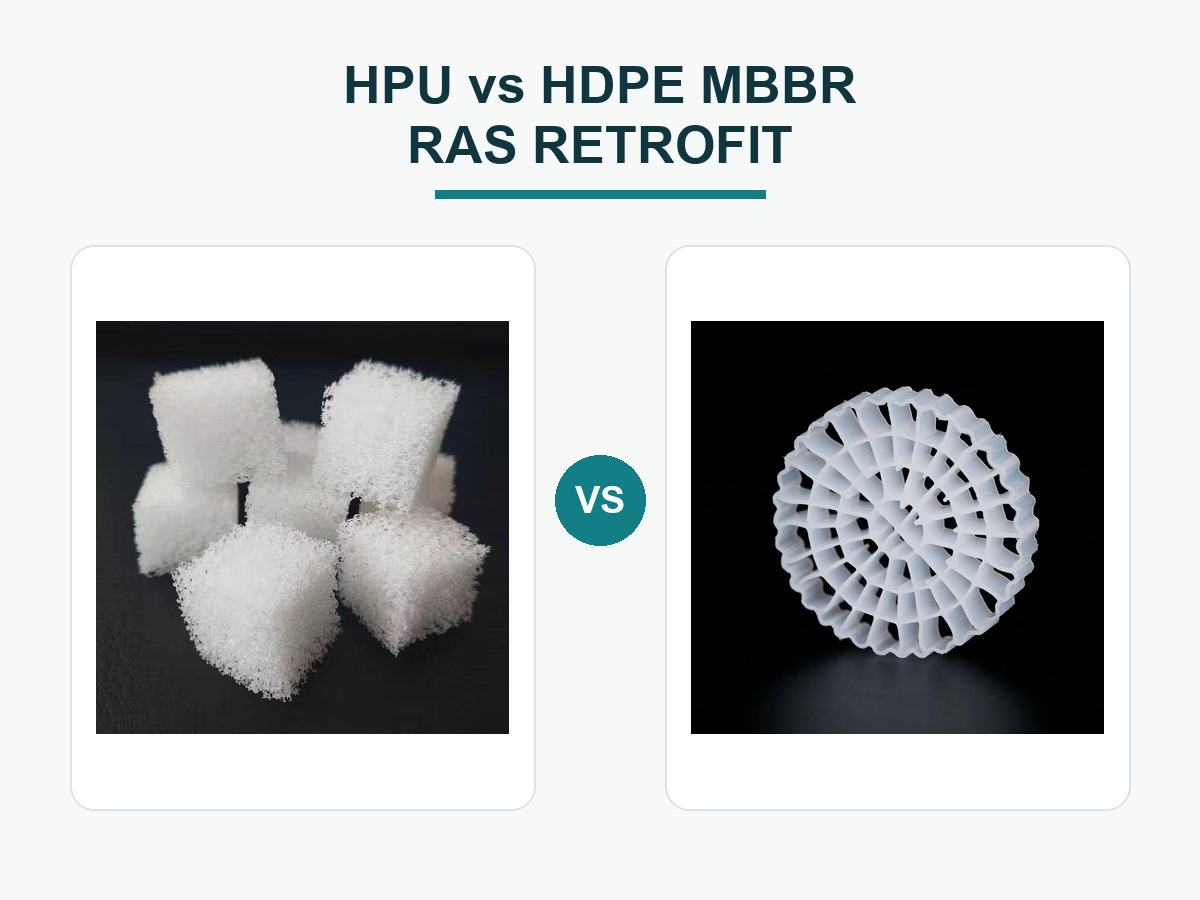
When an existing recirculating aquaculture system reaches its biological treatment limit, choosing a new biofilm carrier is not simply a question of which media has the highest published surface area.
Two common options are porous polyurethane media such as HydroNovus NovusPore™ HPU and conventional rigid HDPE MBBR carriers. Both provide surfaces for attached-growth microorganisms, but they behave differently inside the reactor.
For a retrofit project, the better choice depends on available tank volume, biological loading, mixing, oxygen transfer, solids management, media retention and how much the existing system can be modified.
1. HPU and HDPE MBBR Media Solve the Same Problem Differently
Both media types are designed to support attached biomass, but their physical structures are very different.
NovusPore™ HPU Media
NovusPore™ HPU uses an open-cell polyurethane structure with high porosity and a large internal area for microbial attachment.
Typical HydroNovus HPU specifications include:
- Specific surface area: approximately 3,500–5,000 m²/m³
- Pore structure: approximately 20–25 PPI
- Porosity: above 95%
- Standard dimensions: approximately 30 × 30 × 30 mm
- Typical filling ratio evaluated for many projects: around 25–30%
Its porous structure allows biomass to develop not only on the external surface but also within protected internal spaces.
HDPE MBBR Media
Conventional MBBR carriers use rigid HDPE structures with protected internal channels.
The carriers move continuously inside the reactor under aeration or mechanical mixing and are retained by outlet screens.
The required media model and filling ratio depend on biological loading, ammonia-removal requirements, available reactor volume, mixing conditions and oxygen-transfer capacity.
2. When HPU Becomes Attractive in a Space-Limited Retrofit
The strongest reason to evaluate HPU is usually limited reactor volume.
If an existing RAS cannot easily add another large biofilter tank, increasing the amount of usable biofilm area within the available space becomes important.
The high internal surface area of porous HPU media can make it useful where the design objective is to support more attached biomass without proportionally increasing reactor volume.
This does not mean that HPU automatically increases treatment capacity in every existing biofilter.
The additional surface still needs adequate water contact, dissolved oxygen and substrate transport.
A retrofit should therefore confirm that circulation, solids control and oxygen supply can support the additional biological activity.
3. When Conventional HDPE MBBR May Be the Better Choice
HDPE MBBR media remains a practical option for many RAS projects.
Rigid moving-bed carriers are familiar to many system integrators and are well suited to reactors already designed around continuous media movement, aeration and retention screens.
HDPE media may be especially practical when:
- the existing tank already operates as a conventional moving-bed reactor
- sufficient reactor volume is available
- the aeration system provides reliable mixing
- outlet screens are already installed
- simple media handling is important
- the project prefers a widely established MBBR operating configuration
In these conditions, replacing the existing process with a very different carrier configuration may provide little practical advantage.
4. Do Not Compare Media by Surface Area Alone
Surface-area figures are useful, but they should not be used as the only selection criterion.
Published square meters per cubic meter do not automatically equal usable biological treatment capacity.
The real performance of a biofilm system also depends on:
- protected versus exposed surface
- oxygen transfer
- water movement through and around the carrier
- biofilm thickness
- ammonia and organic loading
- temperature
- solids accumulation
- hydraulic retention conditions
- reactor mixing
A carrier with very high theoretical surface area can still underperform if the internal surface is not receiving enough oxygen or substrate.
Likewise, a lower-surface-area carrier can perform reliably when reactor hydraulics, oxygen transfer and biological loading are well matched.
5. Solids Management Can Change the Media Decision
Solids control is especially important in RAS because feed fines, fecal solids and suspended organic material continuously enter the treatment loop.
Excess solids entering the biofilter increase oxygen demand and can interfere with biological activity.
For porous media, solids loading deserves particular attention because the objective is to keep the internal structure biologically active rather than allowing excessive particulate accumulation.
For moving HDPE carriers, excessive solids can also increase heterotrophic growth and shift oxygen demand away from nitrification.
The biofilter decision should therefore be made together with the upstream mechanical filtration strategy.
A biofilter upgrade cannot compensate indefinitely for inadequate solids removal.
6. Mixing and Oxygen Requirements Matter
HDPE MBBR carriers rely on sufficient movement inside the reactor. Aeration or another mixing arrangement must keep the carriers circulating and maintain adequate contact between water, oxygen and biofilm.
HPU media has a different physical structure, but oxygen and water transfer remain equally important.
When additional biological surface area is installed, potential biomass retention also increases. The oxygen system must therefore be checked against the expected biological load rather than simply left at the previous operating condition.
In a retrofit, review:
- existing dissolved oxygen
- blower or oxygen-system capacity
- reactor circulation
- media movement
- dead zones
- peak feed loading
- water temperature
If the biofilter is already oxygen-limited, adding more carrier surface alone may not solve the original problem.
7. A Practical Retrofit Decision Framework
For a space-limited RAS retrofit, the decision can be simplified into a series of engineering questions.
Question 1: Is Tank Volume the Main Limitation?
If substantial additional reactor volume is available, conventional HDPE MBBR may remain a straightforward solution.
If reactor volume is highly constrained, higher-surface-area porous media becomes more relevant.
Question 2: Is the Existing Biofilter Properly Mixed and Oxygenated?
If dissolved oxygen, circulation or mixing is already inadequate, correct these limitations before assuming that more media is required.
Question 3: Is Mechanical Solids Removal Performing Properly?
High suspended-solids loading can reduce the benefit of either media type.
Review drum filtration or other solids-removal equipment before increasing biological carrier loading.
Question 4: What Biological Load Must the Retrofit Handle?
Useful inputs include:
- system water volume
- daily feed rate
- fish biomass
- TAN or ammonia concentration
- nitrite concentration
- temperature
- existing biofilter volume
- current media type and quantity
- target production capacity
These values are more useful for media selection than surface-area data alone.
8. HPU or HDPE MBBR: Which Should You Choose?
There is no universal winner.
Choose the media according to the limitation that the retrofit is trying to solve.
HPU becomes particularly interesting when reactor footprint is strongly constrained and the project needs to evaluate a much higher amount of biofilm-supporting area within the available volume.
Conventional HDPE MBBR remains attractive when the existing reactor already has suitable mixing, retention screens and sufficient tank volume for a conventional moving-bed configuration.
The correct retrofit decision should be based on the complete biological process, not on the carrier specification alone.
HydroNovus can review the existing RAS biofilter, operating data, feed loading, oxygen conditions and available tank space before recommending a media configuration.