Industry Solutions
Modified Bio Balls: One-Piece PP Media in Floating and Sinking Versions — and Where They Actually Fit
Modified bio balls are one-piece 50 mm PP media with finned internals and nothing inside to dissolve. Floating vs sinking versions, ratings, best uses.
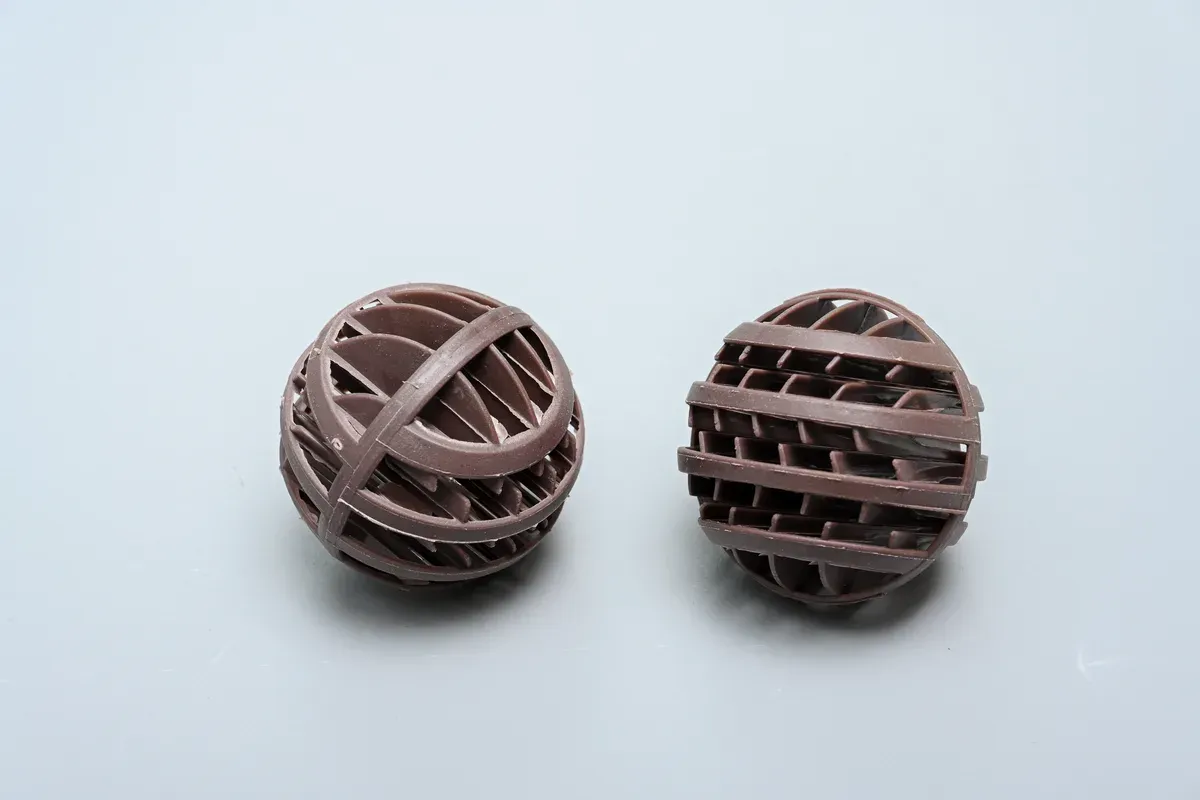
A modified bio ball is a one-piece moulded polypropylene ball, 50 mm across, whose inside is a stack of thin fins rather than a filler. There is no core, no sponge, no loose packing inside the shell — the ball is a single piece of PP, and the "modification" is in its geometry and its density: the fin stack gives the biofilm a large protected surface to grow on, and the ball is made in two densities, a floating version and a sinking version, so the same media can be matched to how a filter actually runs.
That one-piece construction is the point of the product. It exists because the older design it replaces — a hollow lattice ball filled with a separate core material — has a known failure mode: the shell survives for years, but the core inside it does not.
What "modified" actually changes
Two things are modified relative to a plain plastic ball.
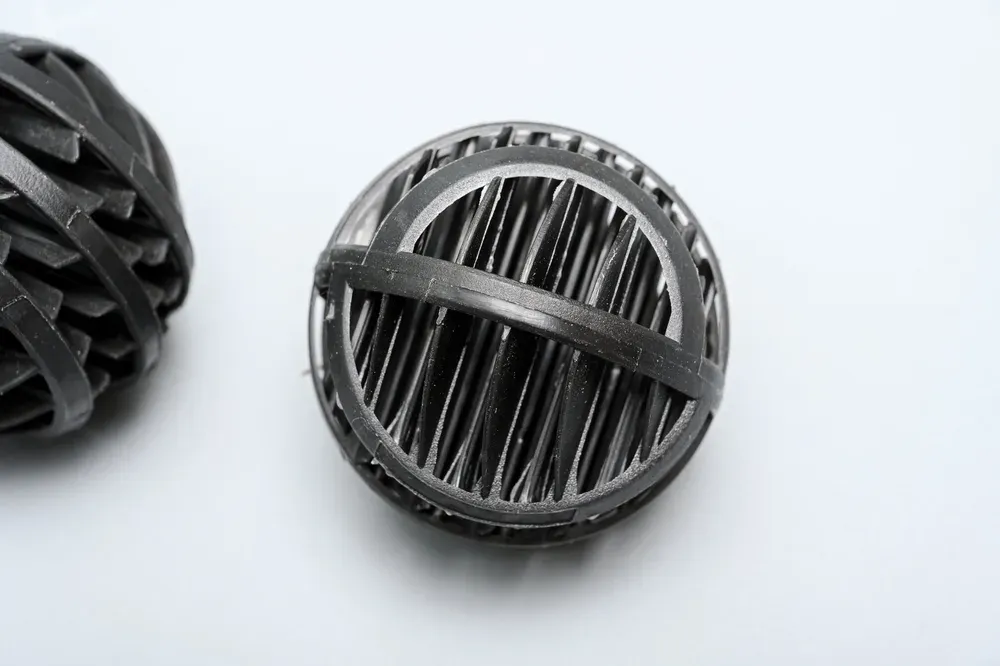
The internal geometry. A plain hollow ball offers biofilm little more than its shell. The modified ball carries a dense internal fin structure — visible in the close-up photographs on the product page — which raises the rated specific surface area to 1,400 m²/m³ (maker's rating). The fins are sheltered inside the lattice shell, so the biofilm growing on them is protected from direct abrasion while water and air still pass freely through the open structure
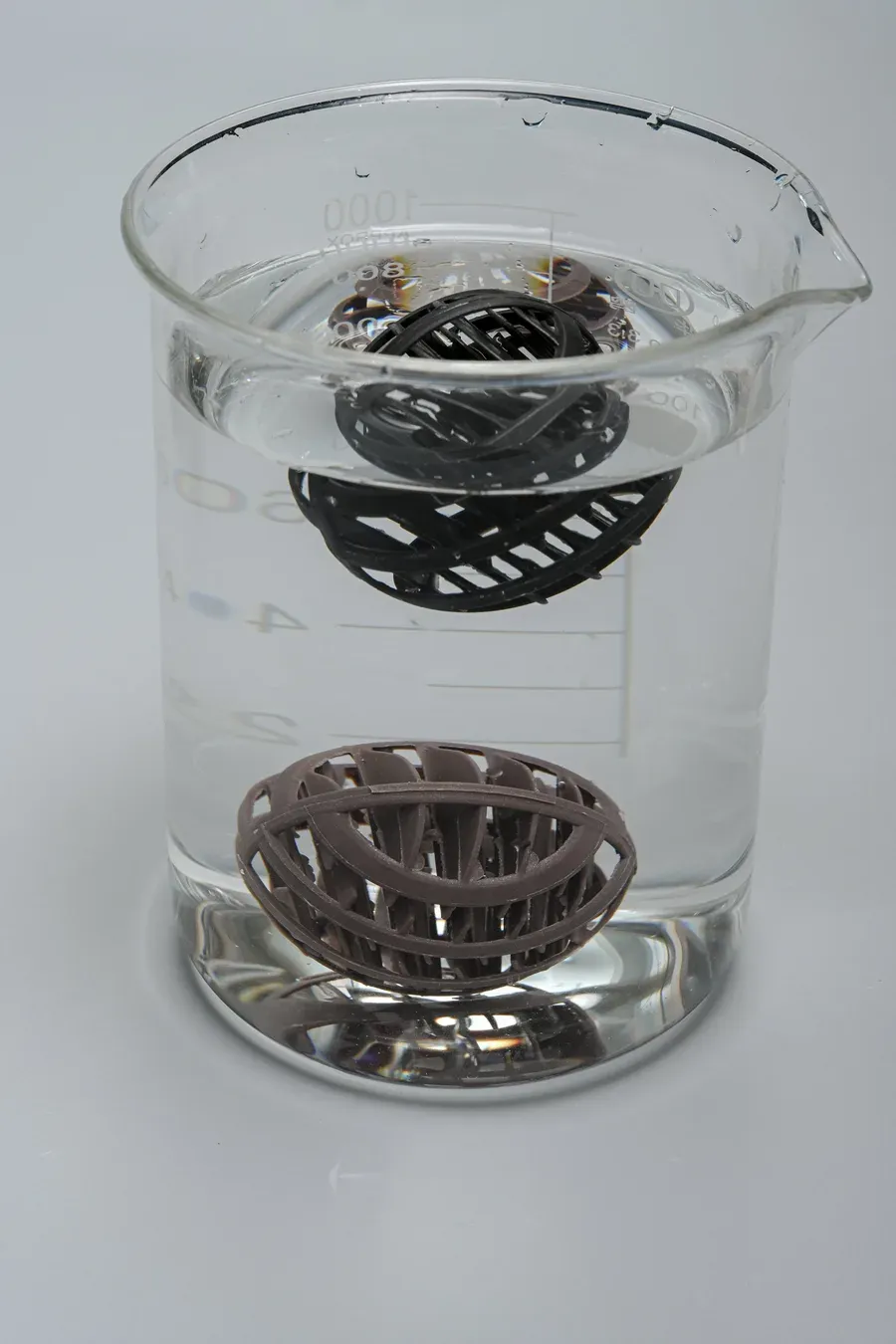
The density. The ball is produced in a floating version and a sinking version. In a simple beaker test the difference is obvious: the floating ball rides at the surface, the sinking ball rests on the bottom. Which one a filter needs depends on the filter, as the next section explains.
The material itself is unmodified in the way that matters: solid polypropylene throughout, with nothing in the construction that can soften, dissolve or wash out of the ball in service.
Why one-piece matters: the core problem with filled balls
Suspended-ball media with a separate core — sponge, fibre or mineral filling inside a plastic lattice shell — are widely sold, and when they fail, they fail in a characteristic way. The PP shell is chemically stable and comes out of the tank looking almost unchanged. The core is the weak point: sponge-type cores in particular can degrade in sewage that carries chlorine and disinfectants from cleaning chemicals, soften, break up and gradually disappear, leaving an empty rattling shell that no longer treats anything. Operators typically discover this months in, when performance has already fallen away and the balls have visibly shrunk.
A one-piece ball removes that failure mode by removing the core. What you put in the tank is what is still there years later: the same PP fins, carrying biofilm. For filters that are difficult or expensive to open and re-fill — sealed biofilter chambers, packaged johkasou-type plants, rotating contactors where media is retained by the drum itself — that difference in maintenance risk is usually the deciding argument, ahead of any surface-area figure.
Floating or sinking: how to choose
Neither version is "better" — they suit different hydraulics.
- Floating version — for filters where the media bed should stay up against a top screen or distribute itself at the surface of a submerged bed, and for aerated or upflow arrangements where a buoyant media is held in place by a retaining screen. Buoyancy also keeps the balls gently mobile in a mixed tank rather than compacting at the bottom.
- Sinking version — for downflow and trickling arrangements where the media must stay settled in a packed bed, resist being floated up by rising air or flow surges, and hold its position in wet/dry filters.
State which version you need when you order, and why: a supplier who only asks "how many cubic metres?" without asking about your filter's flow direction and retention arrangement is guessing. If a ball is to be retained by size alone — for example inside a rotating drum or behind a specific screen aperture — confirm the retention dimension against the 50 mm ball diameter before ordering, because a 50 mm ball will pass any opening larger than itself.
Where modified bio balls fit — and where they do not
Good fits
- Trickling and wet/dry biological filters
- Fixed-bed and submerged fixed biofilter chambers
- Aquaculture and RAS side-stream biofiltration (after upstream solids removal)
- Pond and koi filtration
- Packaged domestic sewage units of the johkasou type
- Replacement of worn filled-ball or mineral media in existing chambers
Not a fit
- As a drop-in MBBR substitute. A moving-bed reactor needs carriers designed to circulate continuously with the tank's aeration, mixing and retention screens. A 50 mm ball is a fixed/floating bed media, not an MBBR carrier — for a new MBBR, use purpose-designed MBBR media instead.
- As primary solids removal. Bio balls support biological growth; they do not strain solids out of the stream. Put mechanical solids removal ahead of them, especially on aquaculture duty.
How the three plastic-and-sponge media families compare
| Modified bio balls | HDPE MBBR carriers | Hydrophilic sponge media |
|---|---|---|---|
Construction | One-piece PP ball, Ø50 mm, finned inside | Moulded HDPE wheels/chips | PU sponge cubes, open-cell |
Rated surface area | 1,400 m²/m³ (maker's rating) | >650 to >1,600 m²/m³ by model (catalogue) | >5,000 m²/m³ |
Bed behaviour | Floating or sinking versions; fixed, floating or retained beds | Continuously moving bed under aeration | Fixed or retained in frames/screens |
Weak point | Needs correct retention sizing (Ø50) | Needs retention screens and steady aeration | The sponge material itself ages — replenishment typically only after ~5 years of retrofit service |
Typical home | Trickling/fixed biofilters, RAS side-stream, packaged units | MBBR/IFAS reactors | Capacity upgrades in existing tanks |
The middle column of our sponge vs HDPE carrier selection guide works through the sponge-versus-carrier choice in engineering depth; the ball's case is simpler — it is the low-maintenance option for filters that stay in one place.
Service life, stated the way the maker stands behind it
Plastic biofilter media attract inflated lifespan claims, so here is the basis we quote on: the maker of these balls rates them at around five years of typical service, with a one-year warranty. PP does not dissolve, and a one-piece ball has no core to lose, so the media does not disappear in service the way a filled ball can — but any claim of ten years or more for a working biofilter ball should be treated as a brochure number unless the maker will put it in writing. Judge competing offers by what the supplier will warrant, not by the largest number on the page.
What to send us for a selection
Media quantity cannot be worked out from tank volume alone. For a first-pass recommendation, send:
- Aquaculture / RAS: system volume, recirculation flow, species and biomass or daily feed rate, water temperature, TAN target, and how solids are removed upstream.
- Wastewater: average and peak flow, COD/BOD and ammonia, TSS, temperature, treatment target, available filter volume, and how the filter is configured (trickling, submerged fixed bed, rotating, packaged unit).
We will come back with the version (floating or sinking), a quantity basis, and — where a different media family honestly fits better — that recommendation instead.
FAQ
What is a modified bio ball?
A one-piece moulded PP ball, 50 mm in diameter, with a finned internal structure instead of a filled core. The modification is the fin geometry (rated 1,400 m²/m³) and the density: it is made in floating and sinking versions.
How long do modified bio balls last?
The maker rates them at around five years of typical service with a one-year warranty. The one-piece PP construction has no core that can degrade or wash out, which is the usual reason filled balls fail early.
Can I use bio balls instead of MBBR media?
Not as a direct substitute. Bio balls suit fixed, trickling, wet/dry and retained beds. An MBBR needs carriers designed to move continuously with the reactor's aeration and screens.
Floating or sinking — which do I need?
Floating for beds held against a top screen, upflow or buoyant arrangements; sinking for packed downflow and trickling beds that must stay settled. Tell the supplier your filter's flow direction and retention arrangement and let them match the version to it.
Choosing between ball, carrier and sponge?
Send your filter type, flow and load data via our contact page. We supply all three media families — the modified bio balls on this page, MBBR carriers and NovusPore sponge from our own media lines — and we will recommend the one that fits your filter, including when that is not the ball.