How to Find the Right Polymer Dose for a Screw Press: Bench Test to Ramp-Up
Find the right polymer dose for your screw press: a bench test, dose maths in kg per tonne of dry solids, and a safe ramp-up sequence.
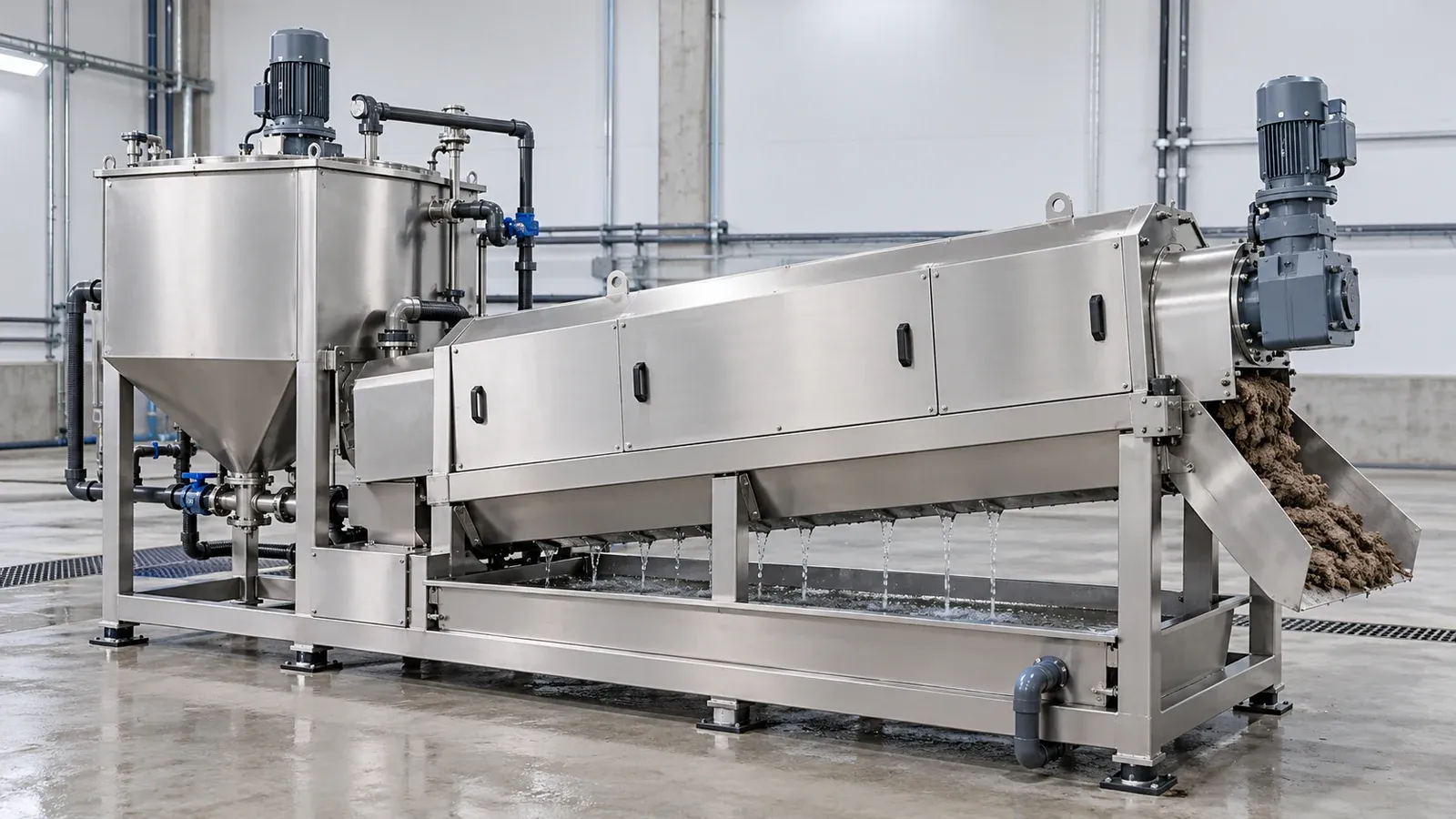
There is no fixed polymer dose for a screw press. The right dose is the one your sludge needs today, found by a bench test followed by a careful ramp-up on the press. A dose copied from another plant — or a supplier's brochure — is a starting guess, not an answer. The test takes under an hour and tells you which polymer works, how much you need, and what the cake will look like.
Why the dose cannot be copied from another plant
Polymer dose is set by the sludge, not the machine. Two plants running the same press can need very different doses because their sludge differs in solids content, particle charge, organic fraction, age, and chemicals already added upstream.
A fresh waste activated sludge flocculates differently from a digested one; sludge aged a week in storage behaves differently from sludge fed straight from the clarifier; and cold sludge conditions more slowly, often needing more polymer.
The press adds a second layer: screw speed, back-pressure, wash water, and feed rate change how much work the floc must survive — and the volute screw press treats floc gently, which is why dose and floc strength matter together. A dose that looks perfect in a beaker can still fail on the press if the floc is too weak to survive the screw. The bench test finds the dose; the press confirms it.
The dose maths: kg of polymer per tonne of dry solids
Polymer dose is expressed as kilograms of active polymer product per tonne of dry solids (kg/t DS) — the only basis that lets you compare doses between plants, because it removes the effect of how wet the sludge is.
Dose (kg/t DS) = polymer used (kg/h) ÷ dry solids fed (t/h)
Dry solids fed comes from the feed:
Dry solids (t/h) = feed flow (m³/h) × sludge concentration (% DS) × 10
(1% DS is roughly 10 kg of dry solids per m³ of sludge.)
Worked example
A press is fed at 10 m³/h with sludge at 2% DS.
- Dry solids fed = 10 × 2 × 10 = 200 kg DS/h, or 0.2 t/h.
- If the bench test points to a dose of 6 kg/t DS, polymer use = 6 × 0.2 = 1.2 kg/h of polymer product.
- If the polymer is made down as a 0.2% solution, that 1.2 kg/h is delivered as 600 litres per hour of solution.
This is an illustrative example with round numbers, not a recommendation. Your bench test supplies the dose number; the maths turns it into a pump setting.
The most common dosing error is confusing kilograms of neat polymer product with litres of made-down solution — always convert back to kg/t DS before comparing two trials. Our guide to polymer dosing system sizing for DAF and sludge dewatering covers how the make-down and dosing equipment is sized around these numbers.
What dose range should you expect?
Dose ranges are starting points for the bench test, never guarantees. As a typical first-pass range — confirm it by your own test — municipal waste activated sludge commonly starts around 4–8 kg/t DS. Digested sludge often needs more, primary sludge often less; industrial sludges sit outside these bands entirely, and two sludges from the same town can need doses several times apart.
If your bench test lands far outside the expected band, do not force it back — check the sludge first: concentration, age in storage, upstream chemical changes. The screw press sizing guide explains how dry-solids load, rather than flow alone, sets what the press is asked to do.
The bench test, step by step
You need a 1-litre beaker, a sample of sludge exactly as it reaches the press, polymer made down at the concentration the press will use, a pipette, and a stopwatch.
Step 1 — Take a representative sample. Fill the beaker from the press feed line, not the top of a storage tank. Note the solids content if you know it.
Step 2 — Add polymer in small steps. Start low — about 3 kg/t DS — and stir gently for a few seconds: enough to mix, not enough to shear the floc apart.
Step 3 — Read the floc, not the clock. The right dose shows clear water between firm, distinct flocs that hold together when the beaker is swirled gently. Under-dosed sludge stays cloudy, with fines that will not gather. Over-dosed sludge forms large, slimy, sticky flocs, and the water between them turns cloudy again.
Step 4 — Repeat at the next step up. Increase the dose in small steps until the water is clearest and the flocs firmest — that is your bench-test dose. Run one trial a step above it: if the result gets worse, you have confirmed the peak.
Step 5 — Write it down with the conditions. Record the dose with the sludge source, solids content, temperature, and polymer product and make-down concentration — a result without conditions is useless next month.
One bench test takes under an hour; plants that skip it spend far longer chasing wet cake.
Ramp-up on the press: from beaker to stable operation
A bench result is a starting point, not a finished setting. Move it across in stages.
Start at the bench dose. Set the dosing pump to the bench-test dose at the planned feed rate, using the maths above. Start the press at a moderate feed rate, not maximum throughput.
Give it time. Run at least 20–30 minutes at each setting before judging it — polymer needs contact time, and the cake needs time to build. Judging after two minutes is the most common ramp-up mistake.
Change one thing at a time. If the cake is wet, check the dose before touching screw speed or back-pressure. Change dose, speed, and pressure together and you will never know which change fixed the problem — or caused the next one.
Watch the filtrate, not just the cake. Clear filtrate with a firm cake means the dose is holding. Cloudy filtrate means the floc is too weak — usually under-dosing, or a floc sheared apart by too much mixing energy or screw speed.
Lock the setting in writing. Once the press is stable — dry cake, clear filtrate, steady throughput — record dose in kg/t DS, feed rate, screw speed, and back-pressure: the next shift's baseline, and the first thing to check when performance drifts.
Under-dosed or over-dosed? Reading the symptoms
| Symptom | Likely cause | Action |
|---|---|---|
| Wet, soft cake that will not hold its shape | Under-dosing, or floc too weak for the screw | Increase dose in small steps; check mixing energy is not shearing the floc |
| Cloudy filtrate with fine solids passing through | Under-dosing, or polymer type wrong for this sludge | Re-run the bench test; check whether a different charge type is needed |
| Large, sticky, slimy flocs; cake smears on the screw | Over-dosing | Reduce dose step by step until the water clears and flocs firm up |
| Cake dry at first, then wetter through the shift | Sludge changing (concentration falling, sludge ageing in storage) | Re-check feed solids; re-run a quick bench test on the current sludge |
Most symptoms point at the sludge or the settings, not the press. Our screw press troubleshooting guide for wet cake and dirty filtrate covers the machine-side checks — screen condition, wash water, screw wear — to rule out alongside the dose.
Make-down and handling: where good doses go wrong
A correct bench dose fails when the polymer is not prepared properly — three points cover most failures.
Make-down concentration. Follow the supplier's make-down guidance for the product you use. Too concentrated a solution does not disperse evenly; too dilute a solution adds unnecessary water to the feed.
Ageing time. Most emulsion and powder polymers need a maturing period after make-down before they perform fully. Dosing unmatured solution looks like under-dosing and tempts operators to raise the dose — then the matured solution overdoses the sludge an hour later.
Solution age. Made-down solution degrades and loses activity, so the press slowly needs more of it. If the dose keeps creeping up, check the solution's age before blaming the sludge. The automatic PAM/PAC polymer dosing system prepares and doses automatically, removing the two most common handling errors — wrong concentration and unaged solution.
Re-run the bench test whenever the sludge changes: a new production line, an upstream chemical change, a return from shutdown, or cake and filtrate drifting from baseline.
FAQ
What polymer dose should a screw press use?
There is no universal dose. It is found by a bench test on your sludge, expressed in kg of polymer per tonne of dry solids. Municipal waste activated sludge commonly starts around 4–8 kg/t DS as a first-pass range only — the bench test, not the range, sets your dose.
How do I do a polymer bench test for a screw press?
Add made-down polymer to a beaker of press-feed sludge in small steps, mixing gently. The right dose gives clear water between firm flocs that survive a gentle swirl; record it with the sludge conditions, then confirm it on the press with a staged ramp-up.
Why is my screw press cake wet even though I increased the polymer dose?
Wet cake is not always under-dosing — over-dosing also gives a wet, slimy cake. Cloudy filtrate points to too little polymer or a weak floc; sticky, smearing flocs point to too much. Re-run the bench test on the current sludge before raising the dose.
Does polymer dose change with the seasons?
It can. Cold sludge conditions more slowly and may need a higher dose, and sludge character often shifts with production through the year. Re-test when cake or filtrate drifts from the recorded baseline.
Not sure what dose your sludge needs?
Send us your sludge type, feed rate and solids content, and the press you are running via our contact page. We will check the dose basis and press sizing free of charge; sizing support for a specific project is arranged case by case.