Industry Solutions
How Poor Solids Removal Reduces Biofilter Performance in RAS
Poor solids removal can overload an RAS biofilter, increase oxygen demand and reduce nitrification stability. Learn how mechanical filtration and biofiltration should work together.
When ammonia starts rising in a recirculating aquaculture system, attention often goes directly to the biofilter.
The first reaction may be to add more carrier media, increase aeration or enlarge the biological tank.
But the biological filter may not be the original problem.
If suspended solids are not removed efficiently before water reaches the biofilter, the biological stage must handle more than dissolved ammonia and biodegradable compounds. Feed particles, fish waste and fine organic solids can increase oxygen demand, encourage excessive heterotrophic growth and interfere with the conditions required for stable nitrification.
For this reason, mechanical solids removal and biological filtration should be evaluated as one treatment process rather than as two unrelated pieces of equipment.
1. What Should the Mechanical Filter Remove Before the Biofilter?
In an RAS, uneaten feed, fecal material and other suspended particles are continuously produced.
The mechanical filtration stage should remove as much of this particulate load as practical before it remains in circulation long enough to break down into smaller particles and dissolved organic matter.
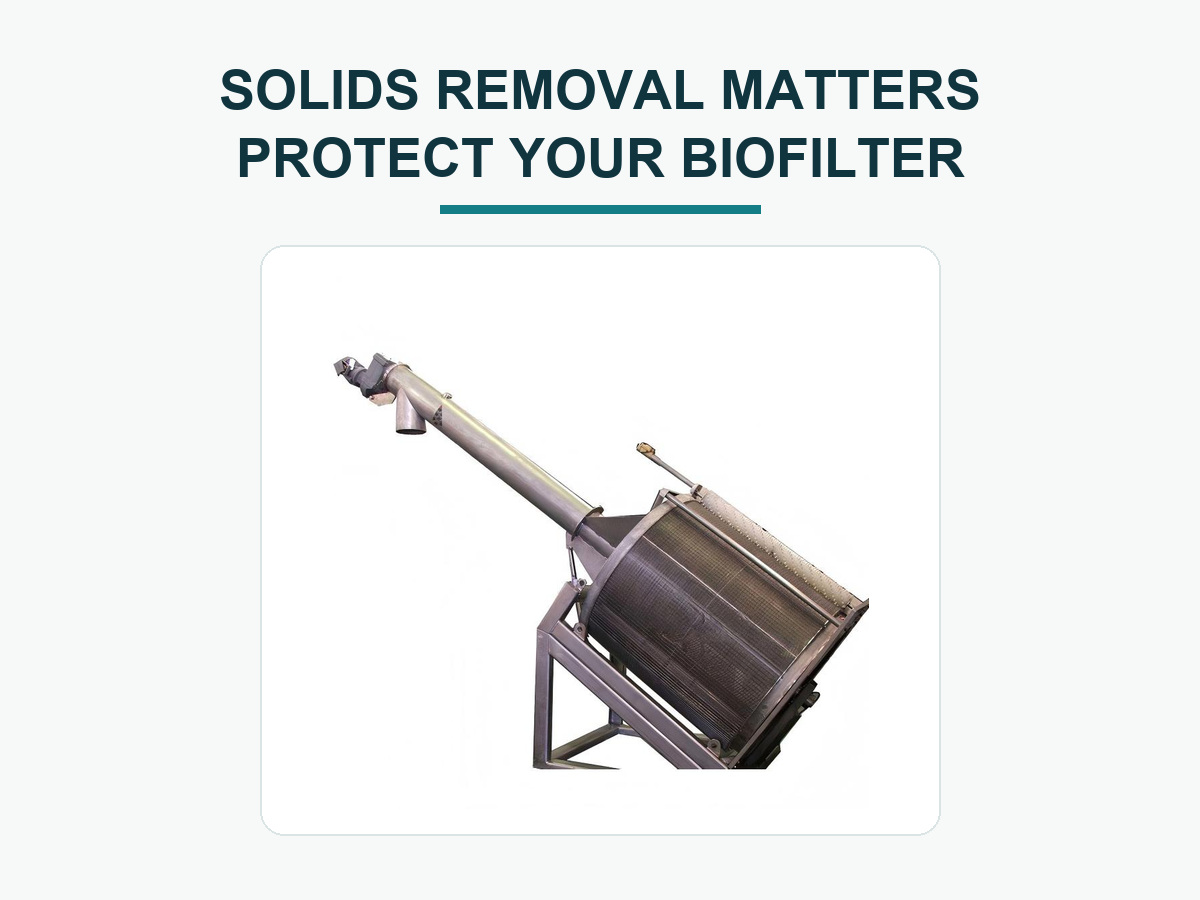
Rotary drum filtration is commonly used because it can continuously separate suspended solids from the recirculating water while maintaining a relatively compact footprint.
The required screen opening should not be selected from one universal micron value.
The correct choice depends on factors such as:
- fish species and size
- feed characteristics
- solids production
- recirculation flow
- acceptable head loss
- downstream treatment requirements
- cleaning frequency
- target water quality
The purpose of mechanical filtration is not simply to make the water look clearer. It is to reduce the particulate load that the rest of the RAS must process.
2. What Happens When Too Many Solids Reach the Biofilter?
A biofilter is designed primarily to provide a stable environment for the microorganisms responsible for biological treatment.
When excessive particulate matter enters the biological stage, several things can happen at the same time.
Organic solids may be degraded by heterotrophic microorganisms. This activity consumes oxygen and can compete with nitrifying microorganisms for available dissolved oxygen.
Fine particles may also become trapped within the reactor or around biofilm carriers.
The result can be higher biological oxygen demand inside the biofilter even though the fish production load itself has not changed.
This is one reason why a biofilter that previously operated reliably may begin to show unstable ammonia performance when mechanical solids removal deteriorates.
3. Solids Increase Oxygen Demand Before You See an Ammonia Problem
Low dissolved oxygen is one of the most important conditions to check when nitrification becomes unstable.
But the problem is not always insufficient aeration equipment.
Sometimes the oxygen system is supplying approximately the same amount of oxygen as before, while the biological oxygen demand has increased because more organic solids are entering the reactor.
In this situation, simply increasing carrier surface area does not address the full problem.
More biofilm area cannot compensate for a treatment train that is sending excessive organic solids into the biological stage.
For troubleshooting, check both:
- oxygen supply
- oxygen demand
The second part is often overlooked.
4. Fine Solids Can Affect Different Biofilm Media in Different Ways
Both conventional HDPE MBBR carriers and porous polyurethane media depend on good contact between water, oxygen and active biofilm.
However, their physical structures are different.
HDPE MBBR Media
Rigid HDPE carriers move inside the reactor under aeration or mechanical mixing.
Adequate movement helps maintain contact between water and biofilm and assists with normal biofilm control.
When excessive organic solids enter the reactor, heterotrophic growth and oxygen consumption can increase even if the carrier itself continues to move normally.
NovusPore™ HPU Media
NovusPore™ HPU uses a porous open-cell polyurethane structure with a large internal area for biomass retention.
Its protected internal structure is useful when a project requires high biological surface area within a limited reactor volume.
At the same time, upstream solids control remains important.
The objective is to maintain active biological contact throughout the porous structure rather than allow excessive particulate accumulation to occupy the available internal space.
Higher surface area makes upstream solids management more important, not less important.
5. Poor Solids Removal Can Look Like a Biofilter Capacity Problem
This is where retrofit projects can easily move in the wrong direction.
Consider an RAS where feed loading has increased and ammonia control is becoming less stable.
The immediate conclusion may be:
“The biofilter is too small.”
That may be correct.
But before adding media or installing another biological reactor, it is worth checking whether the existing system is receiving a higher particulate and organic load than originally intended.
Useful questions include:
- Is the mechanical filter operating continuously?
- Has the screen condition changed?
- Is bypass occurring?
- Has solids production increased with feed loading?
- Are fine solids visibly accumulating downstream?
- Has cleaning frequency changed?
- Is sludge being removed from the system quickly enough?
- Has dissolved oxygen inside the biofilter fallen?
- Has the media become more heavily coated?
If several of these conditions have changed, the apparent biofilter-capacity problem may actually involve both mechanical and biological treatment.
6. Why Faster Solids Removal Matters
Solids do not remain chemically unchanged while circulating through an RAS.
The longer particulate waste remains in the water, the more opportunity there is for physical breakdown and biological decomposition.
Large particles that could have been mechanically separated may gradually become smaller suspended particles or contribute to dissolved organic loading.
Once that happens, downstream removal becomes more difficult.
This is why solids-removal performance should be evaluated not only by screen size but also by how quickly separated solids are removed from the recirculating water.
Capturing waste is only part of the job. The system should also remove that waste from the active water loop efficiently.
7. Mechanical Filtration, Biofiltration and Oxygen Should Be Checked Together
A useful RAS troubleshooting sequence is:
Mechanical solids removal → biological filtration → oxygen transfer → recirculation
These stages affect each other.
If mechanical filtration performs poorly, the biological stage receives additional organic load.
If biological load increases, oxygen demand increases.
If oxygen transfer is already close to its limit, nitrification becomes more vulnerable.
If recirculation or mixing is inadequate, both oxygen distribution and biofilm contact can become uneven.
For this reason, upgrading only one piece of equipment without reviewing the surrounding process can lead to disappointing results.
When Ammonia Starts Rising
Check:
- daily feed rate
- fish biomass
- TAN or ammonia
- nitrite
- dissolved oxygen
- pH
- alkalinity
- water temperature
- mechanical filter condition
- suspended solids
- current biofilter volume
- media type and quantity
When Solids Are Increasing
Check:
- mechanical-filter screen condition
- actual recirculation flow
- solids bypass
- backwash or cleaning performance
- sludge discharge
- feed fines
- particle size distribution
- downstream accumulation
These checks help separate a true lack of biological capacity from a process problem created upstream.
8. Do Not Size the Biofilter in Isolation
A biofilter calculation based on feed load, ammonia production and carrier surface area is useful, but it should not be separated from the rest of the treatment train.
The water entering the biological reactor determines the environment in which that biofilter must operate.
A well-designed RAS therefore considers:
- solids production
- mechanical separation
- biological loading
- oxygen demand
- hydraulic flow
- media configuration
- sludge removal
- final water-quality targets
The best biofilter is still dependent on the quality of the water entering it.
When evaluating an existing RAS, HydroNovus therefore recommends reviewing the mechanical and biological stages together before deciding that additional biofilter media is required.
If your RAS is experiencing rising ammonia, increased solids loading or limited biological capacity, send us the existing system data. We can review the filtration, biofilter and oxygen conditions together and identify where the actual bottleneck is occurring.