Industry Solutions
Static Screen vs Rotary Drum Screen for Industrial Wastewater: Which Should You Choose?
Compare static screens and rotary drum screens for industrial wastewater pretreatment, including flow, solids load, screen opening, energy, cleaning and maintenance.
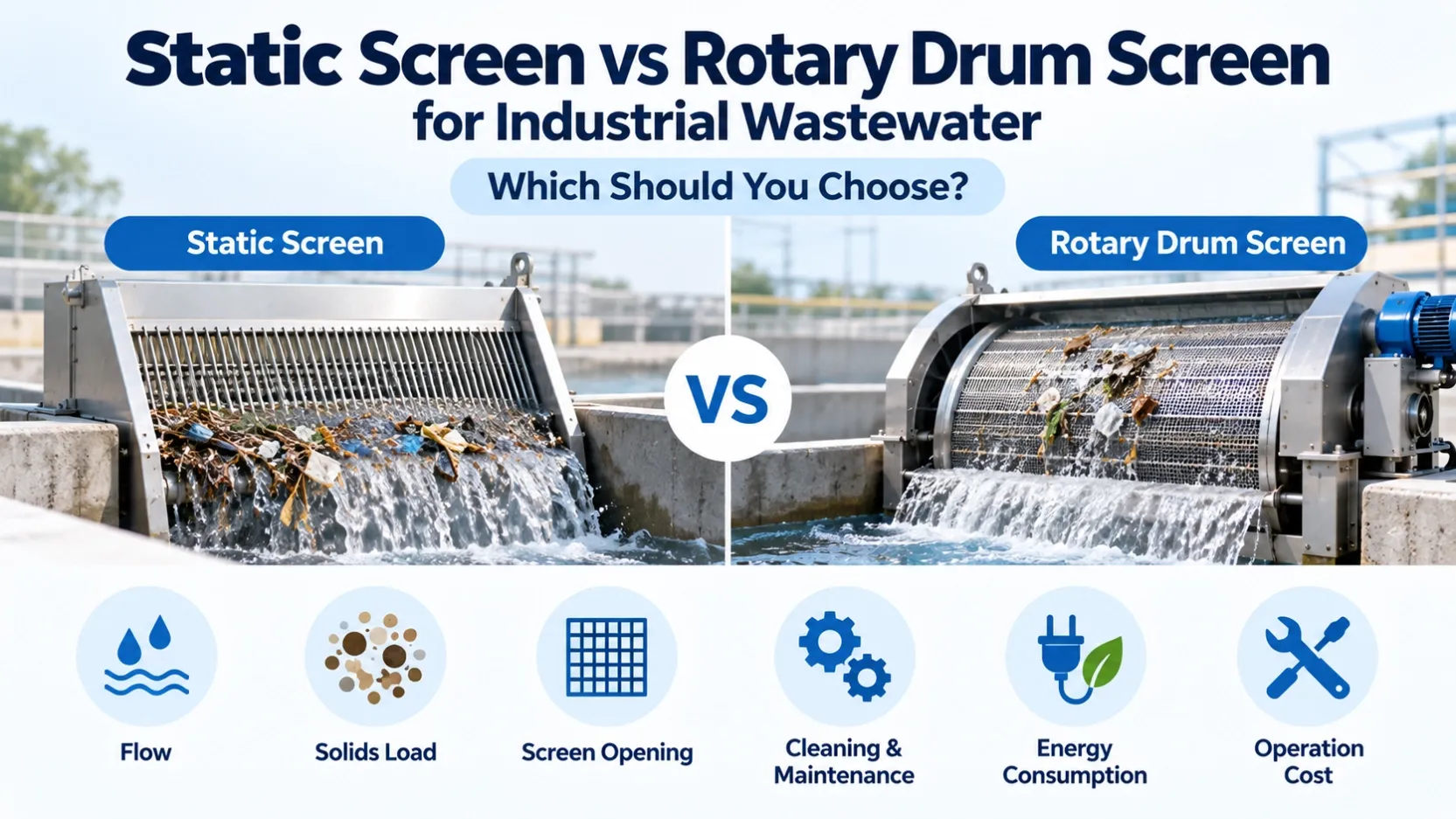
Industrial wastewater pretreatment often starts with a simple equipment question:
Should we use a static screen or a rotary drum screen?
Both remove suspended or coarse solids before downstream treatment.
But they operate differently and fit different hydraulic and solids-loading conditions.
A static screen relies mainly on gravity and wedge-wire screening.
A rotary drum screen uses a rotating screening surface and usually provides continuous mechanical cleaning.
The better choice depends on more than screen opening.
It should consider:
Flow · Solids Load · Particle Type · Screen Opening · Cleaning · Energy · Maintenance
Quick Answer
Static screens are often attractive for relatively simple, gravity-fed pretreatment where low energy use and low mechanical complexity are priorities. Rotary drum screens are generally better suited to higher or more variable solids loads where continuous screening and automatic cleaning are required.
Neither technology is automatically better.
The correct choice depends on the wastewater and operating conditions.
What Is a Static Screen?
A static screen is a fixed screening device with no rotating screening surface.
Wastewater normally flows over a wedge-wire or similar screen surface.
Water passes through the openings while larger solids remain on the surface and move downward for collection.
Its main advantages are:
- no drive motor for the screening surface
- simple construction
- low energy consumption
- relatively low mechanical complexity
- straightforward maintenance
HydroNovus uses static screening as one of its pretreatment options for industrial and municipal wastewater projects. The current product range is shown on the HydroNovus wastewater-treatment equipment page.
What Is a Rotary Drum Screen?
A rotary drum screen uses a cylindrical screening surface that rotates during operation.
Depending on the equipment configuration, wastewater may flow:
- from inside to outside
- from outside to inside
Captured solids are separated from the screen surface through rotation, spray washing or mechanical cleaning.
The rotating mechanism allows the screen to handle solids continuously.
Rotary drum screens are often considered when:
- solids loading is higher
- flow varies significantly
- continuous automatic operation is required
- manual cleaning should be minimized
- finer screening is required
Static Screen vs Rotary Drum Screen: Main Differences
Item | Static Screen | Rotary Drum Screen |
|---|---|---|
Screening surface | Fixed | Rotating |
Drive motor | Normally no | Yes |
Energy consumption | Low | Higher |
Mechanical complexity | Low | Higher |
Automatic cleaning | Limited / hydraulic or manual depending on design | Usually integrated |
Solids handling | Suitable for manageable solids loading | Better for continuous or heavier solids loading |
Flow variation | Better with relatively stable conditions | Often more tolerant when correctly sized |
Maintenance | Simple | More mechanical components |
Wash water | Often low | Commonly required |
Capital cost | Generally lower | Generally higher |
Typical role | Simple pretreatment | Continuous automated screening |
1. Start With Flow
The first design input should be:
- average flow
- peak flow
- operating hours
- continuous or batch discharge
Do not select a screen from daily wastewater volume alone.
For example, a factory may discharge most of its wastewater during:
- production shifts
- washdown
- CIP cleaning
- batch dumping
A screen sized only from average daily flow may become hydraulically overloaded during these periods.
Therefore:
Peak flow often controls screen size more than average flow.
2. Solids Load Is Just as Important as Flow
Two wastewater streams can have the same hydraulic flow but very different screening requirements.
One may contain only occasional large particles.
Another may contain:
- fibers
- food solids
- plastic fragments
- hair
- vegetable matter
- paper fibers
- process debris
The second stream creates a much higher solids load on the screening surface.
A static screen that performs well with light solids loading may require frequent cleaning under heavy loading.
A rotary drum screen may provide greater operating stability because captured solids are continuously removed.
3. Screen Opening Should Match the Treatment Objective
Smaller screen openings remove smaller particles.
But finer screening also creates more resistance.
Potential effects include:
- faster screen blockage
- higher head loss
- greater cleaning demand
- larger required screen area
- increased wash-water use
The correct screen opening should therefore match the downstream treatment requirement.
Ask:
What particles actually need to be removed before the next process stage?
Do not automatically choose the smallest opening available.
4. Pretreatment Requirements Depend on the Downstream Process
The purpose of screening is to protect or improve downstream treatment.
Downstream equipment may include:
- pumps
- equalization tanks
- DAF
- biological treatment
- MBBR
- sludge systems
- membrane treatment
For example, removing coarse fibers before a pump may require a different screen than pretreatment before fine solids separation.
In a broader industrial ETP, screening should therefore be selected as part of the process train.
5. Static Screens Are Attractive When Simplicity Matters
A static screen can be a good option where the project prioritizes:
- simple operation
- low energy consumption
- limited mechanical maintenance
- relatively stable wastewater flow
- manageable solids loading
- gravity flow
Because the screening surface itself does not require rotation, there are fewer moving parts.
This can be valuable for:
- small industrial plants
- remote sites
- decentralized systems
- applications with limited maintenance personnel
However, simplicity should not be confused with unlimited capacity.
A static screen still needs sufficient screen area and appropriate hydraulic conditions.
6. Rotary Drum Screens Are Attractive for Continuous Solids Removal
A rotary drum screen may be more suitable when the plant receives continuous or variable solids loads.
Typical advantages include:
- automatic screen movement
- continuous solids removal
- automatic spray cleaning
- reduced manual intervention
- more stable operation under changing load
This can make rotary screening attractive in industries such as:
- food processing
- slaughterhouses
- vegetable processing
- fisheries
- pulp and paper
- textile wastewater
- other solids-rich industrial streams
Actual suitability still depends on the particle characteristics.
7. Fibrous Solids Can Strongly Influence Screen Selection
Fibers can behave differently from granular solids.
Examples include:
- textile fibers
- paper fibers
- hair
- plant fibers
- string-like debris
Fibrous solids may:
- wrap around equipment
- bridge screen openings
- form mats
- increase cleaning demand
For these wastewater streams, screen geometry and cleaning method can be more important than nominal opening size alone.
A site sample or clear description of the solids can help equipment selection significantly.
8. Fats, Oils and Grease Can Create Additional Problems
Wastewater from:
- food processing
- meat processing
- dairy
- kitchens
- rendering
may contain fats, oils and grease.
These materials can coat the screening surface and reduce hydraulic capacity.
Screening may still be useful for removing coarse solids, but it does not replace downstream oil or low-density solids separation.
Where the project contains significant FOG or light suspended solids, Dissolved Air Flotation may be required after screening.
A typical sequence may be:
Coarse Screening → Equalization → Coagulation / Flocculation → DAF → Biological Treatment
9. Hydraulic Head Is Important for Static Screens
Static screens generally rely strongly on gravity flow.
The project therefore needs sufficient:
- inlet elevation
- available head
- outlet elevation
- screen surface area
If hydraulic head is limited, adding a static screen can raise upstream water levels.
This is particularly important in retrofit projects.
Before installation, provide:
- upstream water level
- downstream water level
- available elevation difference
10. Rotary Drum Screens Also Create Hydraulic Resistance
A rotary drum screen is mechanically cleaned, but it still creates head loss.
Head loss can increase when:
- solids load increases
- screen opening becomes finer
- the screen surface becomes partially blocked
- peak flow rises
The drive and cleaning system do not eliminate hydraulic limitations.
The screen still needs enough effective surface area for the design flow.
11. Wash Water Should Be Included in the Design
Rotary drum screens commonly use spray water to clean the screening surface.
This means the project should consider:
- wash-water source
- wash-water pressure
- flow requirement
- nozzle condition
- drainage
Poor spray cleaning can reduce effective screening area.
Nozzle blockage can also lead to:
- solids buildup
- higher head loss
- lower capacity
Wash-water quality therefore matters.
12. Static Screens Are Not Truly “Maintenance Free”
No motor does not mean no maintenance.
A static screen still requires:
- inspection
- surface cleaning
- solids removal
- checking for blockage
- structural inspection
Wastewater containing sticky, fibrous or greasy solids can require significant cleaning even when there are no moving mechanical parts.
The better description is:
lower mechanical complexity
rather than:
no maintenance
13. Rotary Drum Screens Have More Mechanical Components
Rotary drum equipment may include:
- motor
- gearbox
- bearings
- chain or transmission
- spray system
- drum support
- seals
These components require periodic maintenance.
Therefore, the plant should evaluate whether it has:
- maintenance staff
- spare parts
- wash water
- power
- access for inspection
Automatic equipment reduces manual screen cleaning, but it introduces mechanical maintenance.
When a Static Screen May Be the Better Choice
A static screen may fit well when:
- wastewater flow is relatively stable
- solids load is moderate
- solids are easily screened
- gravity head is available
- low energy use is important
- operator simplicity is important
- manual inspection is acceptable
It can also work well as a first-stage pretreatment device before:
- equalization
- DAF
- biological treatment
When a Rotary Drum Screen May Be the Better Choice
A rotary drum screen may fit better when:
- solids loading is high
- flow changes significantly
- continuous automatic operation is required
- frequent manual cleaning is undesirable
- screen openings need to be relatively fine
- the plant operates for long hours
Its additional mechanical complexity can be justified when automation reduces operating problems.
Static Screen vs Rotary Drum Screen Decision Table
Project Condition | Static Screen | Rotary Drum Screen |
|---|---|---|
Low to moderate solids load | Strong option | Possible |
High continuous solids load | Limited / check carefully | Strong option |
Stable gravity flow | Strong option | Possible |
Variable flow | Evaluate carefully | Often better |
Lowest energy priority | Strong advantage | Requires power |
Minimal mechanical parts | Strong advantage | More maintenance |
Continuous automatic cleaning | Limited | Strong advantage |
Fine screen opening | Possible with adequate area | Often practical |
Limited maintenance personnel | Potential advantage | Depends on automation support |
Heavy fibrous solids | Case-specific | Case-specific; cleaning design important |
A Better Screen-Selection Sequence
Step 1 — Define the Flow
Provide:
- average flow
- peak flow
- operating hours
Step 2 — Describe the Solids
Include:
- type
- approximate size
- concentration
- fibrous / sticky / granular
- oil and grease
Step 3 — Define the Removal Target
Determine what must be stopped before the next treatment stage.
Step 4 — Select Preliminary Screen Opening
Choose according to the downstream protection requirement.
Step 5 — Check Hydraulic Conditions
Review:
- inlet level
- outlet level
- available head
Step 6 — Evaluate Cleaning
Decide whether the project can accept:
- periodic manual cleaning
- automatic spray cleaning
- mechanical maintenance
Step 7 — Compare Lifecycle Operation
Review:
- electricity
- wash water
- operator time
- maintenance
- spare parts
Only then select the equipment configuration.
Data Needed Before Selecting an Industrial Wastewater Screen
Hydraulic Data
- average flow
- peak flow
- daily operating hours
- continuous or intermittent discharge
Wastewater
- industry
- temperature
- pH
- oil and grease where relevant
Solids
- TSS if available
- particle size
- particle type
- fiber content
- estimated solids load
Required Screening
- target opening
- downstream treatment
- reason for screening
Site
- gravity or pumped flow
- inlet elevation
- outlet elevation
- available footprint
- electrical supply
Operation
- automatic operation required?
- available wash water?
- maintenance capability?
- current screen problems?
Common Screen-Selection Mistakes
Mistake | Better Approach |
|---|---|
Selecting from flow alone | Include solids loading |
Choosing the smallest opening automatically | Match screen opening to downstream requirement |
Ignoring peak flow | Size for realistic hydraulic peaks |
Assuming static screens never clog | Review solids and cleaning behaviour |
Assuming rotary screens require no operator attention | Include spray and mechanical maintenance |
Ignoring hydraulic head | Check inlet and outlet levels |
Using screening to solve FOG separation | Add DAF or suitable downstream separation |
Comparing only purchase price | Compare energy, water, labor and maintenance |
Frequently Asked Questions
Is a static screen really zero-energy?
The screening surface itself normally does not require a drive motor when operated by gravity. However, the overall wastewater system may still include pumps or other powered equipment.
Which screen handles higher solids load better?
A correctly sized rotary drum screen often provides an advantage where solids loading is high or continuous because the screen surface is automatically cleaned during operation.
Can a static screen use fine openings?
Yes, but finer openings increase hydraulic resistance and cleaning demand. The required screen area and solids characteristics must be evaluated.
Does a rotary drum screen replace DAF?
No. Screening removes particles according to size. DAF is designed to separate suspended solids, fats, oils and low-density flocs through flotation.
Which screen needs less maintenance?
Static screens generally have fewer mechanical components. Rotary screens reduce manual cleaning but require maintenance of motors, drives, bearings and spray systems.
What information is needed for screen sizing?
At minimum, provide average and peak flow, solids type, target screen opening, wastewater characteristics and available hydraulic conditions.
Choosing a Screen for Industrial Wastewater Pretreatment?
Do not begin with:
“Static or rotary?”
Begin with:
“What solids must be removed, at what peak flow, before which downstream process?”
Send HydroNovus:
- industry
- average and peak flow
- operating hours
- solids type
- TSS if available
- particle size
- desired screen opening
- oil and grease where relevant
- inlet and outlet elevations
- downstream process
We can then determine whether the pretreatment stage is better suited to a static screen, rotary drum screen or another solid–liquid separation method.