Industry Solutions
Tube Settler Retrofit: What Data Is Needed Before Adding Lamella Media?
Learn what flow, tank, solids and hydraulic data should be checked before adding tube settler or lamella media to an existing clarifier.
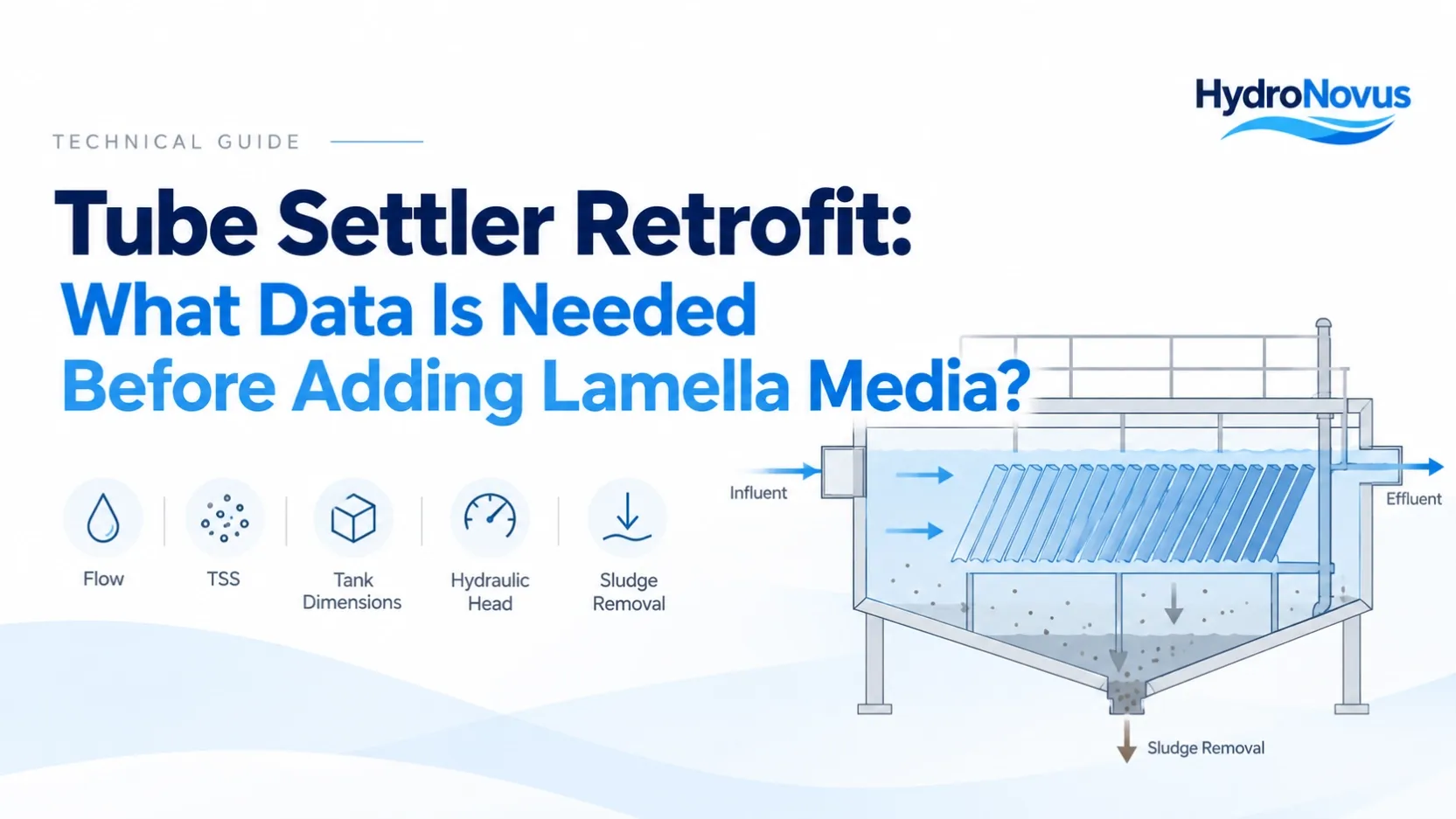
Adding tube settler or lamella media to an existing clarifier can increase effective settling area without building a completely new sedimentation tank.
That makes it attractive for retrofit projects where:
- flow has increased
- suspended solids are escaping
- clarifier footprint is limited
- existing settling capacity is insufficient
- civil expansion is difficult
But a tube settler retrofit should not begin with:
“How many cubic metres of lamella media do we need?”
The first question should be:
What is limiting the existing clarifier, and can lamella media solve that limitation?
A retrofit can improve settling performance only when the hydraulic, solids and tank conditions are suitable.
Quick Answer
Before adding tube settler media, confirm the average and peak flow, influent solids, particle settling behaviour, existing tank dimensions, water depth, inlet distribution, outlet arrangement, sludge removal and available hydraulic head.
Tube settler media increases effective settling area.
It does not automatically correct:
- poor flocculation
- overloaded sludge removal
- hydraulic short-circuiting
- unstable upstream treatment
- excessive oil and grease
- unsuitable particles
The retrofit should therefore be evaluated as a complete clarification system.
What Does Tube Settler Media Actually Do?
Tube settlers create many inclined settling channels inside a compact volume.
Instead of requiring a particle to settle all the way to the bottom of a large tank, the particle only needs to travel a shorter vertical distance before contacting an inclined surface.
The solids can then slide downward toward the sludge collection zone.
The main benefit is:
More effective settling area within the same tank footprint.
This can make lamella media attractive when existing clarifier area is limited.
Tube Settler Media Does Not Create Settling Ability
This distinction is important.
Tube settlers can improve separation of particles that are already capable of settling.
They cannot make every suspended particle settle effectively.
If the wastewater contains:
- very fine colloids
- poorly flocculated solids
- stable emulsions
- high oil content
- extremely light biological solids
the project may first need better:
- coagulation
- flocculation
- DAF
- biological settling control
- upstream solids conditioning
For wastewater containing low-density suspended solids or significant oil and grease, a Dissolved Air Flotation System may be more appropriate than relying only on gravity clarification.
1. Start With Average and Peak Flow
Flow is the first hydraulic input.
Collect:
- average flow, m³/h
- peak flow, m³/h
- daily operating hours
- whether flow is continuous or intermittent
- short-term hydraulic surges
Peak flow is especially important.
A clarifier that performs well at average flow may lose solids during production peaks or washdown periods.
Therefore, retrofit sizing should not use daily average flow alone.
2. Confirm the Existing Tank Dimensions
For an existing clarifier, provide:
- tank length
- tank width
- total depth
- operating water depth
- sludge-zone depth
- inlet-zone dimensions
- outlet-zone dimensions
- freeboard
A simple tank drawing is very useful.
Photos alone often do not show enough information for retrofit evaluation.
The key question is whether there is enough usable volume and geometry to install media while maintaining:
- inlet distribution
- sludge collection
- outlet flow
- maintenance access
3. Identify the Clarifier Type
The existing structure may be:
- rectangular sedimentation tank
- circular clarifier
- inclined plate clarifier
- secondary clarifier
- chemical settling tank
- industrial sedimentation basin
Retrofit options differ between these configurations.
A rectangular tank may allow straightforward modular media installation.
A circular clarifier may require more careful structural and hydraulic evaluation.
The retrofit should fit the tank.
The tank should not be forced to fit a standard media module.
4. Influent TSS Is Important—but Not Enough
Total suspended solids provides useful loading information.
But TSS alone does not describe settling behaviour.
Two wastewaters with the same TSS can perform very differently because of:
- particle size
- particle density
- floc strength
- oil content
- biological solids
- chemical conditioning
Therefore, provide:
- influent TSS
- target effluent TSS
- sludge type
- upstream chemical treatment
- existing settling performance
If available, settling-test observations are also useful.
5. Check Whether the Solids Actually Settle
Before adding tube settler media, observe the existing sludge.
Useful questions include:
- Do flocs settle quickly in a jar?
- Does the supernatant become relatively clear?
- Are solids light and fluffy?
- Does sludge remain suspended?
- Does oil float to the surface?
- Are particles very fine?
- Does sludge settle and then rise again?
These observations can reveal whether the main problem is:
insufficient settling area
or
poor particle conditioning
Those are different problems.
6. Surface Loading Still Matters
Clarification is strongly related to hydraulic surface loading.
A simplified concept is:
Surface Loading Rate = Flow ÷ Effective Settling Area
Tube settler media increases effective settling area by creating multiple inclined settling surfaces.
That is the reason a retrofit can increase capacity within a relatively small tank.
However, the design should use an appropriate loading rate for the actual wastewater.
There is no single universal loading value suitable for every sludge type.
7. Peak Hydraulic Loading Can Control the Design
Industrial wastewater often varies throughout the day.
Examples include:
- production shifts
- batch discharge
- cleaning cycles
- CIP wastewater
- stormwater intrusion
- filter backwash
- equalization-tank pumping cycles
If peak flow is significantly higher than average flow, the lamella section may need to be evaluated against peak conditions.
A retrofit that works only at average flow may still fail during the hours that matter most.
8. Inlet Distribution Is Critical
Even a correctly sized lamella pack can perform poorly if water enters the settling zone unevenly.
Poor inlet design can cause:
- high local velocity
- turbulence
- short-circuiting
- floc breakup
- unequal loading across media
The objective is to distribute flow as evenly as possible before wastewater enters the tube-settler section.
Therefore, a retrofit should review:
- inlet pipe position
- baffles
- feed channel
- distribution openings
- velocity entering the settling zone
Adding media without correcting severe inlet short-circuiting may produce limited improvement.
9. Outlet Collection Must Also Be Uniform
Water leaving the settling zone should be collected evenly.
Poor outlet configuration can draw excessive flow through one section of the media.
Check:
- outlet weirs
- launders
- pipe location
- number of collection points
- weir level
- hydraulic balance
Uniform outlet collection helps use the installed settling area effectively.
10. Available Hydraulic Head Can Limit a Retrofit
Tube settler media creates hydraulic resistance.
The retrofit must therefore check the available water-level difference through the system.
Important elevations include:
- upstream operating level
- lamella section
- outlet weir
- downstream water level
If the existing process has very little hydraulic head available, adding media and support structures may affect upstream water levels.
This is especially important in gravity-flow plants.
11. Sludge Removal Must Be Able to Handle the Additional Solids
Improved settling means more solids should reach the sludge zone.
That is good—but only if the sludge can be removed.
Check:
- hopper geometry
- sludge collection area
- sludge pump capacity
- pumping frequency
- sludge concentration
- dead zones
- scraper system where applicable
If settled solids accumulate excessively, they can:
- become septic
- rise again
- block flow
- increase maintenance
- reduce effective clarifier volume
A lamella retrofit should therefore include a sludge-handling check.
12. Media Angle and Geometry Matter
Tube settler modules are typically installed at an inclination that allows settled solids to move downward.
Important parameters include:
- channel size
- media length
- inclination
- module dimensions
- material
- support structure
The objective is to balance:
- settling area
- solids movement
- hydraulic performance
- structural stability
- cleaning access
The smallest channel is not automatically the best choice.
Very small channels may create more area, but they can also become more sensitive to fouling or solids accumulation.
13. Wastewater Characteristics Affect Fouling Risk
Some wastewater streams contain materials that may accumulate on lamella surfaces.
Examples include:
- fibers
- grease
- sticky solids
- biological growth
- precipitated minerals
- chemical sludge
In these applications, maintenance access becomes especially important.
A design should consider:
- whether modules can be removed
- access for flushing
- cleaning frequency
- available working space
- fouling history
A retrofit that maximizes area but cannot be cleaned easily may create long-term operating problems.
14. Tube Settlers and DAF Solve Different Separation Problems
Tube settlers primarily rely on gravity settling.
DAF intentionally floats particles using microbubbles.
This means their strengths are different.
Tube Settler / Lamella
Often suitable for:
- settleable suspended solids
- chemical flocs with adequate density
- compact gravity clarification
- clarifier capacity upgrades
DAF
Often attractive for:
- fats and oils
- low-density solids
- light biological solids
- particles that float more readily than they settle
For industrial wastewater projects, process selection should start from the solids characteristics rather than equipment preference.
See HydroNovus' industrial DAF system and Industrial ETP Process Design guide for broader pretreatment context.
15. Chemical Conditioning May Be More Important Than More Media
If the wastewater contains fine colloidal particles, clarification may depend strongly on coagulation and flocculation.
Changing:
- coagulant
- polymer
- dosage
- mixing energy
- reaction time
can sometimes improve clarification more than simply increasing settling area.
That is why existing chemical treatment should be reviewed before deciding that the clarifier itself is undersized.
16. Retrofit Capacity Should Not Be Based on Tank Volume Alone
A common request is:
“Our tank is 30 m³. How much tube settler should we install?”
Tank volume alone is not enough.
A clarification retrofit should consider:
Flow
↓
Solids Characteristics
↓
Required Surface Loading
↓
Available Settling Area
↓
Tank Geometry
↓
Hydraulics
↓
Sludge Removal
The available tank volume only tells part of the story.
Tube Settler Retrofit Decision Table
Existing Condition | Tube Settler Retrofit |
|---|---|
Settleable solids, limited tank footprint | Good candidate |
Existing clarifier overloaded hydraulically | Worth evaluating |
Peak flow significantly above original design | Worth evaluating |
Good floc formation but insufficient area | Strong candidate |
Poorly flocculated colloids | Fix conditioning first |
High oil and grease | DAF may fit better |
Very light solids | Evaluate flotation or alternative separation |
Severe inlet short-circuiting | Correct hydraulics first |
Sludge-removal system already overloaded | Upgrade sludge handling first |
Limited hydraulic head | Check carefully before retrofit |
Data Needed Before Designing a Tube Settler Retrofit
Flow Data
Provide:
- average flow
- peak flow
- operating hours
- batch or continuous discharge
Water Quality
Provide:
- influent TSS
- target effluent TSS
- COD where relevant
- oil and grease where relevant
- pH
- temperature
Solids Information
Describe:
- sludge source
- particle type
- flocculation
- settling behaviour
- sludge concentration
Existing Chemicals
Provide:
- coagulant
- polymer
- dosage
- mixing process
Tank Information
Provide:
- length
- width
- total depth
- water depth
- inlet location
- outlet location
- sludge zone
- drawings or photos
Hydraulic Information
Provide:
- upstream water level
- downstream water level
- available head
- current overflow or short-circuiting problems
Sludge Handling
Provide:
- sludge pump
- pumping frequency
- hopper arrangement
- current sludge-removal problems
Common Tube Settler Retrofit Mistakes
Mistake | Better Approach |
|---|---|
Sizing only from tank volume | Start from flow and settling duty |
Using average flow only | Check peak hydraulic load |
Assuming all TSS settles equally | Review particle and floc behaviour |
Adding media without checking inlet distribution | Correct hydraulics first |
Ignoring outlet weirs | Balance outlet collection |
Maximizing media area without considering fouling | Include cleaning and maintenance |
Ignoring sludge removal | Check hopper and sludge-pump capacity |
Using tube settlers for oily/light solids automatically | Compare with DAF |
Assuming media alone fixes poor clarification | Review chemicals and upstream process |
Frequently Asked Questions
Can tube settlers increase the capacity of an existing clarifier?
Yes, when insufficient effective settling area is the main limitation and the solids are suitable for gravity settling.
How much tube settler media do I need?
The answer depends on flow, design surface loading, media geometry and available tank configuration. Tank volume alone is not enough.
Can tube settlers remove oil?
Tube settlers are primarily gravity-settling devices. Wastewater containing significant oil, grease or low-density solids may be better suited to DAF or another separation method.
Do I need chemical dosing before a tube settler?
Not always. But wastewater containing fine or colloidal solids may require coagulation and flocculation before efficient settling can occur.
Can I install tube settlers in an existing tank?
Often yes, but tank geometry, hydraulic head, support structure, inlet distribution, outlet collection and sludge removal must be checked first.
Does smaller tube-settler channel size always improve performance?
No. Smaller channels can increase nominal settling area, but fouling, solids accumulation and cleaning requirements must also be considered.
Before Adding Lamella Media to an Existing Clarifier
Do not start by asking:
“How many cubic metres of tube settler media can fit in the tank?”
Start with:
“Why is the existing clarifier failing to meet the required solids separation?”
Send HydroNovus:
- average and peak flow
- influent and target TSS
- wastewater and sludge type
- chemical dosing
- tank dimensions
- inlet and outlet arrangement
- available hydraulic head
- sludge-removal information
- photos or drawings
We can then determine whether the project needs tube settler media, hydraulic modification, improved flocculation, DAF or another clarification solution.