Industry Solutions
How to Keep an RAS Biofilter Stable Under Changing Loads
A practical RAS biofilter stability guide covering load changes, solids carryover, oxygen, mixing, media condition and an operator troubleshooting sequence.
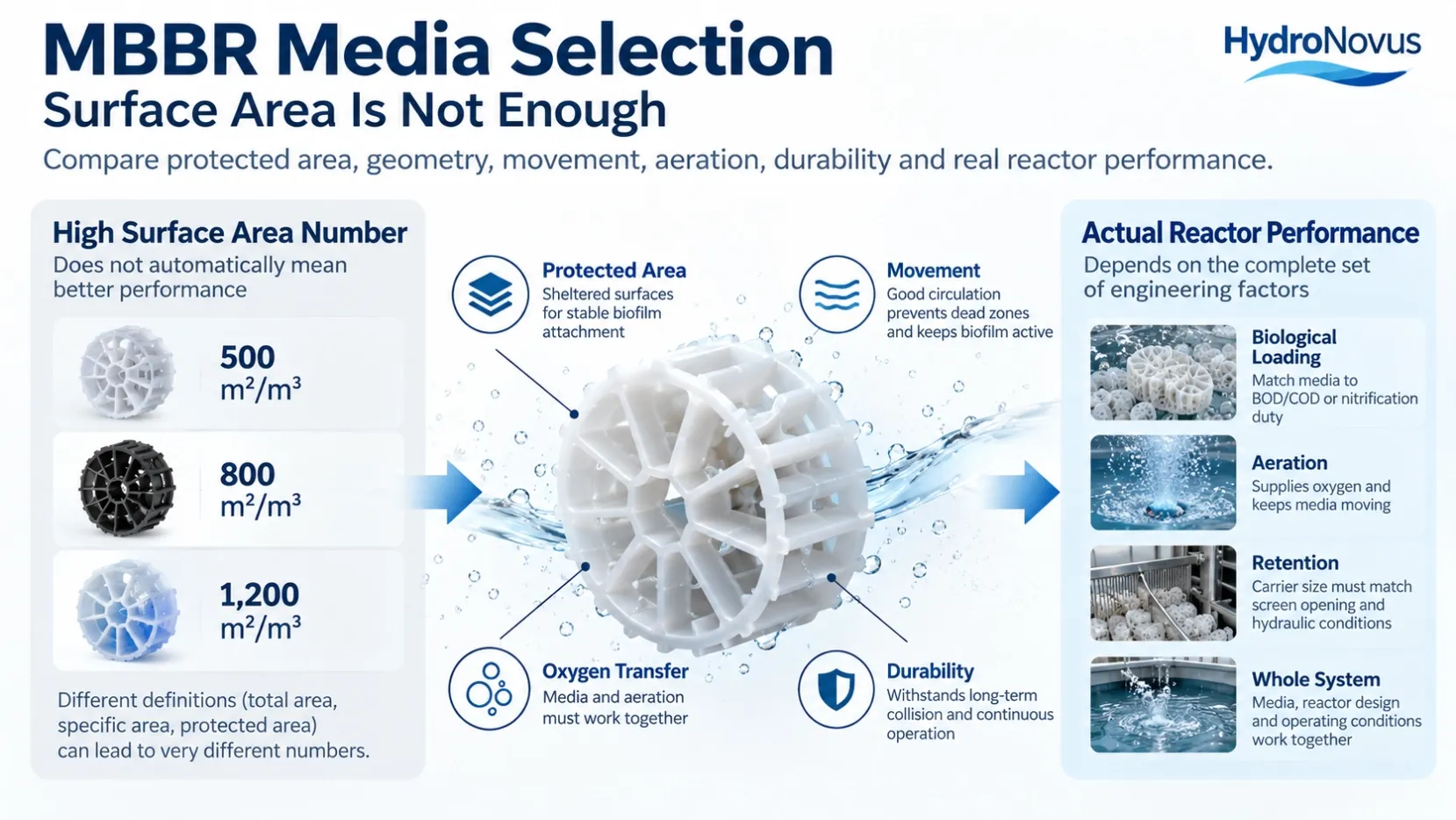
An RAS biofilter stays stable when biological load, oxygen delivery, water chemistry, solids control and hydraulic contact remain within the system's workable range. Carrier media can retain biomass, but media alone cannot prevent instability when feed load rises, solids bypass the mechanical stage or aeration and mixing deteriorate.
Treat rising ammonia or nitrite as a system signal. Reconcile feed and biomass load, mechanical filtration, oxygen, pH/alkalinity, temperature, flow and carrier condition before adding media or increasing aeration blindly.
Conceptual RAS Diagnostic Path
CONCEPTUAL DIAGNOSTIC PATH - NOT A SITE EMERGENCY PROCEDURE: Confirm signal -> reconcile feed and biomass -> inspect solids removal -> map oxygen and mixing -> check chemistry -> inspect carrier condition -> make one bounded correction -> verify the trend.
This sequence is a visual triage aid. Site alarm limits, fish-health procedures and named escalation owners take precedence. The featured image is an existing HydroNovus media-library asset illustrating moving-bed media, not evidence from a specific facility.
Stability Is More Than Peak Treatment Capacity
A short period of acceptable ammonia control at a low feed rate does not prove that a biofilter will remain stable at the operating peak. Commercial RAS loading changes with fish biomass, feed input, temperature, maintenance events and solids-removal performance.
Operational stability means that the system continues to control ammonia and nitrite through expected load changes, while operators can detect drift early and respond without creating a second problem. It does not mean water quality will be constant under every condition.
The Main Variables Behind RAS Biofilter Stability
Feed, biomass and ammonia load
Feed rate and standing biomass are practical indicators of the load entering the treatment train. Compare current values with the biofilter design basis and the last stable operating period. A step change in feeding can appear in water-quality trends before the attached community fully adapts; the load, ammonia and nitrite relationships are summarized in the University of Florida RAS water-quality guidance.
Solids carryover
Uneaten feed, fecal particles and fragmented solids can raise oxygen demand and accumulate around media or within the reactor. A biofilter that appears undersized may instead be receiving more particulate and organic load because screening, drum filtration, sludge discharge or housekeeping has deteriorated. The importance of mechanical filtration, monitoring and biofilter loading is also addressed in the Victorian Fisheries Authority RAS guideline.
Use the separate guide on how poor solids removal affects an RAS biofilter when solids carryover is the leading symptom.
Oxygen and carbon dioxide conditions
Check dissolved oxygen at representative reactor locations and during the highest expected demand period. Also inspect blower or oxygen-supply performance, diffuser condition and gas transfer. A normal value at the outlet does not prove that every media zone receives adequate oxygen.
pH, alkalinity and temperature
Nitrification is sensitive to its chemical and thermal environment. Trend pH, alkalinity and temperature with ammonia and nitrite rather than viewing each parameter in isolation. A gradual chemistry change can reduce performance even when feed load appears unchanged; use the UF/IFAS water-quality overview for background relationships and the site design basis for actual limits.
Record whether the reported ammonia value is total ammonia nitrogen (TAN) or another test basis. The toxic un-ionized fraction depends on environmental conditions including pH and temperature, so interpret results against species-specific and site-approved limits rather than applying a universal threshold from this article.
Hydraulic flow, mixing and media movement
Water must contact the active biofilm, and moving carriers should circulate throughout the intended reactor volume. Check for dead zones, short-circuiting, blocked retention screens, uneven aeration, carrier clustering or abnormal water level and head loss.
Biofilm and carrier condition
Inspect color, coating, odor, excessive solids accumulation, damaged carriers and unusual sloughing. Moving media can reduce localized accumulation when mixing and upstream solids control are appropriate, but it does not eliminate clogging or fouling risk under all operating conditions.
Operator Sequence When Ammonia or Nitrite Starts to Rise
Mobile and shift-handover version
On a phone or shift sheet, record one line per step: time and location; measured value and unit; stable baseline; feed/biomass change; solids-removal condition; DO and circulation observation; chemistry observation; action taken; owner; retest time; response. This preserves the same sequence without requiring side-to-side table reading.
Step | Operator check | Purpose |
|---|---|---|
1. Confirm the signal | Repeat the measurement and check instrument condition | Avoid acting on a bad sample or sensor |
2. Reconcile load | Feed rate, biomass, mortality and recent operating changes | Identify whether biological demand increased |
3. Check solids removal | Screen/drum condition, bypass, backwash and sludge discharge | Find added particulate and oxygen load |
4. Check oxygen and mixing | DO profile, air delivery, media circulation and dead zones | Confirm transfer and contact conditions |
5. Check chemistry | pH, alkalinity, temperature and relevant treatment chemicals | Identify inhibition or environmental drift |
6. Inspect the biofilter | Carrier condition, accumulation, screens and sloughing | Separate physical from biological symptoms |
7. Make one bounded adjustment | Reduce load or correct the confirmed constraint | Preserve cause-and-effect visibility |
8. Verify the response | Trend ammonia, nitrite and operating variables | Confirm recovery before restoring load |
If ammonia or nitrite is rising rapidly, the operating response must protect the stock and follow the facility's water-quality and fish-health procedures. This article does not replace site-specific emergency limits or veterinary guidance.
Routine troubleshooting stops when a verified result reaches the site alarm or emergency threshold, stock behavior or mortality changes materially, oxygen delivery is lost, or the trend continues to worsen despite the first bounded correction. At that point, alert the named responsible operator and follow the site emergency procedure. Retest cadence and escalation ownership should be written into that procedure.
Check Critical-Service Resilience
Confirm that water-quality, blower or oxygen-supply and circulation alarms function as intended. Review standby power, duty/standby pumps or blowers, backup aeration or oxygen where provided, and the date of the last failover test. Assign ownership for acknowledging alarms and escalating a failed critical service.
Cleaning, Backwashing and Maintenance
Cleaning should remove accumulated solids or restore hydraulic contact without stripping all active biomass. The appropriate method depends on the reactor and media configuration. Document what was cleaned, how aggressively, and what happened to ammonia, nitrite, oxygen and solids afterward.
Use staged, site-approved maintenance where the configuration allows it. Avoid cleaning every biological stage at once, preserve active treatment capacity, record pre- and post-maintenance conditions, and restore load only after the agreed recovery checks pass.
Where a backwash or agitation step is used, verify that waste solids actually leave the active water loop. Redistributing detached material without effective removal can move the oxygen demand downstream rather than solving it.
When to Consider a Retrofit
Consider a capacity or configuration review after operating constraints have been separated from a true load-capacity gap. Evidence for a retrofit includes a sustained increase in verified load, stable upstream solids control, adequate oxygen and mixing, acceptable water chemistry, intact media and persistent treatment shortfall.
If available tank volume is the main constraint, see How to Increase RAS Biofilter Capacity Without Expanding Tank Volume. For media tradeoffs, use the separate HPU-versus-HDPE retrofit comparison.
Data to Send for a Preliminary RAS Biofilter Review
Provide species and biomass, average and peak feed rate, circulation flow, TAN/ammonia and nitrite trends with units, pH, alkalinity, temperature, dissolved oxygen locations, fish behavior and mortality observations, stocking or harvest events, recent medication or disinfectant exposure, existing biofilter dimensions, media type and fill, aeration or mixing arrangement, upstream solids-removal equipment, maintenance history and the retrofit objective.
HydroNovus can provide a preliminary RAS biofilter assessment that documents the constraint screen, missing-data list and recommended next engineering step. It is not a final design or guarantee of water quality. Discuss your RAS project.
Technical References and Claim Map
The University of Florida IFAS guidance on RAS problem solving and maintenance supports the monitoring, records and emergency-procedure approach.
Its companion RAS water-quality overview discusses biofilter load, ammonia/nitrite, oxygen and solids-removal interactions.
The Victorian Fisheries Authority RAS guideline supports the discussion of system monitoring, alarms, backup services, mechanical filtration and biofilter loading. Project-specific limits and emergency actions must still come from the facility design and operating plan.