Bio-Cord Curtains in an Existing Activated-Sludge Tank: More Capacity Without a New Tank
Bio-Cord curtains add fixed biofilm area to an existing activated-sludge tank. Sizing, spacing, aeration checks, SND layering, and when not to use them.
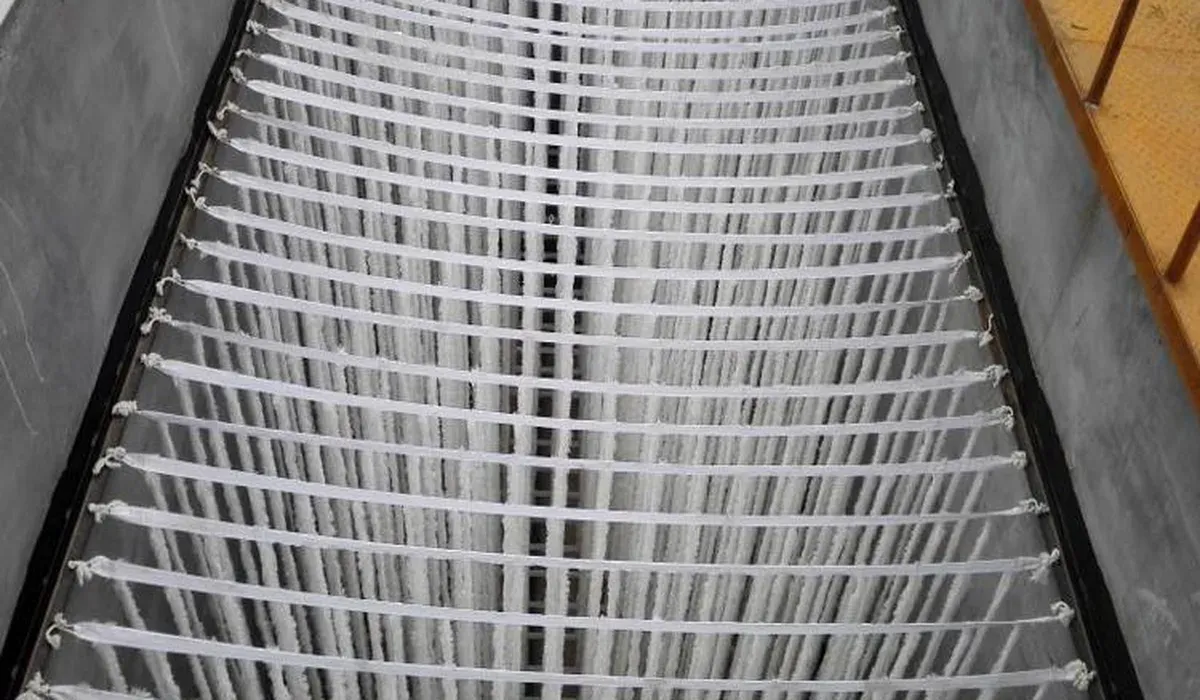
A Bio-Cord curtain retrofit adds fixed biofilm surface to an activated-sludge tank that has run out of room. The suspended biomass stays, the cord adds an attached biofilm layer, and the combined system treats more load in the same concrete — no new tank, no new footprint. That is the whole appeal, and it only works if four checks are done first: how much cord the tank can hold, whether the spacing lets water and air move, whether the blowers can feed the extra oxygen demand, and whether the tank suits fixed media at all.
How Curtains Change an Activated-Sludge Tank
A Bio-Cord curtain is a set of braided fibre cords hung vertically from a frame in the aeration basin. The cords do not move. Wastewater flows past them and a biofilm grows on the fibre loops, while the tank keeps its suspended activated sludge. The retrofit is therefore a hybrid: suspended growth plus attached growth in one volume. It is the IFAS idea with fixed media: no retention screens, no carrier inventory, and the aeration grid does the mixing.
Installation is the advantage. Frames are lowered into a drained or partially drained tank, fixed to the walls or floor, and the cords are hung from them. The limit is the same as the advantage: because the media is fixed, every square metre of it must be reached by oxygen and substrate, or it becomes dead weight.
HNS manufactures Bio-Cord at its own Yixing factory and supplies cord on frames sized to the tank. All figures here are supplier-stated peer figures, not HNS-verified specifications; the measurement method is unstated by every source that publishes them.
Sizing and Spacing: What the Tank Can Actually Hold
Sizing starts from the tank, not the catalogue. Usable volume is the aerated volume minus frames, headers, walkways, and clearance above the diffusers. A frame that fills the tank wall to wall looks efficient on paper and starves the middle of the basin in practice.
Two peer-published installation figures set the working envelope. Frame spacing — the gap between adjacent cord frames — is commonly stated as 100–200 mm, and cord packing as 25–100 metres of cord per cubic metre of frame volume. Both come from peer blog data, not a standard: tighter spacing risks channelling, where flow bypasses the cords inside a dense block; wider spacing keeps flow even but wastes volume.
Cord diameter is the other choice. Round Bio-Cord commonly comes in 45–80 mm diameters, in polypropylene and vinylon fibre — the most cited material combination. Supplier-stated specific surface areas are published as ranges; the conservative public value for each diameter is the bottom of its range, used in the table below.
| Cord diameter | Supplier-stated surface area, bottom of range (m²/m³) |
|---|---|
| 45 mm | 4,500 |
| 50 mm | 5,600 |
| 60 mm | 6,000 |
| 70 mm | 4,500 |
| 80 mm | 4,000 |
Three things about this table matter. First, the figures are supplier-stated with the method unstated everywhere — they describe the cord bundle, not the reactor volume, so they cannot be compared directly with installed-area figures measured per cubic metre of tank. Second, surface area does not rise smoothly with diameter: it peaks at 60 mm and falls at 70 and 80 mm, which no published source explains. Third, choosing a diameter is not choosing the biggest number. A thicker cord is mechanically sturdier but packs fewer metres into the same frame.
Size in this order: measure the tank and aeration layout, set frame footprint and spacing, calculate installed cord length, then convert to installed surface at the bottom-of-range figure. If the gap does not close, add frame area or choose a different retrofit — not a more optimistic figure. For how surface-area figures are measured and why the basis matters, see BET vs Nominal Surface Area: What Biofilm Media Figures Actually Mean. For the wider retrofit comparison, see MBBR vs IFAS for a Wastewater Plant Retrofit.
The Aeration-Demand Check Most Retrofits Skip
This check decides whether a curtain retrofit succeeds or slowly suffocates. Every square metre of added biofilm is added oxygen demand. Suspended biomass keeps its old demand; attached biomass adds demand for carbon oxidation and, where it nitrifies, for oxygen-hungry ammonia oxidation.
Before ordering cord, check three things. First, blower capacity against the new total oxygen demand: existing load plus the load the added biofilm is expected to carry. Second, the diffuser layout under the frames: curtains hung directly above a diffuser grid can trap bubbles and create dead zones, while curtains in a gap between grids can sit in a low-oxygen shadow. Third, the dissolved-oxygen profile across the basin at the new load, measured after start-up rather than assumed from the design sheet. If blowers cannot cover the added demand, the options are a blower upgrade, a smaller installation, or a different retrofit.
Fouled or uneven diffusers show up immediately as patchy biofilm growth, so a curtain retrofit pairs naturally with a diffuser review. See MBBR Aeration Sizing: Oxygen, Mixing, Blower and Diffuser Checks and Fine-Bubble Disc vs Tube Diffusers: How to Choose. For the data a proper retrofit assessment needs, see MBBR Retrofit Data for a Capacity Increase.
Simultaneous Nitrification-Denitrification on the Cord
The most useful property of a thick biofilm on a fixed cord is its layered structure. Oxygen diffuses in from the water and is consumed as it travels inward, so the outer layer stays aerobic while the inner layer, close to the fibre, can become anoxic even while the bulk liquid is aerated. Nitrifiers in the outer layer convert ammonia to nitrate; denitrifiers inside convert nitrate toward nitrogen gas. Both reactions happen in the same biofilm, in the same tank, at the same time. This is simultaneous nitrification-denitrification, or SND.
SND is real but conditional. It needs a biofilm thick enough to hold an oxygen gradient, a bulk dissolved-oxygen level high enough to feed the outer layer without flooding the inner layer, and enough biodegradable carbon reaching the inner layer. Too thin a film, too much dissolved oxygen, or too little carbon, and the anoxic zone never forms. In a curtain retrofit, SND is therefore something to verify during commissioning — by tracking ammonia and nitrate across the basin — not something to promise in advance. No removal-rate guarantee can be attached to it.
Where SND establishes itself, nitrogen improves without an added anoxic tank or recycle; where it does not, the retrofit still adds carbon-oxidation and nitrification capacity. Either outcome is acceptable if planned for.
Installation, Start-Up, and Living With Curtains
The tank, or the section receiving frames, is taken out of service; frames are set, cords hung, and clearances checked against diffusers and walls. Keep cords clear of settled solids at the floor without wasting the lower water column. Suspension height is commonly stated by suppliers at up to about 3 m, a practical limit to check against tank depth before ordering.
Start-up is slower than the sales literature suggests. Biofilm colonisation takes weeks, and full nitrification on the new surface takes longer than carbon oxidation. The sludge carries the load while the film develops, but first-month performance is not final performance — do not judge the installation on week-two effluent.
Maintenance is inspection, not replacement. Cords are checked for uneven growth, clogging between frames, and mechanical damage. Suppliers typically claim a service life of 10+ years for round cord; that is a supplier claim, not a guarantee, and it assumes normal duty and intact frames. Dry weight per metre and porosity for round cord are not published by the sources checked — any figure offered for them should be treated as unverified.
The same fixed-versus-moving media trade-off in RAS is covered in Increase RAS Biofilter Capacity Without Expanding Tank Volume.
When Curtains Are the Wrong Choice
Curtains are not a universal retrofit, and saying so is part of sizing them honestly. They are the wrong choice in at least five situations.
First, a tank with no spare aeration capacity and no budget for a blower upgrade.
Second, a tank with poor hydraulics — short-circuiting, dead corners, or a diffuser layout that cannot be adjusted.
Third, wastewater with heavy fibrous solids, rags, or fats that mat between cords.
Fourth, a plant needing a large, rapid capacity step — roughly doubling throughput, for example. Curtains add incremental area to an existing volume; they do not change the volume.
Fifth, a tank needing frequent full drains for other reasons, or where frames would block access to equipment that needs regular maintenance.
In each case the answer is a different retrofit, a phased plan, or an honest statement that the tank has reached its limit.
FAQs
How much extra capacity can Bio-Cord curtains add to an existing activated-sludge tank?
There is no fixed percentage. It depends on installed cord length at workable spacing, the bottom-of-range surface area for the chosen diameter, and whether the blowers can supply the extra oxygen demand. Size from the tank and the air supply first.
Do Bio-Cord curtains replace the activated sludge?
No. A curtain retrofit is a hybrid: the suspended sludge stays, and the cord adds an attached biofilm layer in the same tank. The sludge carries the load during start-up; both fractions treat wastewater once the film is mature.
Will curtains improve nitrogen removal?
They can, through simultaneous nitrification-denitrification in the layered biofilm — an aerobic outer layer and an anoxic inner layer on the same cord. But SND needs a thick enough film, the right dissolved-oxygen level, and enough carbon reaching the inner layer. Verify it by ammonia and nitrate sampling during commissioning, not by promising it in advance.
How long do Bio-Cord curtains last?
Suppliers typically claim 10+ years for round cord. That is a supplier claim, not a guarantee. Dry weight per metre and porosity for round cord are not published by the sources checked, so no figure for either should be relied on.
For a sizing check on your own tank — dimensions, existing aeration capacity, current load, and target effluent — contact HNS Watertech at /contact.