BET vs Nominal Surface Area: Why Media Numbers Don't Compare
Sponge at 20,000 m²/m³, carrier at 800: the figures use different rulers. BET, nominal and protected area explained, plus what to ask.
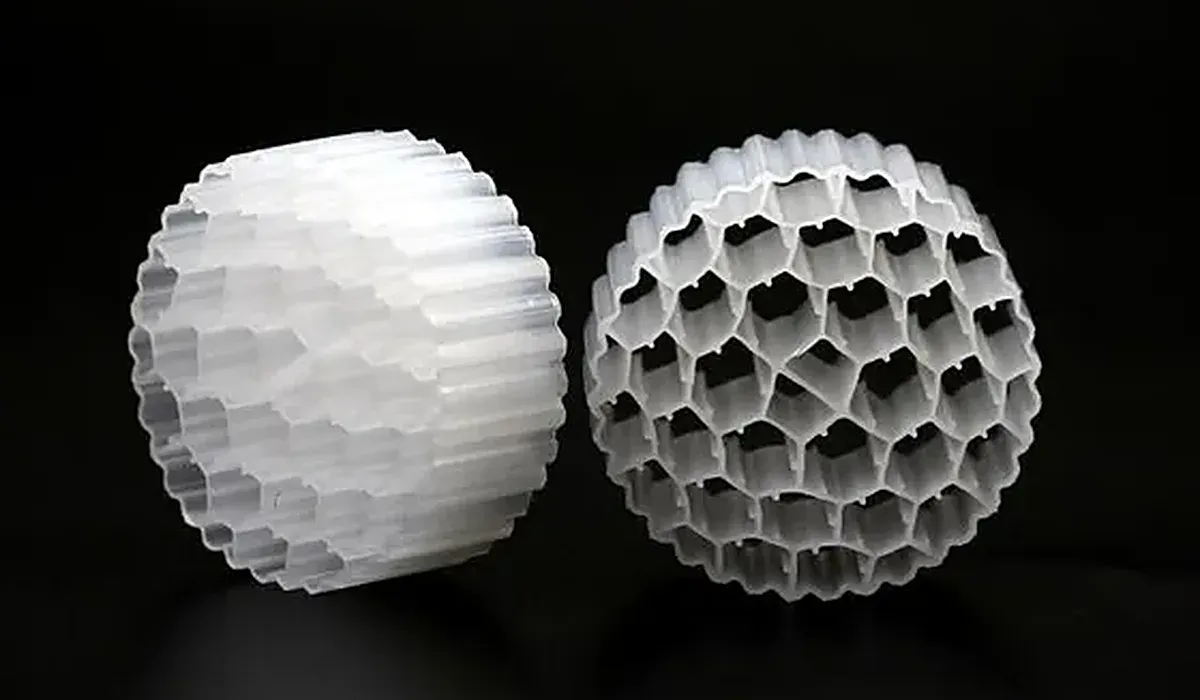
Line up the brochures and the numbers look absurd. One sponge is advertised above 20,000 m²/m³. Another sponge is stated at 4,000 m²/m³. A plastic carrier sits at 800 m²/m³, and the same carrier model appears at above 700 in one catalogue and above 800 in another. Buyers then ask the obvious question: if one medium has twenty-five times the surface area of another, why is it not twenty-five times better — or twenty-five times the price?
The short answer is that these numbers are not measured with the same ruler. Some are calculated from a drawing, some are measured with gas, and some count only the surface where biofilm can actually survive. A bigger number is not a better medium until you know which basis produced it. This article covers the measurement methods only — for how the figures feed into choosing a medium, see our MBBR media selection guide.
Nominal surface area: a number calculated from geometry
For a moulded plastic carrier, the headline figure is usually the nominal (geometric) surface area. Nobody measures it with an instrument. It is arithmetic: the surface area of one carrier — its outer walls, internal partitions and fins — is calculated from the carrier geometry, then multiplied by the number of carriers in a cubic metre.
That makes the nominal figure useful and limited at the same time. It is a fair way to describe the geometry of a carrier, and two carriers calculated under identical counting rules can be compared. But the counting rules are exactly where suppliers diverge, as shown below. The nominal figure also says nothing about how much of that surface keeps a working biofilm in a real reactor, which is why carrier suppliers also work with the next figure.
Protected surface area: the part the biofilm keeps
In a moving bed, carriers collide with each other thousands of times a day, and aeration scouring is constant. Biofilm on the exposed outer faces is knocked and worn away as fast as it grows. The biofilm that persists — and does the treatment — sits on the sheltered internal surfaces: inside the carrier's cells and channels, out of the direct abrasion path.
Protected surface area counts only those sheltered surfaces. It is smaller than the nominal total, and it is the design-relevant figure for a carrier, because loading rates and media volumes are worked out from the area that actually carries biofilm. Our MBBR media volume calculation shows how the volume of media for a duty is derived from a surface loading rate — that arithmetic only works if the area figure behind it is the protected one.
The HNS catalogue states its carriers on this nominal/protected basis: MBBR19 above 650, MBBR37 above 800, MBBR40 above 900, MBBR64 above 1,200, MBBR76 above 1,600, MBBR04 above 900, MBBR05 above 1,000 and MBBR06 above 800 m²/m³. The full range is on the MBBR media product page.
BET surface area: a number measured with gas
BET is a different kind of figure entirely. The BET method (Brunauer–Emmett–Teller, with the measurement principle standardised in ISO 9277) does not look at geometry at all. A gas such as nitrogen is adsorbed onto the material at low temperature, and the amount adsorbed reveals the total accessible surface — including the internal walls of every open pore, down to molecular scale.
For a porous material such as polyurethane sponge, that internal pore surface is enormous, so BET results run into the thousands of m²/m³. One sponge supplier states 4,000 m²/m³ measured by BET. Another advertises above 20,000 m²/m³ without stating a method at all. Neither number is a geometry figure, and neither can be set beside a carrier's nominal figure.
The reason is scale. A bacterial cell is roughly a micrometre across, and a working biofilm needs pores and channels far larger than that, with wastewater flowing past them. Much of the pore surface a gas molecule can reach is in pores far too small for bacteria to colonise, or in dead-end pores with no flow. BET area is a genuine property of the material — it is meaningful when comparing two sponges measured the same way — but it does not translate into colonisable area in service, and there is no conversion factor between a BET figure and a protected-area figure.
Our own NovusPore sponge is stated at above 5,000 m²/m³ on the sponge product page — a porous-material figure, on a porous-material basis. We do not rank it against our own carriers' figures, because the bases differ; the practical differences between the two media families are covered in our sponge vs HDPE carrier comparison.
The three methods side by side
| Method | What it measures | Used for | What it misses |
|---|---|---|---|
| Nominal (geometric) | Total surface calculated from carrier geometry | Describing and comparing carrier geometry | How much of the surface keeps biofilm under abrasion |
| Protected | The sheltered internal surface where biofilm persists | Carrier design: loading rates and media volumes | Anything about porous materials; still depends on counting rules |
| BET (gas adsorption) | Total accessible surface including internal pore walls | Comparing porous materials measured the same way | Whether the surface is colonisable or sees any flow in service |
Why even two nominal numbers can disagree
Method is not the only problem. Two suppliers can both quote a "nominal" figure for the same carrier model and still differ — the same model appears above 700 m²/m³ in one catalogue and above 800 m²/m³ in another. The usual causes are counting rules, not dishonesty:
- Which faces are counted. Both faces of every internal wall, or only some surfaces?
- What is included. Are the internal cross-partitions, fins and rim counted in full, in part, or not at all?
- Drawing or moulded part. Geometry taken from the design drawing differs slightly from a moulded carrier once tolerances and shrinkage are included.
- Rounding and "above" claims. A figure stated as ">800" may be a rounded minimum, while another supplier prints a calculated value to the nearest ten.
The same looseness shows up with sponge: one supplier's own pages give two different figures for the same sponge product. When the basis is not printed next to the number, there is no way to know which version — or which ruler — you are looking at.
What to ask before you compare
Before ranking any two media on surface area, ask the supplier five things:
- Which method produced the figure — geometric calculation, protected-area basis, or BET measurement?
- Is it total or protected area? For a carrier, the protected figure is the one design is based on.
- Can I see the basis in writing — a datasheet or test report that states the method, not just the number?
- Am I comparing like with like? Carrier against carrier on the same basis; sponge against sponge on the same basis. Never across.
- What loading rate do you design to? A supplier who works from protected area and a stated loading rate is giving you a checkable design, not a headline.
If a quotation leads with a very large surface-area number and cannot answer the first question, the number is marketing, not engineering.
FAQs
Is a higher surface area always better?
No. A higher figure only means more area on the basis used to produce it. A BET figure in the thousands and a protected-area figure in the hundreds describe different things, and within one basis, usable area also depends on whether the surface is sheltered, colonisable and reached by the flow.
Can a BET figure be converted into a protected-area figure?
No. There is no conversion factor, because the two methods count different surfaces: gas-accessible pore walls at molecular scale versus sheltered geometry at carrier scale. Any supplier offering a simple multiplier between them is inventing it.
Which figure should I use to size an MBBR?
For plastic carriers, use the protected surface area together with a surface loading rate for your duty, and check the supplier's counting basis before comparing models. For sponge, treat the stated area as a material property and size from the supplier's loading data for the actual application instead.
Why does the same carrier model show different numbers from different suppliers?
Because the counting rules differ: which faces and internal walls are included, whether the geometry comes from the drawing or the moulded part, and how the result is rounded. Ask each supplier for the basis in writing and the figures usually become explainable — and comparable.
Get a like-for-like check: if you are comparing media quotations and the surface-area figures do not line up, send us the datasheets and we will tell you which basis each figure is on and how they really compare — contact us.