MABR vs MBBR: Membrane Biofilm and Carrier Biofilm Compared
MABR and MBBR both grow biofilm — but one feeds it oxygen through a membrane, the other through bubbles. Mechanism, hardware and retrofit fit compared.
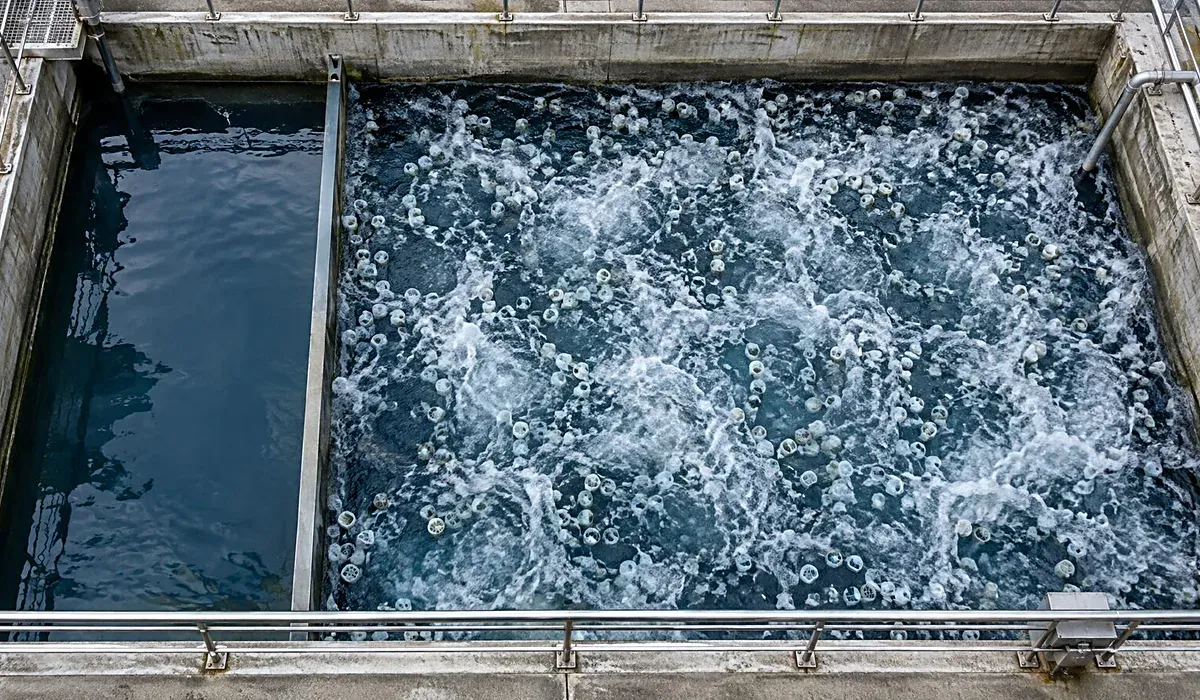
MABR and MBBR are not the same process, and they are not interchangeable names for one technology. Both grow a biofilm to do biological treatment work, and both are sold as ways to add capacity without building new tanks. The similarity mostly ends there. In an MABR (membrane-aerated biofilm reactor), the biofilm grows on a gas-permeable membrane, and oxygen is delivered through that membrane without bubbles. In an MBBR (moving bed biofilm reactor), the biofilm grows on free-moving plastic carriers, and oxygen arrives as bubbles from an aeration system in the same liquid. Where the oxygen comes from decides almost everything else: the hardware in the tank, the retrofit work, the operating sensitivities and the failure modes.
How MABR feeds its biofilm: oxygen from inside
An MABR module is a bundle of gas-permeable membranes — hollow fibres or cords — submerged in the process tank. Air, or in some designs oxygen-enriched air, is supplied at low pressure to the inside of the membrane. Oxygen diffuses through the membrane wall directly into the biofilm attached to the outer surface. There is no bubble column doing the transfer; the gas crosses the wall molecule by molecule.
This creates a diffusion pattern engineers call counter-diffusion. Oxygen is at its highest concentration at the membrane surface and falls off through the depth of the film. Ammonia and organic matter diffuse in the opposite direction, from the bulk liquid toward the membrane. The two gradients cross inside one biofilm, and that is the MABR's signature advantage: nitrifying bacteria settle near the membrane, where oxygen is plentiful, while the outer layer of the same film — starved of oxygen but supplied with carbon from the liquid — can denitrify. Nitrification and denitrification in a single biofilm, without a separate anoxic zone, is the result suppliers design for.
Because transfer is bubble-less, an MABR also strips far less of the tank's volatile content into the air above it, and the exhaust gas leaving the membrane is small in volume. The trade-off is that the membrane is both the biofilm's home and its oxygen supply line: if the surface fouls or the film grows too thick, performance is affected at the source.
How MBBR feeds its biofilm: oxygen from the liquid
An MBBR tank holds thousands of small plastic carriers, kept in constant motion by aeration or, in anoxic zones, by mechanical mixing. HNS carriers are 100% virgin HDPE with a density of 0.96–0.98, just below that of water, so they circulate through the whole tank volume rather than floating in a layer or sinking. Typical filling ratios run from 15% to 65% of tank volume, depending on the duty.
Here the diffusion pattern is co-diffusion: oxygen and substrates both arrive from the bulk liquid, from the same side. Oxygen is supplied by a conventional blower and diffuser grid — the same air that keeps the carriers moving. Biofilm thickness is controlled passively: carriers collide with each other and with the tank walls, and the shear sloughs off excess growth. A new fill normally grows its working biofilm — membrane formation, in the older terminology — within 3 to 15 days, after which the film is self-regulating.
The protected surface area inside the carriers is where the biofilm lives, and it is the figure that matters when comparing media: in the HNS catalogue, for example, MBBR19 offers more than 650 m²/m³, MBBR37 more than 800, MBBR64 more than 1,200 and MBBR76 more than 1,600 m²/m³. Our MBBR media selection guide explains how to read those numbers and why the measurement basis must be stated before any two suppliers' figures are compared.
The two processes side by side
| Aspect | MABR | MBBR |
|---|---|---|
| Biofilm grows on | Gas-permeable membrane (fibres or cords) | Free-moving plastic carriers |
| Oxygen delivery | Through the membrane wall, bubble-less | Bubbles from a blower and diffuser grid |
| Diffusion pattern | Counter-diffusion: oxygen and substrates from opposite sides | Co-diffusion: both from the bulk liquid |
| Simultaneous nitrification–denitrification | Designed-in, within one biofilm | Needs separate zones or stages in most layouts |
| Main hardware in the tank | Membrane modules in frames, low-pressure air supply | Carriers, outlet retention screens, aeration grid |
| Biofilm thickness control | Managed by air scouring and cleaning regime | Passive, by carrier collision and shear |
| Typical sensitivities | Membrane fouling, film overgrowth, membrane integrity | Screen blockage, dead zones, carrier loss through damaged screens |
| Process redesign for retrofit | Module placement, air supply and controls change | Usually limited to screens and an air-capacity check |
What each process asks of the plant
The MABR's core asset is the membrane module itself. It needs a clean, controlled air supply at low pressure, a scouring or relaxation regime to manage the film, periodic cleaning, and instrumentation to watch trans-membrane behaviour. The membranes are a manufactured, replaceable component with a finite service life, and the supplier relationship matters for the life of the plant.
The MBBR's core asset is a tank full of carriers, and its demands are more mechanical than chemical: retention screens at the outlet to keep media in the tank, enough air to mix as well as to oxygenate, and a blower with capacity for both jobs. How those two air duties are balanced is covered in our MBBR aeration sizing guide. Carriers themselves have no moving parts and no cleaning cycle; sponge media is an alternative carrier family for some duties, compared in our guide to sponge vs HDPE MBBR media selection.
Retrofit fit: why both are in the news
Both processes are being bought for the same reason — existing plants that need more nutrient removal inside a fixed footprint. The recent headlines are mostly MABR's. DuPont's OxyMem MABR was announced in November 2026 for the Windsor water reclamation plant in California, reported as the first municipal MABR deployment in the United States. In New Zealand, Veolia's ZeeLung MABR is operating paired with an MBR at Te Kauwhata, and a ZeeLung MABR + MBR upgrade at Watercare's Wellsford plant was reported in November 2026. These are vendor-announced projects, cited here as evidence of where the technology is being deployed, not as performance references.
An MABR retrofit typically means installing module frames into existing aeration lanes, reworking the air supply, and adjusting process control around the new biofilm behaviour. It is a process change, not just an equipment addition. An MBBR retrofit usually means filling part of the existing tank volume with carriers, fitting retention screens, and confirming the blowers can mix the bed — the same fill-the-existing-volume logic used to raise RAS biofilter capacity without expanding tank volume in aquaculture systems. Neither route needs new civil works in most cases; they differ in how much of the process itself is redesigned.
When each is the practical choice
MABR is the practical choice where the design is built around it: tight nitrogen limits in a fixed footprint, a process layout that benefits from nitrification and denitrification in one film, or a site where bubble-less operation matters — for example, where stripping volatile compounds to air is a concern. It rewards plants with the instrumentation and supplier support to look after membranes properly.
MBBR is the practical choice for most retrofits of existing aeration tanks, for plants that want capacity from equipment their operators already understand, and for duties where a broad, competitive media supply matters more than a single integrated package. HNS manufactures MBBR and sponge media — see the MBBR media product page — and does not sell MABR systems. Stated plainly: for most retrofits, the carrier route needs no membrane modules and no process re-design; the media goes into the tank the plant already has. Where a design genuinely calls for membrane aeration, a specialist MABR supplier is the right address — the two processes solve overlapping problems with different machinery, and choosing between them starts with the mechanism, not the brochure.
FAQs
Is MABR just another name for MBBR?
No. Both are biofilm processes, but in an MABR the biofilm grows on a gas-permeable membrane that supplies its oxygen bubble-lessly, while in an MBBR the biofilm grows on free-moving plastic carriers and oxygen comes from bubble aeration. The hardware, retrofit work and failure modes are different.
Which one uses less energy, MABR or MBBR?
There is no universal figure, and any percentage quoted without a duty attached should be treated as marketing. Bubble-less transfer avoids the losses of pushing air through deep water as bubbles, but the real comparison depends on loading, tank depth, blower efficiency and how much air each process needs for mixing and scouring. Ask both suppliers to state their energy basis against the same load.
Can MABR and MBBR be combined in one plant?
Yes, hybrid layouts exist — the Te Kauwhata plant in New Zealand, for example, pairs an MABR with an MBR, and membrane aeration can be staged ahead of carrier-based polishing. Combining processes is a design decision: each stage still has to be sized on its own load, and the operator takes on both sets of maintenance duties.
My plant has an existing aeration tank. Which retrofit is simpler?
In most cases the MBBR route: carriers are added to the existing volume, retention screens are fitted, and the main check is whether the blowers can mix the media bed as well as supply oxygen. An MABR retrofit adds module installation, a reworked air supply and process-control changes on top of the tank work.
Get a media sizing check: if you are weighing a carrier-based retrofit, send us your tank volume, current process and treatment target and we will check media type, quantity and filling ratio for you — contact us.