Nitrite Spike in a Running RAS: What to Do in the First 24 Hours
Nitrite rising in your RAS? A step-by-step first-24-hours response: verify the reading, protect the fish, cut feed, exchange water and find the cause.
A nitrite spike in a running recirculating aquaculture system is an emergency: the first 24 hours decide how much damage it does. Nitrite blocks the blood's ability to carry oxygen, so fish can suffocate in water that still tests fine for dissolved oxygen. The response is a fixed sequence — verify the reading, protect the fish, stop adding load, dilute the nitrite, then find and fix the cause, in that order — treating the cause first while fish are still exposed is the wrong priority.
This is a first-response guide for operators — not a replacement for veterinary or fish-health advice for your species.
Why nitrite spikes happen
In a healthy RAS, two groups of bacteria work in sequence: ammonia oxidisers convert ammonia to nitrite, and nitrite oxidisers convert nitrite to nitrate. A spike means the second step has fallen behind the first — nitrite is produced faster than the biofilter can clear it.
A biofilter upset. Anything that harms the nitrite oxidisers — a cleaning chemical reaching the biofilter, a sudden temperature swing, a pH crash, a power cut that stops flow or aeration — knocks back the slower-growing nitrite oxidisers first. They also recover more slowly, which is why nitrite often rises after ammonia settles.
A load increase. More feed, more fish, or higher stocking density raises ammonia production. Ammonia oxidisers respond first and produce nitrite faster; nitrite oxidisers take longer to catch up — the gap is the spike.
A new or restarted biofilter. An immature biofilter, or one restarted after a shutdown, passes through a nitrite phase: biofilm on HDPE media takes 3 to 15 days to form, on hydrophilic sponge media typically 3 to 7 days, and the nitrite oxidisers are the last to reach full capacity. Our MBBR startup and biofilm commissioning guide explains that sequence.
A hidden water-chemistry shift. Nitrification consumes alkalinity, so falling alkalinity drifts the system toward a pH drop that stresses the biofilter. Low oxygen in the biofilter has the same effect, even when the fish tanks still read acceptable dissolved oxygen. If spikes keep returning without an obvious trigger, check alkalinity and biofilter oxygen first.
Hour 0–1: verify before you act
Do not act on a single test result: a wrong reading wastes the response window, and the actions below cost real feed, water, and salt.
Re-test with a fresh sample. Take water from the fish tank, not the biofilter outlet alone, and re-run the test. Check the kit or probe: expiry, calibration, reagent storage.
Test the full set. Measure ammonia and nitrite together, plus pH, temperature, and dissolved oxygen. The pattern tells you what kind of event this is: ammonia high with nitrite rising means the whole chain is behind; ammonia low with nitrite high means only the nitrite step has stalled. That distinction shapes the rest of the response.
Look at the fish. Lethargy, fish at the inlet or surface, reduced appetite, rapid gill movement — these mean nitrite is already affecting the stock. If fish show symptoms, move straight to the protection steps below.
Check what changed. What changed in the last 48 hours — feed, stocking, chemicals, power, cleaning, temperature? Write it down; the cause is usually in that list.
The first-24-hours sequence
| Step | When | Action | Why |
|---|---|---|---|
| 1. Verify | Hour 0–1 | Re-test nitrite, ammonia, pH, temperature, dissolved oxygen; check the test kit | A wrong reading wastes the response window |
| 2. Stop the load | Immediately | Stop feeding; postpone grading, transfer, handling | Every gram of feed becomes ammonia, then nitrite |
| 3. Protect the fish | Hour 0–2 | Raise dissolved oxygen at the tanks; add chloride (common salt), about 10:1 chloride-to-nitrite — confirm the level for your species before dosing | Chloride competes with nitrite at the gills; oxygen offsets reduced blood oxygen capacity |
| 4. Dilute | Hours 1–6 | Exchange water in stages — typically 10–20% of system volume, repeated as readings dictate, not one large shock exchange | Dilution lowers nitrite now; staged exchange avoids stressing fish and biofilter |
| 5. Support the biofilter | Hours 2–12 | Restore flow and aeration; check alkalinity and correct a pH drift; do not clean or disturb the media | The nitrite oxidisers need oxygen, stable pH, and undisturbed biofilm to recover |
| 6. Re-test on a schedule | Every 2–4 hours | Log nitrite and ammonia each time; resume feeding only when nitrite is back near baseline and falling | The trend, not one reading, shows the biofilter has caught up |
| 7. Find the cause | Hours 12–24 | Work the change list; fix the trigger before resuming normal operation | A spike that is diluted but not explained will return |
Do not shortcut the sequence: feeding, cleaning the biofilter, or one massive exchange instead of staged exchanges each slow recovery and hurt the fish.
Protecting the fish: what actually helps
Stop feeding. This is the most effective action in the first hour, and it costs nothing: no feed means no new ammonia, hence no new nitrite. Fish can go a day without feed without harm in most systems; a day of nitrite exposure can kill them.
Add oxygen. Nitrite reduces the blood's oxygen-carrying capacity, so fish need more dissolved oxygen to compensate. Increase aeration or oxygen supply at the tanks, and check oxygen is actually reaching the fish — not only that the generator is running. Our guide to RAS oxygen supply and generator sizing covers the checks that matter when oxygen delivery, not just production, is the question.
Chloride, with care. Chloride competes with nitrite for uptake at the gills, so raising chloride is the standard protective measure in freshwater RAS. A common operator rule of thumb is a chloride-to-nitrite ratio of about 10:1 — a rule of thumb, not a prescription: confirm the right level for your species, life stage, and water before dosing, and never use iodised table salt or salt with anti-caking additives. In brackish or marine systems the water already carries chloride.
Helping the biofilter recover
The biofilter recovers on its own given oxygen, stable chemistry, and time — the operator's job is to remove obstacles, not intervene in the biology.
Keep water flowing through the biofilter. A biofilter starved of flow or oxygen cannot clear nitrite at all. Check pumps, air supply, and distribution for even flow across the media bed.
Do not clean the media. The instinct in a crisis is to clean something — but cleaning biofilter media during a spike strips the recovering biofilm and sets recovery back by days. The media needs attention only after the spike, and only if inspection shows clogging or channelling. Our RAS biofilter troubleshooting guide covers the solids, oxygen, and loading checks for that post-spike inspection.
Check alkalinity and pH. Nitrification consumes alkalinity continuously, and a spike often coincides with alkalinity running down. If pH is drifting low, correct it gradually — a sudden pH swing is itself a biofilter stress. Alkalinity depletion is the hidden constraint behind many repeat spikes.
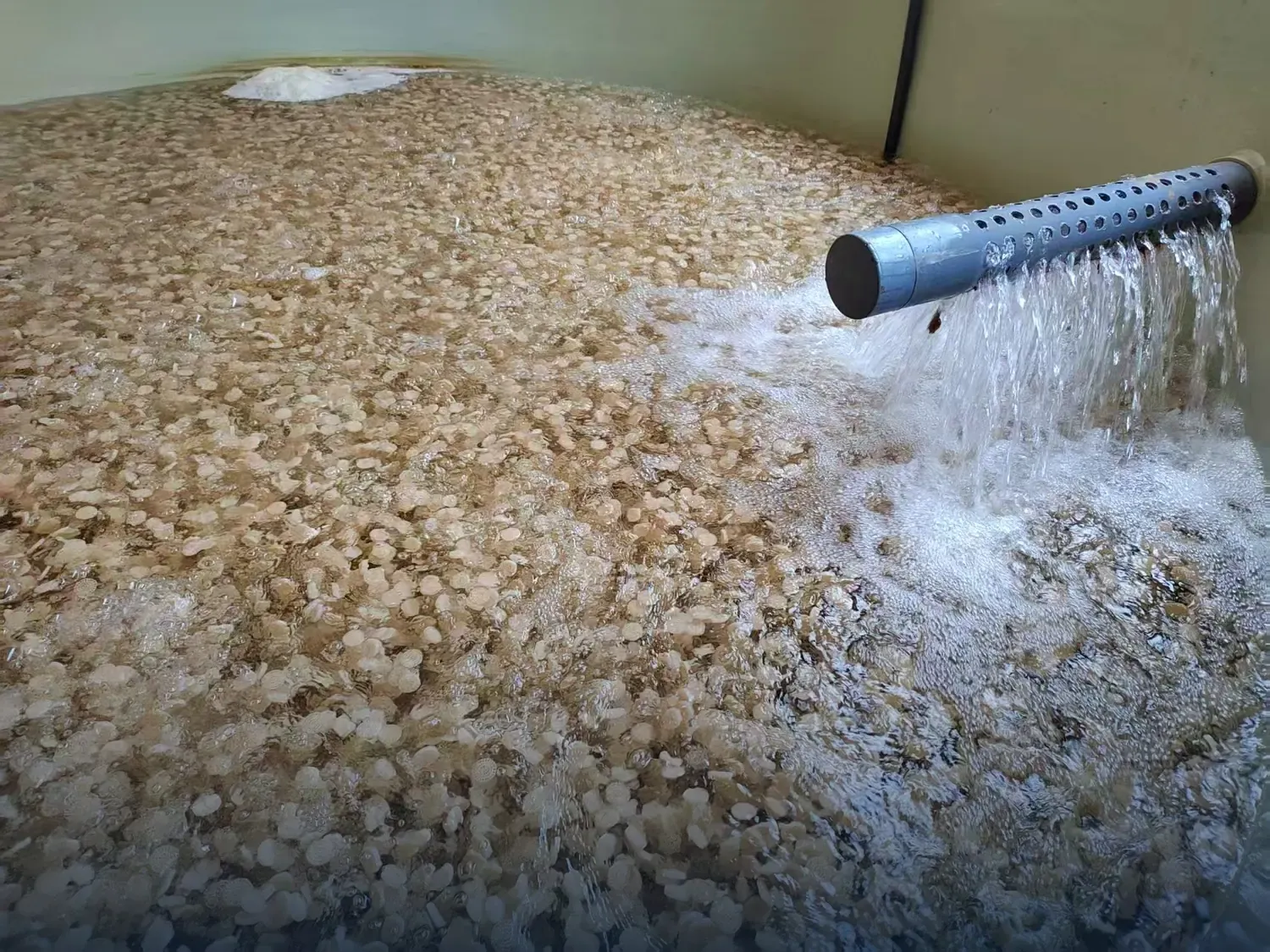
Add capacity only as a planned step, not a crisis fix. If the spike exposed a real capacity shortfall, the fix is more protected surface area — planned after the spike, not improvised during it. Sponge media is often used for exactly this: surface area above 5,000 m²/m³, porosity above 98%, adding a large amount of biofilm area in a small volume, with biofilm forming typically in 3 to 7 days. The NovusPore PPC sponge media page carries the product data; the HDPE MBBR media range lists the protected surface area for each model.
After the spike: preventing the next one
Once nitrite is back near baseline and fish are feeding normally, work through the prevention list — a spike with no identified cause will return.
- Feed changes in steps. Raise feed gradually after any stocking increase; give the biofilter days, not hours, to grow into the new load.
- Log alkalinity, not just pH. A pH reading tells you where you are; an alkalinity trend tells you where you are heading. Falling alkalinity warns that a pH crash and biofilter upset are coming.
- Protect the biofilter from chemicals. Keep cleaning and disinfection chemicals out of the biofilter loop, with a clear procedure for wash water.
- Keep a change log. Feed, stocking, cleaning, power, temperature — the log turns the next spike from a mystery into a ten-minute diagnosis.
- Know your ammonia baseline too. Nitrite spikes and ammonia excursions share causes — track both together, and treat rising ammonia as an early warning that nitrite may follow.
FAQ
What should I do first when nitrite spikes in my RAS?
Verify the reading, stop feeding, and protect the fish with extra oxygen and — in freshwater systems — chloride confirmed for your species. Dilute with staged water exchanges while the biofilter recovers; find the cause only after the fish are protected.
How long does a nitrite spike last in a RAS?
It lasts until the nitrite oxidisers catch up with the load. In a mature biofilter after a brief upset, that is usually hours to a day or two once the load is cut and the biofilter has oxygen and stable pH. A biofilter still maturing takes longer — biofilm formation on HDPE media runs 3 to 15 days.
Can I keep feeding during a nitrite spike?
No — every gram of feed becomes ammonia and then nitrite. Stopping feed cuts the load fastest, and most fish tolerate a day without feed far better than a day of nitrite exposure.
Will a water exchange alone fix a nitrite spike?
It lowers the reading but does not fix the biofilter. Exchange water to protect the fish now, and at the same time cut the feed load, restore biofilter oxygen and pH, and find the trigger — otherwise nitrite climbs again once the exchange stops.
Worried your biofilter is too small for the load?
Send us your system volume, stocking level, feed rate, and current nitrite and ammonia readings via our contact page. We will check the biofilter capacity free of charge. The MBBR and sponge media come from our own factory in Yixing, and sizing support for a specific project is arranged case by case.