Screw Press Sizing for Biogas Digestate: DS Load & Dilution
Sizing a screw press for biogas digestate? Work from dry solids load, not flow: dilution maths, jar-test conditioning and cake targets explained.
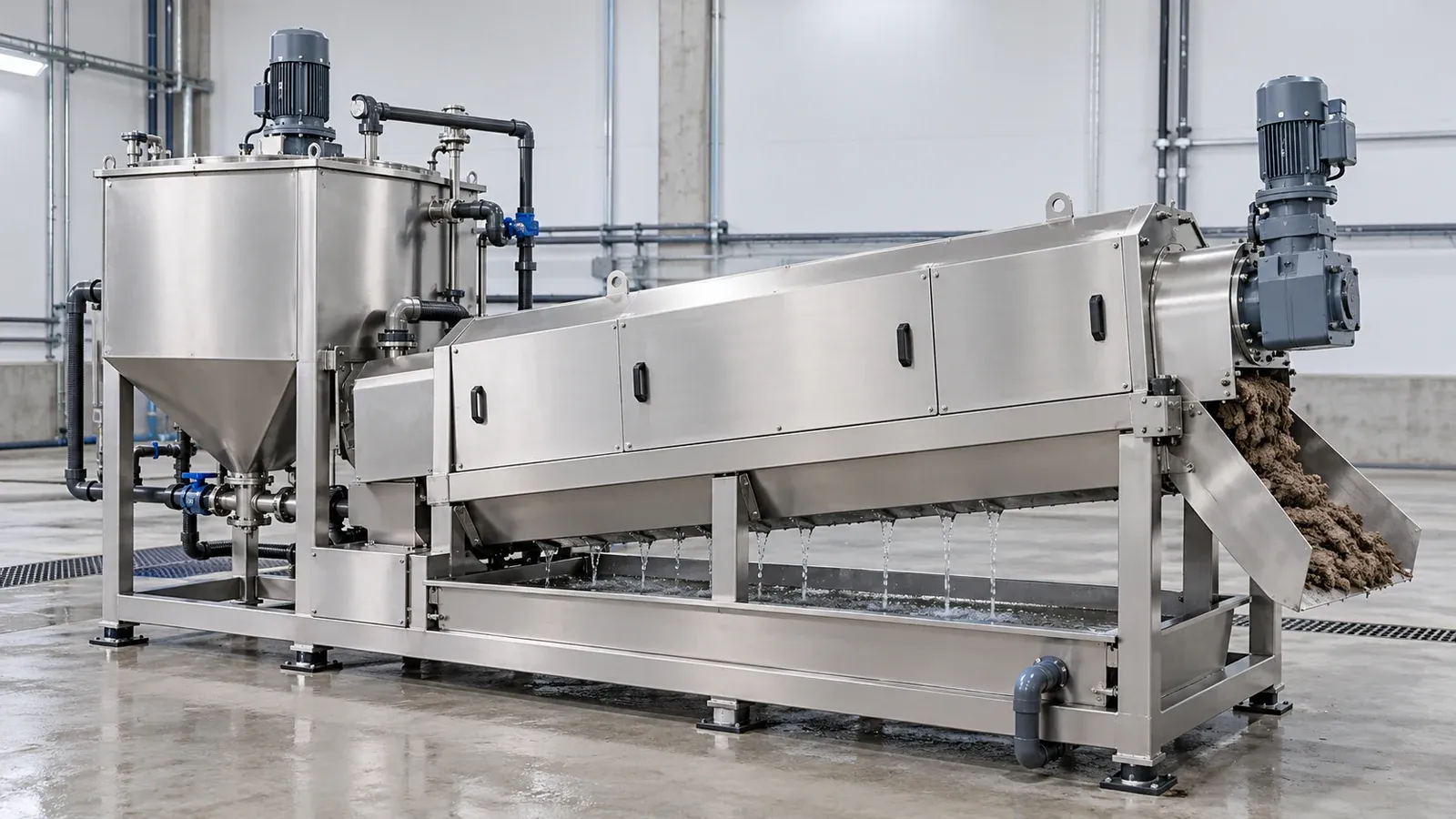
Digestate is the sludge screw presses are most often sized wrong for. The nameplate capacity of a stacked screw press is stated for thin sludge. Digestate leaves the digester thick, organic-rich and reluctant to flocculate. This guide works through the four calculations and checks that decide a correct selection, using a typical case: roughly 3 m³/h of digestate at about 8% dry solids, with an organic share near 70% of the solids.
Why digestate sizes differently from municipal sludge
Three properties make digestate harder than the thin municipal sludge most screw press brochures assume.
First, concentration. Municipal waste activated sludge typically arrives at the press at 1–3% dry solids. Digestate commonly leaves the digester at 5–10%. At the same volume flow, the press sees two to five times the solids load.
Second, organic share. Digestate solids are mostly organic — often around 70% — and a large part of that organic fraction is fine colloidal material that does not settle or flocculate on its own. That is why two suppliers can look at the same digestate and recommend different chemical routes, and why the jar test in Step 3 matters more here than for ordinary sludge.
Third, variability. Digestate concentration drifts with digester feedstock, retention time and season. A selection that only works at one exact concentration will fail on the weeks the digester runs thicker. Size for the load at the upper end of the expected range, not for the average day.
A screw press is still the right machine for digestate — but the sizing arithmetic, not the brochure capacity, is what has to be right.
Step 1: Convert flow into dry solids load
Screw presses are selected on dry solids throughput, not on volume. The same flow at different concentrations is a different machine, so convert first and compare second.
Dry solids load (kg DS/h) = flow (m³/h) × dry solids (%) × 10 — assuming a sludge density of about 1,000 kg/m³ and solids measured by weight, which holds closely enough for digestate.
For the example: 3 × 8 × 10 = 240 kg DS/h.
That is a heavy load for a screw press, whatever the flow sounds like. The same 3 m³/h at 2% solids would be 60 kg DS/h — a machine several sizes smaller. Any sizing discussion that starts from m³/h alone is unreliable. Daily totals complete the picture: 240 kg DS/h over 8 running hours is about 1.9 t DS/day; over 24 hours it is about 5.8 t DS/day. State running hours before comparing models.
The same load-first method is set out in our screw press sizing guide.
Step 2: Check the feed concentration — and the dilution maths
A stacked screw press accepts feed at roughly 1–3.5% dry solids. At 8%, the example digestate must be diluted before the flocculation tank. Dilution is done in a tank or basin; press filtrate is normally returned as the dilution water, so no fresh water is consumed.
Dilution multiplies the hydraulic load while the solids load stays constant:
| Dilution target | Diluted flow through the press | What changes |
|---|---|---|
| 3.5% DS | about 6.9 m³/h | Smallest hydraulic load; needs the strongest flocculation |
| 3% DS | about 8.0 m³/h | Middle ground for many digestate feeds |
| 2% DS | about 12 m³/h | Easiest flocculation; largest pump, pipe and tank duty |
| No dilution (8% DS) | 3 m³/h | Not acceptable — above the press feed range |
The press must pass the diluted volume and capture the full 240 kg DS/h. This is why "dilute more" is not automatically safer: every step down in concentration is a step up in hydraulic size, pump duty and tank volume. Dilute only as far as stable flocculation and feeding require — the jar test in Step 3, not habit, should make that call.
Sequence matters: dilute first, then condition and flocculate, then press. Conditioning a sludge at 8% and diluting afterwards wastes chemicals and breaks the flocs you just paid to build.
Step 3: Decide the conditioning route with a jar test, not an opinion
High-organic digestate is where suppliers disagree most. One school doses cationic polymer only. The other conditions first — an inorganic coagulant such as PFS to neutralise colloid charge, a sludge conditioner to improve structure, then cationic polymer to build the final floc. The second route costs more in equipment and in daily chemical consumption. It is also the route that works when polymer alone produces small, weak flocs and cloudy filtrate.
Neither opinion should win by default. A jar test settles it in ten minutes:
- Take a representative digestate sample, diluted to the planned feed concentration.
- Dose the candidate chemical sequence at two or three dose levels.
- Look for: floc size and strength, how fast free water releases, filtrate clarity after a short drain through cloth.
- Photograph or film each beaker next to its dose label.
Strong, fast-draining flocs with polymer alone → the simple route is justified. Weak flocs or milky filtrate → budget for conditioning. Run this test before accepting any quotation, whichever supplier you choose. The bench-test method and the ramp-up from bench dose to press dose are covered in our polymer dose bench test guide.
One caution: dilute the sample to the feed concentration from Step 2 first — a polymer that looks excellent at 8% can fail at 2%.
Step 4: Fix the cake target before fixing the model
Expected cake moisture for digestate on a screw press is typically around 80–85%. If that is acceptable for storage and transport, select on capacity and keep the model — and the price — down. If the operation needs drier cake, the selection changes: larger press, slower throughput per unit, or a different dewatering technology altogether. The cake target is a process decision, not a sales preference, and it must be fixed before models are compared.
Wet cake and dirty filtrate after the press is running are usually a symptom of a wrong step above — feed concentration, conditioning or cake target — rather than a faulty press. The diagnostic order is set out in our screw press troubleshooting guide. And if the choice is still between press types rather than between press sizes, the screw press vs belt vs chamber filter press comparison sets out where a screw press fits.
Feed pump and pipework: the part quotations forget
Thick digestate does not behave like water in a pump. At 8% solids, a standard centrifugal feed pump will struggle or block; a progressive-cavity pump or a pump with a cutter is the usual answer, and it belongs in the quotation, not as a surprise after delivery.
Two checks before signing:
- Pump duty at the undiluted concentration. Size the feed pump for the thickest digestate the digester will actually deliver, and confirm the suction line can handle it without bridging.
- Dilution water supply. Filtrate return is the normal source, but the return line, its pump and the dilution tank volume must match the diluted flow in the table above — 12 m³/h of dilution water is a different installation from 7 m³/h.
Ask for them in writing — they are small items against the price of the press, and the ones most often missing from a first quotation.
Selection checklist
- Flow (m³/h) and dry solids (%) → dry solids load (kg DS/h)
- Total volume per day and planned running hours
- Dilution target concentration, and the resulting diluted flow
- Conditioning route, decided by jar test on the actual sludge
- Cake moisture target
- Feed pump duty at the undiluted concentration (thick digestate may need a cutter or progressive-cavity pump)
- Power standard at site (for export sets, e.g. 400 V / 50 Hz three-phase in Europe)
Get these seven points right and the model number is the easy part. Get the first three wrong and no model will rescue the installation. For background on how screw press technology reached its current stacked-ring form, see our history of screw press dewatering.
Buying-side view: why quotations for the same digestate differ so widely — see the companion article on hnswatertech.com.
Frequently asked questions
Can a screw press take 8% digestate directly?
No. A stacked screw press normally accepts feed at roughly 1–3.5% dry solids. Digestate at 8% must be diluted first, usually with returned press filtrate, and the press must then be sized for the diluted flow as well as the solids load.
How do I know whether polymer alone is enough, or I need conditioning first?
Run a jar test on a sample diluted to the planned feed concentration, at two or three dose levels for each candidate route. Strong, fast-draining flocs with polymer alone justify the simple route; weak flocs or milky filtrate mean budgeting for conditioning.
What cake dryness should I expect from digestate on a screw press?
Typically around 80–85% moisture, i.e. 15–20% dry solids in the cake. Fix the cake target before comparing models — a drier target changes the selection, and may point to a different dewatering technology.
What information does a supplier need to quote a digestate screw press?
Flow and dry solids (so the kg DS/h load can be calculated), daily volume and running hours, the dilution target, the jar-test conditioning route, the cake moisture target, and the feed pump duty at the undiluted concentration.
Next step: If you are sizing a screw press for digestate, send us your flow, dry solids and running hours through the contact page and we will run a free sizing and quantity check against our screw press range.