Sponge-Core Balls or All-Plastic Bio Balls? Choosing Media for Small Systems and Rotating Drums
Sponge-core balls or all-plastic bio balls for a small system or rotating drum? Compare surface area, service life, failure modes and sizing checks.
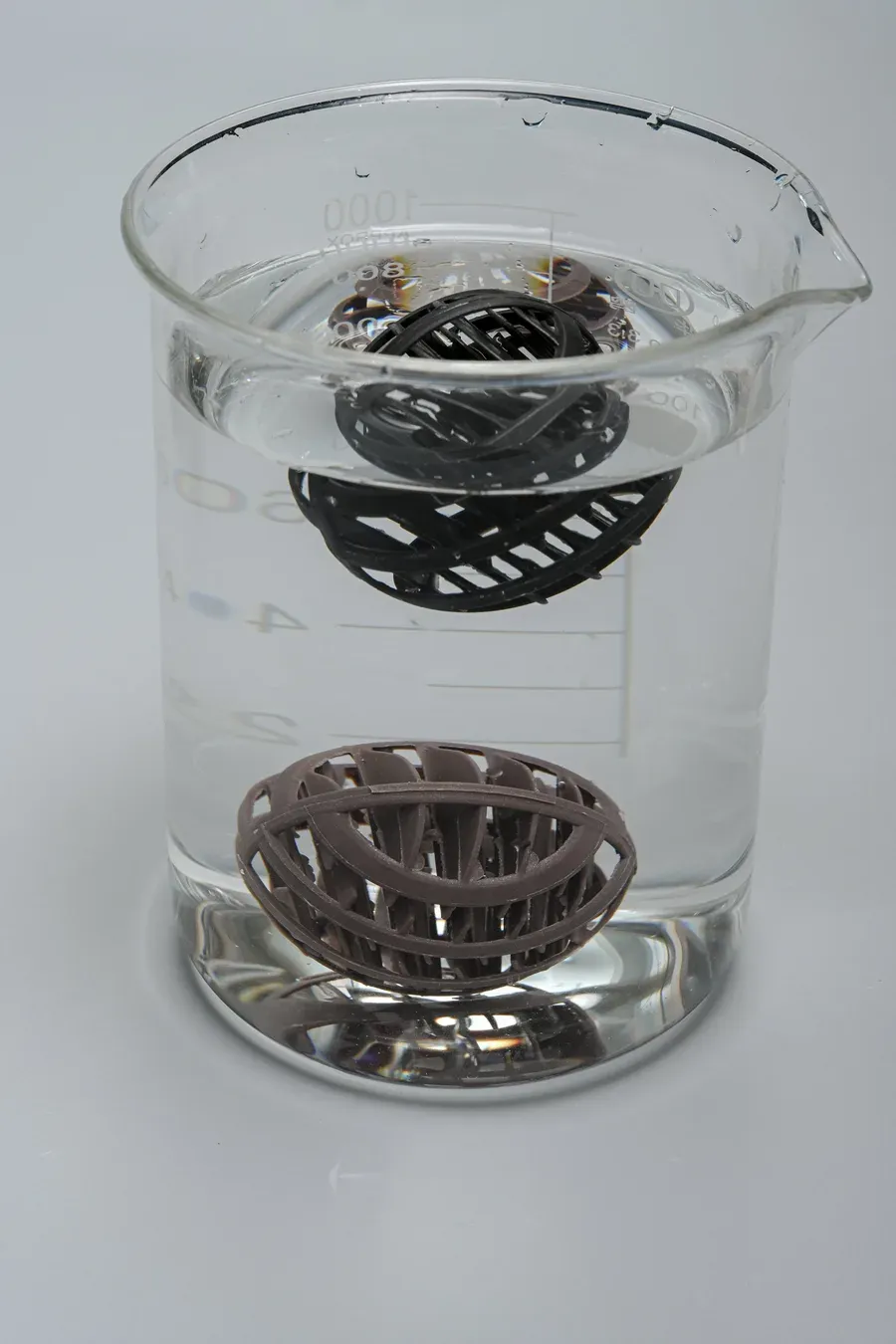
Short answer: neither fill is "better" in the abstract — they fail in different ways, and the right choice depends on your duty. A sponge-core ball gives you far more protected surface per cubic metre and faster start-up, suiting small systems and drums that need capacity in a fixed volume. An all-plastic ball gives up some surface but is dimensionally stable: it does not shrink, harden or lose volume. In rotating-drum duty, sponge life is the honest weak point — expect around three years from sponge cores in a drum, not the five-plus years of gentler submerged service. Work through the checks below before you order, and measure your screens first.
How each fill actually works
A sponge-core ball is a hollow plastic cage — commonly in the 150 mm class — packed with a hydrophilic polyurethane sponge core. Wastewater flows through the cage, and the biofilm grows mainly inside the sponge's pore network, sheltered from shear. The cage gives the soft core its shape, protects it from crushing and washout, and makes the media easy to handle and fish out of a tank or drum.
An all-plastic bio ball has no core. The ball itself is a moulded plastic lattice — fins, spokes and internal walls — and the biofilm grows on those rigid surfaces. There is nothing inside to degrade, compact or wash away, so the geometry you install on day one is what you still have years later. Floating and sinking versions exist.
Both are loose-filled into rotating drums, small MBBR or IFAS retrofits, trickling zones and package plants where media must be free-moving and easy to replace by hand.
Surface area: why the headline numbers don't compare directly
This is where buyers get misled, so be careful. For HNS's NovusPore hydrophilic sponge, the specific surface area is over 5,000 m²/m³, with porosity over 98% and biofilm typically established in 3–7 days. That figure counts the internal pore surface of the sponge, which is genuinely where most of the biomass sits.
For suspended balls of the 150 mm class, a figure of around 1,400 m²/m³ is commonly quoted in the market. Treat it with caution: it is a supplier-stated figure, and suppliers calculate ball-media area on different bases — some count only the shell lattice, some include the core, some model pores and some measure them. Two balls both labelled "1,400 m²/m³" may not carry the same working biomass at all.
The practical conclusion is not "sponge wins because 5,000 is bigger than 1,400." It is this: surface-area figures cannot be compared head-to-head across media types or across suppliers unless the measurement basis is the same. Compare media instead on how they behave in your duty — start-up speed, stability at your load, and how long the working volume survives — and use surface area only as a first filter within one product family. The same discipline applies to MBBR media selection by surface area, where protected versus total area is a frequent source of confusion.
Service life and how each one fails
Sponge cores wear out from the inside. The realistic failure mode is not the cage breaking — it is the sponge itself shrinking, hardening and losing pore volume. Low-grade sponge can shrink and harden within months, and this is not theoretical: in one rotating-drum installation we were asked about this year, the operator's earlier sponge media shrank within months of going into the drum. Drum duty is hard on sponge — repeated wetting, draining, rotation and air exposure age the material faster than constant submerged service. HNS's engineering expectation for sponge cores in rotating-drum duty is roughly three years. That is a duty-specific expectation, not a guarantee, and it is deliberately lower than the figure for submerged sponge: in standard submerged service, NovusPore sponge typically needs replenishment only after about five years.
All-plastic balls wear out slowly and predictably. There is no core to shrink. The ball keeps its diameter and free volume, and the typical figures quoted in the market for this product type are a service life of around five years with about a one-year warranty — typical quoted figures, so confirm them in writing with your own supplier. What limits a plastic ball is surface condition: over years the lattice can foul or scale, and a share of balls will crack under mechanical abuse. But the decline is gradual and visible, not a sudden loss of fill volume.
Rigid MBBR carriers are the long-life benchmark, if your vessel can use them: moulded from 100% virgin HDPE, they carry a service life of over 15 years, with surface areas such as MBBR37 at over 800 m²/m³ and MBBR64 at over 1,200 m²/m³. In a drum they are not always practical — carriers need the right retention and movement — but they set the reference for "long life". Our comparison of sponge media against HDPE MBBR carriers goes deeper on that trade-off.
| Check | Sponge-core ball | All-plastic bio ball |
|---|---|---|
| Where the biofilm grows | Inside the sponge pore network, protected from shear | On the rigid plastic lattice surfaces |
| Quoted surface area | Sponge (NovusPore) >5,000 m²/m³ | ~1,400 m²/m³, supplier-stated for the 150 mm class — basis varies |
| Start-up | Fast — biofilm in 3–7 days on the sponge | Slower — film must build on smooth plastic |
| Main failure mode | Core shrinks and hardens; loss of working volume | Fouling/scaling of lattice; occasional cracked balls |
| Realistic life expectation | ~3 years in rotating-drum duty (expectation, not guarantee); replenishment after ~5 years in submerged service | ~5 years typical quoted life, ~1-year warranty — confirm with supplier |
| Dimensional stability | Changes as the core ages | Stable — diameter and volume stay constant |
Before anything else: measure your screens and openings
This is the cheapest check on the page, and skipping it is the most common ordering mistake with ball media. Measure the smallest screen, slot or retention opening the media has to be held back by, before you order. A ball that is smaller than the smallest opening will escape — into the next process stage, a pump volute or a discharge line. Check the drum's end openings, any discharge slots and the strainer on the outlet, and take the smallest figure as your limit; then choose a ball diameter with a clear margin above it, not a near fit that passes once a ball deforms or a screen wears.
This matters doubly in old drums: if a sponge core shrinks inside a cracked cage, the core can escape through an opening the intact ball never could. The same retention-first logic we apply to MBBR retention screen sizing applies here — retention is a measurement, not an assumption.
So which one should you choose?
Choose a sponge-core ball when capacity per cubic metre is your binding constraint: a small system that must gain treatment capacity inside a fixed drum or tank volume, a light-to-moderate load where the sponge's protected surface and 3–7 day biofilm formation shorten start-up, and where you accept a planned core replacement on roughly a three-year cycle in drum duty as a normal maintenance item. Go in with that replacement planned and budgeted, not as a surprise.
Choose an all-plastic ball when dimensional stability and low attention matter more than peak surface: unattended or hard-to-access installations, operators who cannot schedule media change-outs, or duties where a shrinking fill would cause real problems — for example where escaped or compacted media would foul downstream equipment. You give up surface and start-up speed; you gain a fill whose volume is the same in year four as in year one.
Consider rigid MBBR carriers instead when the vessel is a purpose-built or retrofitted aerated tank with proper retention screens and air mixing — for a long-life, set-and-forget fill, the MBBR media range is usually the better engineering answer than either ball. And if your real question is sponge cubes versus plastic carriers rather than balls, start from the NovusPore sponge media specifications and the modified bio balls side by side.
Whichever way you lean, ask the supplier three things in writing: the basis of the surface-area figure, the expected life in your duty (name the drum explicitly), and what the warranty covers — volume loss and shrinkage, or only breakage.
FAQ
How long does sponge-core ball media actually last in a rotating drum?
Expect roughly three years from a good hydrophilic sponge core in rotating-drum duty — an engineering expectation, not a guarantee. Low-grade sponge can shrink and harden within months. Submerged, the same class of sponge lasts longer, with replenishment typically only needed after about five years.
Can I compare the m²/m³ figures of sponge balls and plastic balls directly?
No. Sponge figures (over 5,000 m²/m³ for NovusPore) count internal pore surface; ball figures (around 1,400 m²/m³, supplier-stated) are calculated on bases that vary between suppliers. Compare behaviour in your duty, not headline numbers.
What size bio ball do I need so it doesn't escape from my drum?
Measure the smallest opening the media must be retained by — drum end openings, slots, outlet strainers — and choose a ball diameter clearly larger than that smallest opening. If any opening is close to the ball size, fix the retention first; media replacement is the wrong time to discover the gap.
Is it worth replacing all-plastic balls with sponge-core balls for more capacity?
Only if the extra protected surface solves a real capacity limit in your fixed volume, and only with a planned core replacement cycle — around three years in a drum. If your current fill is stable and meeting limits, the change buys surface at the cost of a consumable core.
Not sure which fill fits your drum or small system?
Send us your drum dimensions, smallest retention opening and flow, and we will run a free sizing, quantity and sample check — including an honest life expectation for your duty — via our contact page.