Tube Settler Sludge Accumulation: Why Sludge Sits on the Tubes Instead of Sliding Down
Sludge building up on your tube settlers instead of sliding down? The causes — floc, flow, inlet, sludge removal — and what to check first.
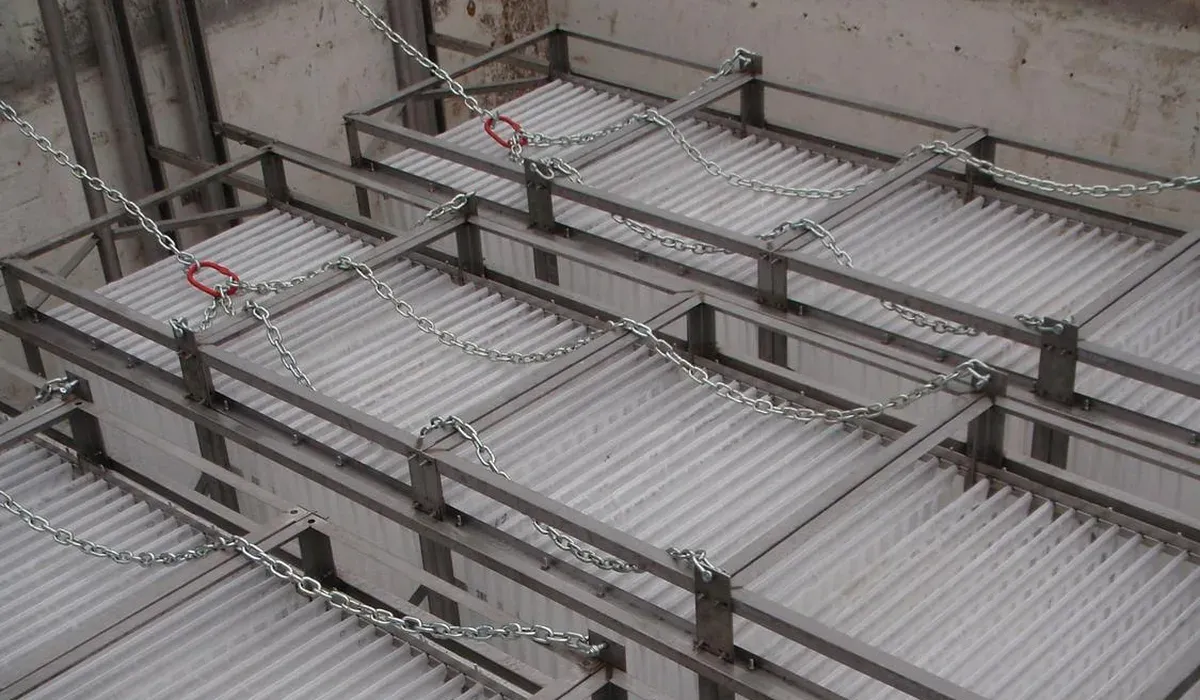
Sludge building up on tube settlers is usually not a media problem. It means the solids arriving are too light, too sticky, or arriving too fast — or the sludge underneath is not being removed. In a healthy clarifier, settled solids slide down the inclined tube wall into the sludge zone. When they stay put, find which of the two it is — the solids, or the removal — before hosing the tubes harder.
A tube-settler manufacturer published a full article on it in 2026, about a plant that took its clarifier offline every week to clean the tubes. On Eng-Tips, an engineer asked the same question: sludge in the bottom of a lamellar settler, and whether gas from it was lifting solids back up.
Where the Sludge Actually Sits
"Sludge accumulation on tube settlers" means three different places, each meaning something different.
On top of the media pack. A visible layer on the upper surface, sometimes covering the tube openings: solids arrive faster than they can enter, or are too light to settle.
Inside the tubes. Sludge clinging to the inclined walls, narrowing the channels until flow goes around the media instead of through it. Effluent worsens gradually; by the time it is noticed, many channels are partly blocked.
Under the media, in the sludge zone. Sludge that did slide down, but was never removed. It sits in the hopper, goes septic, and produces gas; the bubbles rise through the tubes and lift solids back up, so it looks as if the media is failing — when the problem is below it.
Find out which of the three you have first — cleaning the tubes will not help if the problem is in the sludge zone.
How a Clean Tube Settler Is Supposed to Move Sludge
Tube settlers shorten the distance a particle has to fall: instead of settling to the bottom of a deep tank, a particle only has to reach the inclined wall of a tube — typically installed at about 60° to the horizontal — and slide down into the sludge zone. Water flows upward while solids move downward.
That sliding depends on three things: solids heavy enough to settle; a wall clean enough to slide on; and upward velocity low enough. Upward velocity is set by the surface loading rate — flow divided by effective settling area. When any one of the three breaks down, sludge accumulates.
Why Sludge Stops Sliding: Five Causes
1. The floc is too light or too weak
The most common cause. Flocs from an overloaded or unstable activated sludge process, fine chemical sludge, or colloidal solids never properly flocculated will not settle in a tube any better than in an open tank: tube settlers can only separate particles that are capable of settling. If the floc is the problem, the answer is upstream — better coagulation and flocculation, or better biological settling control — not more media. Our tube settler retrofit data article explains why a retrofit should start with what is limiting the clarifier.
2. Grease, oil, fibres, or biofilm make the walls sticky
Some wastewaters coat the tube walls: fats and oils, fibres, sticky chemical sludge, or biological growth. Once coated, settled solids stick instead of sliding, and each layer makes the next stick more easily. Wastewater with significant oil and grease is often a poor fit for gravity clarification — see DAF vs lamella clarifiers for when flotation fits better. Where fouling is a risk, cleaning access matters more than maximum settling area.
3. Flow is too high, especially at peaks
A clarifier that performs well at average flow can lose solids during peaks, washdown, or batch discharge. Upward velocity rises with flow, and at peak flow it can exceed the settling velocity of the floc — solids that would slide down at average flow are held up or carried over the weirs. Always check sizing against peak flow, not daily average. The same applies to surface loading — see our lamella clarifier sizing article: no single loading value suits every sludge type.
4. Uneven flow and dead zones
If water enters unevenly, some tubes carry far more flow than others: overloaded channels accumulate sludge while neighbouring channels sit nearly empty, so the pack looks half-blocked even though total flow is within design. High local velocity also breaks flocs apart at the inlet. Support frames and module joints add to it: they can shade small areas or trap solids, and where modules were cut to fit an awkward tank, solids collect on the supports and in the gaps — hard to flush out without lifting the modules. Check baffles, feed channels, and distribution openings before blaming the media.
5. Sludge removal is too slow
This is the cause behind the Eng-Tips question. Sludge that slides down still has to leave the tank: if the hopper is too shallow, the pump runs too rarely, or pump capacity is too small, solids accumulate under the media. Left there, the sludge goes septic: anaerobic breakdown produces gas, and the bubbles rise through the tubes, carrying solids back up over the outlet weirs. It can look exactly like a media failure — the same mechanism is covered in our article on floating sludge in primary clarifiers. Check the blanket depth and what the pump is actually removing, not what it is supposed to remove.
Diagnose Before You Clean
Cleaning treats the symptom. Diagnose first, so the sludge does not come straight back:
- Where is the sludge? Top of the pack, inside the tubes, or under the media? Note it before cleaning.
- Sludge blanket: is the pump keeping up? A rising blanket points at removal — see our guide to measuring the sludge blanket and solids.
- When did it get worse — after a production, chemical, flow, or maintenance change? Sudden points at the process; slow at fouling or removal.
- Floc: a jar test takes minutes. Quick settling with a clear supernatant, or light and fluffy? Light floc is an upstream problem.
- Flow even? One section running visibly faster than the rest points at inlet distribution.
- Dosing: a change in coagulant, polymer, dose, or mixing can change floc density — check records against the date the problem started.
If the diagnosis points at the tubes, clean them. If it points upstream or below, cleaning buys a few weeks at most.
Cleaning, and What to Change So It Does Not Come Back
Cleaning methods. Take the tank offline, drain it down, and flush the modules — hosing from above, or air scour where fitted. Some installations allow modules to be lifted out for a more thorough clean. Avoid aggressive high-pressure jetting on thin-walled modules unless the manufacturer confirms it is safe.
How often? No fixed interval suits every plant. Set it by observation — effluent TSS trend, visible build-up, blanket behaviour — not by a calendar. A plant needing weekly cleaning has a cause cleaning alone will not fix.
What to change. Durable fixes follow the diagnosis: light floc — fix coagulation, flocculation, or settling upstream; grease or fibres — improve upstream removal, or reconsider gravity clarification; peak-flow overload — check loading against peak flow, and look at equalisation; uneven inlet — correct baffles and distribution; slow removal — check hopper and pump.
Channel size is the last choice, not the first. A smaller channel gives more area but fouls more easily; a larger channel tolerates sticky solids better and flushes more easily. HNS media comes in three channel sizes:
| HNS model | Channel size (mm) | Specific surface area (m²/m³) | Weight (kg/m³) | Typical service life |
|---|---|---|---|---|
| HNS-TS35 | 35 | 109 | 18 | 5–10 years |
| HNS-TS50 | 50 | 87 | 19 | 5–10 years |
| HNS-TS80 | 80 | 50 | 19.5 | 5–10 years |
Smaller channels suit clean, well-flocculated solids; larger channels suit heavier, stickier, or variable solids. Service life is a product-data figure — not a promised cleaning interval, which depends on the wastewater.
Symptom, Likely Cause, First Check
| What you see | Most likely cause | Check first |
|---|---|---|
| Sludge layer on top of the pack | Solids too fast, or floc too light | Jar test; peak flow vs design loading |
| Tubes narrowing, effluent worsening slowly | Grease, fibres, or biofilm | Inspect a lifted module; upstream oil removal |
| One section blocked, the rest clean | Uneven inlet or a blocked feed opening | Water surface pattern; inlet baffles |
| Sludge rising or floating after settling | Sludge left too long, going septic | Sludge blanket depth; pump run records |
| Media looks fine but effluent TSS is high | Loading too high at peak flow | Peak-flow loading check; floc quality |
Frequently Asked Questions
How often should tube settlers be cleaned?
As often as observation says, not on a fixed calendar. Watch effluent TSS, the pack surface, and the blanket. Weekly cleaning means the cause is still there.
Can tube settlers be cleaned without taking the tank offline?
Partly. Flushing or air scour can remove loose build-up with the tank in service. A full clean — draining down, hosing the modules, clearing the supports — needs the tank offline.
Does sludge on the tubes mean the media has failed?
Usually not. Tube settler media is passive plastic with a typical service life of 5–10 years; it does not wear out like a moving part. Check the solids, flow, and removal first.
Will a larger channel size stop sludge building up?
It helps with sticky or heavy solids and cleaning access — a larger channel is easier to flush and less easily narrowed. It will not fix light floc, peak-flow overload, or slow removal.
Send Us What You Are Seeing
If sludge is building up on your tube settlers, send us average and peak flow, influent and target TSS, sludge type, what the floc looks like, where the sludge is sitting, and photos of the pack surface and sludge zone. We will check whether the problem is the media, the loading, or the removal — and whether you need tube settler media, a channel-size change, or a hydraulic fix. Reach us through our contact page for a free sizing, quantity, and sample check.